JEE Main 2023 — Waves & Oscillations
Physics Waves & Oscillations questions from JEE Main 2023.
Other Years
39 Waves & Oscillations Questions from 2023
The ratio of speed of sound in hydrogen gas to the speed of sound in oxygen gas at the same temperature is:
The distance between two consecutive points with phase difference of $60^{\circ}$ in a wave of frequency $500\mathrm{Hz}$ is $6.0m$. The velocity with which wave is travelling is ______ $\mathrm{km}{s}^{-1}$.
A particle executes SHM of amplitude$A$. The distance from the mean position when its kinetic energy becomes equal to its potential energy is:
A particle is executing simple harmonic motion (SHM). The ratio of potential energy and kinetic energy of the particle when its displacement is half of its amplitude will be
Match List I with List II <table class="pyq-table"><tbody><tr><td></td><td>List I</td><td></td><td>List II</td></tr><tr><td>A</td><td>Troposphere</td><td>I</td><td>Approximate $65-75\mathrm{km}$ over Earth’s surface</td></tr><tr><td>B</td><td>E-Part of Stratosphere</td><td>II</td><td>Approximate $300\mathrm{km}$ over Earth’s surface</td></tr><tr><td>C</td><td>${F}_{2}$-Part of Thermosphere</td><td>III</td><td>Approximate $10\mathrm{km}$ over Earth’s surface</td></tr><tr><td>D</td><td>D-Part of Stratosphere</td><td>IV</td><td>Approximate $100\mathrm{km}$ over Earth’s surface</td></tr></tbody></table>Choose the correct answer from the options given below :
Choose the correct length $(L)$ versus square of time period $({T}_{2})$ ) graph for a simple pendulum executing simple harmonic motion.
Two tuning forks A and B produce 4 beats per second. Fork A has frequency 256 Hz. When B is loaded with wax, beats become 6 per second. The frequency of B is:
An organ pipe $40\mathrm{cm}$ long is open at both ends. The speed of sound in air is $360m{s}^{-1}$. The frequency of the second harmonic is _$________\mathrm{Hz}.$
A guitar string of length $90\mathrm{cm}$ vibrates with a fundamental frequency of $120\mathrm{Hz}$. The length of the string producing a fundamental of $180\mathrm{Hz}$ will be _____ $\mathrm{cm}$
A transverse harmonic wave on a string is given by $y(x,t)=5\mathrm{sin}(6t+0.003x)$ where $x$ and $y$ are in $\mathrm{cm}$ and $t$ in $\mathrm{sec}$. The wave velocity is _________ $m{s}^{-1}$.
In the figure given below. a block of mass $M=490g$ placed on a frictionless table is connected with two springs having same spring constant ($K=2N{m}^{-1}$). If the block is horizontally displaced through $X$ $m$ then the number of complete oscillations it will make in $14\pi$ seconds will be ______. 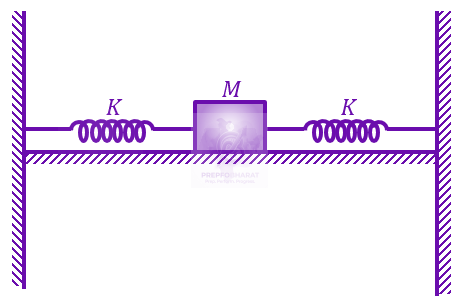
The amplitude of a particle executing SHM is $3\mathrm{cm}$. The displacement at which its kinetic energy will be $25%$ more than the potential energy is: ______ $\mathrm{cm}$.
A block of mass $2\mathrm{kg}$ is attached with two identical springs of spring constant $20N{m}^{-1}$ each. The block is placed on a frictionless surface and the ends of the springs are attached to rigid supports (see figure). When the mass is displaced from its equilibrium position, it executes a simple harmonic motion. The time period of oscillation is $\frac{\pi }{\sqrt{X}}$ in SI unit. The value of $X$ is______. 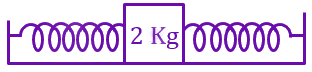
A travelling wave is described by the equation $y(x,t)=[0.05\mathrm{sin}(8x-4t)]m$. The velocity of the wave is: [All the quantities are in SI unit]
Two simple harmonic waves having equal amplitudes of $8\mathrm{cm}$ and equal frequency of $10\mathrm{Hz}$ are moving along the same direction. The resultant amplitude is also $8\mathrm{cm}$. The phase difference between the individual waves is _____ degree.
In a linear Simple Harmonic Motion (SHM) (A) Restoring force is directly proportional to the displacement. (B) The acceleration and displacement are opposite in direction. (C) The velocity is maximum at mean position. (D) The acceleration is minimum at extreme points. Choose the correct answer from the options given below:
The variation of kinetic energy (KE) of a particle executing simple harmonic motion with the displacement ($x$) starting from mean position to extreme position ($A$) is given by
The displacement equations of two interfering waves are given by ${y}_{1}=10\mathrm{sin}(\omega t+\frac{\pi }{3})\mathrm{cm}$, ${y}_{2}=5[\mathrm{sin}(\omega t)+\sqrt{3}\mathrm{cos}\omega t]\mathrm{cm}$ respectively. The amplitude of the resultant wave is _____ $\mathrm{cm}$.
A simple pendulum with length $100\mathrm{cm}$ and bob of mass $250g$ is executing S.H.M of amplitude $10\mathrm{cm}$. The maximum tension in the string is found to be $\frac{x}{40}N$. The value of $x$ is _____.
Which graph represents the difference between total energy and potential energy of a particle executing $\mathrm{SHM}$ vs its distance from mean position?
For a periodic motion represented by the equation $y=sin\omega t+cos\omega t$ the amplitude of the motion is
In an experiment with sonometer when a mass of $180g$ is attached to the string, it vibrates with fundamental frequency of $30\mathrm{Hz}$. When a mass $m$ is attached, the string vibrates with fundamental frequency of $50\mathrm{Hz}$. The value of $m$ is ______ $g$.
For a certain organ pipe, the first three resonance frequencies are in the ratio of $1:3:5$ respectively. If the frequency of fifth harmonic is $405\mathrm{Hz}$ and the speed of sound in air is $324m{s}^{–1}$ the length of the organ pipe is _____ $m$.
For particle $P$ revolving round the centre $O$ with radius of circular path $r$ and regular velocity $\omega$, as shown in below figure, the projection of $OP$ on the $x$-axis at time $t$ is 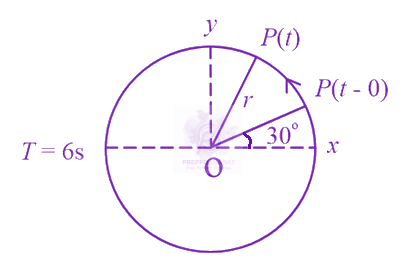
A wire of density $8\times {10}^{3}\mathrm{kg}{m}^{-3}$ is stretched between two clamps $0.5m$ apart. The extension developed in the wire is $3.2\times {10}^{-4}m$. If $Y=8\times {10}^{10}N{m}^{-2}$, the fundamental frequency of vibration in the wire will be _____ $\mathrm{Hz}$
A particle of mass $250g$ executes a simple harmonic motion under a periodic force $F=(–25x)N$. The particle attains a maximum speed of $4m{s}^{-1}$ during its oscillation. The amplitude of the motion is ______$\mathrm{cm}$.
The equation of wave is given by $Y={10}^{-2}\mathrm{sin}2\pi (160t-0.5x+\frac{\pi }{4})$, where $x$ and $Y$ are in $m$ and $t$ in $s$. The speed of the wave is _______ $\mathrm{km}{h}^{-1}$.
The velocity of a particle executing SHM varies with displacement ($x$) as $4{v}^{2}=50–{x}^{2}$. The time period of oscillations is $\frac{x}{7}s$. The value of $x$ is ______. [Take $\pi =\frac{22}{7}$]
For a simple harmonic motion in a mass spring system shown, the surface is frictionless. When the mass of the block is $1\mathrm{kg}$, the angular frequency is ${\omega }_{1}$. When the mass block is $2\mathrm{kg}$ the angular frequency is ${\omega }_{2}$. The ratio $\frac{{\omega }_{2}}{{\omega }_{1}}$ is : 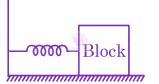
The fundamental frequency of vibration of a string between two rigid support is $50\mathrm{Hz}$. The mass of the string is $18g$ and its linear mass density is $20g{m}^{-1}$. The speed of the transverse waves so produced in the string is _______ $m{s}^{–1}$.
A particle executes S.H.M. of amplitude $A$ along $x$-axis. At $t=0$, the position of the particle is $x=\frac{A}{2}$ and it moves along positive $x$-axis. The displacement of particle in time $t$ is $x=A\mathrm{sin}(\omega t+\delta )$, then the value $\delta$ will be
The general displacement of a simple harmonic oscillator is $x=A\mathrm{sin}\omega t$. Let $T$ be its time period. The slope of its potential energy ($U$) – time ($t$) curve will be maximum when $t=\frac{T}{\beta }$. The value of $\beta$ is ______.
For a solid rod, the Young's modulus of elasticity is $3.2\times {10}^{11}N{m}^{-2}$ and density is $8\times {10}^{3}\mathrm{kg}{m}^{-3}$. The velocity of longitudinal wave in the rod will be
At a given point of time the value of displacement of a simple harmonic oscillator is given as $y=A\mathrm{cos}(30^{\circ}).$ If amplitude is $40\mathrm{cm}$ and kinetic energy at that time is $200J,$ the value of force constant $1.0\times {10}^{x}N{m}^{–1}$. The value of $x$ is _____.
The maximum potential energy of a block executing simple harmonic motion is $25J$. A is amplitude of oscillation. At $\frac{A}{2}$, the kinetic energy of the block is
A steel wire with mass per unit length $7.0\times {10}^{–3}\mathrm{kg}{m}^{–1}$ is under tension of $70N$. The speed of transverse waves in the wire will be:
A mass $m$ attached to free end of a spring executes SHM with a period of $1s$. If the mass is increased by $3\mathrm{kg}$ the period of oscillation increases by one second, the value of mass $m$ is ________ $\mathrm{kg}$.
A particle executes simple harmonic motion between $x=–A\text{and}x=+A$. If time taken by particle to go from $x=0$ to $\frac{A}{2}$ is $2s$; then time taken by particle in going from $x=\frac{A}{2}$ to $A$ is:
A rectangular block of mass $5\mathrm{kg}$ attached to a horizontal spiral spring executes simple harmonic motion of amplitude $1m$ and time period $3.14s$. The maximum force exerted by spring on block is ___ $N$.