JEE Main 2017 — Waves & Oscillations
Physics Waves & Oscillations questions from JEE Main 2017.
Other Years
7 Waves & Oscillations Questions from 2017
Two wires ${W}_{1}$ and ${W}_{2}$ have the same radius $r$and respective, densities ${\rho }_{1}$ and ${\rho }_{2}$, such that ${\rho }_{2}=4{\rho }_{1}$ . They are joined together at the point $O$, as shown in the figure. The combination is used as a sonometer wire and kept under tension $T$. The point $O$ is midway between the two bridges. When a stationary wave is set up in the composite wire, the joint is found to be a node. The ratio of the number of antinodes formed in ${W}_{1}$ to ${W}_{2}$ is 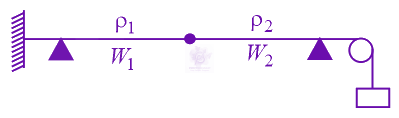
A particle is executing simple harmonic motion with a time period $T$. At time $t=0$, it is at its position of equilibrium. The kinetic energy - time graph of the particle will look like:
A block of mass $0.1\mathrm{kg}$ is connected to an elastic spring of spring constant $640N{m}^{-1}$ and oscillates in a damping medium of damping constant ${10}^{-2} \mathrm{kg} {s}^{-1}$ . The system dissipates its energy gradually. The time taken for its mechanical energy of vibration to drop to half of its initial value, is closest to-
A $1\mathrm{kg}$ block attached to a spring vibrates with a frequency of $1\mathrm{Hz}$ on a frictionless horizontal table. Two springs identical to the original spring are attached in parallel to a$8\mathrm{kg}$block placed on the same table. So, the frequency of vibration of the $8\mathrm{kg}$ block is
In an experiment to determine the period of a simple pendulum of length $1m$, it is attached to different spherical bobs of radii ${r}_{1}$ and ${r}_{2}$ . The two spherical bobs have uniform mass distribution. If the relative difference in the periods, is found to be $5\times {10}^{-4}s$, the difference in radii, $|{r}_{1}-{r}_{2}|$ is best-given by
A standing wave is formed by the superposition of two waves travelling in opposite directions. The transverse displacement is given by, $y(x, t)=0.5\mathrm{sin}(\frac{5\pi }{4}x)\mathrm{cos}(200\pi t)$. What is the speed of the travelling wave moving in the positive $x$ direction? ($x$ and $t$are in meter and second, respectively)
The ratio of maximum acceleration to maximum velocity in a simple harmonic motion is $10 {s}^{-1}.$ At, $t=0$ the displacement is $5m.$ What is the maximum acceleration? The initial phase is $\frac{\pi }{4}$ .