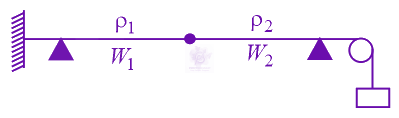
Two wires W_1 and W_2 have the same radius rand respective, densities ρ _1 and ρ _2, such that ρ _2=4ρ _1 . They are joined together at the point O,…
JEE Main 2017 — Physics Waves & Oscillations
2017mcqhard
Two wires W1 and W2 have the same radius rand respective, densities ρ1 and ρ2, such that ρ2=4ρ1 . They are joined together at the point O, as shown in the figure. The combination is used as a sonometer wire and kept under tension T. The point O is midway between the two bridges. When a stationary wave is set up in the composite wire, the joint is found to be a node. The ratio of the number of antinodes formed in W1 to W2 is
Official previous-year question
Held on 8 Apr 2017 · Verified 6 Jul 2026.
Options
A
4:1
B
1:2
C
1:1
D
1:3
Did you get this right?
Sign in to track your attempts and accuracy.
Solution
Let p1 and p2 be the number of antinodes of both wires.
Fundamental frequency remains the same for both wires.
n1=n2
T→same
r→same
l→same
n=2lpπr2ρT
From the above equation, we have
ρ1p1=ρ2p2
→p2p1=ρ2ρ1
The ratio of antinodes is p2p1=21.
Your note
Sign in to keep a private note on this question. Nothing you write is ever public.