JEE Main 2020 — Waves & Oscillations
Physics Waves & Oscillations questions from JEE Main 2020.
Other Years
15 Waves & Oscillations Questions from 2020
A wire of length $L$ and mass per unit length $6.0\times {10}^{-3}kg{m}^{-1}$ is put under tension of $540N.$ Two consecutive frequencies that it resonates at are: $420Hz$ and $490Hz.$ Then $L$ in meters is :
A transverse wave travels on a taut steel wire with a velocity of $v$ when tension in it is $2.06\times {10}^{4}N.$ When the tension is changed to $T,$ the velocity changed to $\frac{v}{2}.$ The value of $T$ is close to:
The displacement time graph of a particle executing SHM is given in figure: (sketch is schematic and not to scale) 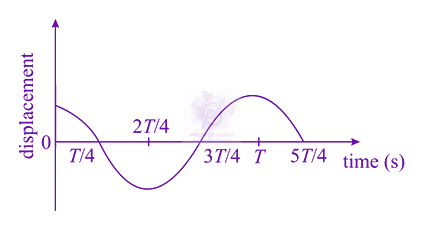 Which of the following statements is/are true for this motion? (A) The force is zero at $t=\frac{3T}{4}$ (B) The magnitude of acceleration is maximum at $t=T$ (C) The speed is maximum at $t=\frac{T}{4}$ (D) The $P.E.$ is equal to $K.E.$ of the oscillation at $t=\frac{T}{2}$
A ring is hung on a nail. It can oscillate, without slipping or sliding (i) in its plane with a time period ${T}_{1}$ and (ii) back and forth in a direction perpendicular to its plane, with a period ${T}_{2}$. The ratio $\frac{{T}_{1}}{{T}_{2}}$ will be :
Two identical strings $X$ and $Z$ made of same material have tension ${T}_{X}$ and ${T}_{Z}$ in then if their fundamental frequencies are $450\mathrm{Hz}$ and $300\mathrm{Hz}$, respectively, then the ratio ${T}_{X}/{T}_{Z}$ is :
Three harmonic waves having equal frequency $v$ and same intensity ${I}_{0}$ , have phase angles $0,\frac{\pi }{4}$ and $-\frac{\pi }{4}$ respectively. When they are superimposed the intensity of the resultant wave is close to:
A block of mass m attached to a massless spring is performing oscillatory motion of amplitude 'A' on a frictionless horizontal plane. If half of the mass of the block breaks off when it is passing through its equilibrium point, the amplitude of oscillation for the remaining system become ƒA. The value of ƒ is:
For a transvers wave travelling, along a straight line, the distance between two peaks (crests) is $5\text{ m}$, while the distance between one crest and one trough is $1.5\text{ m}$. The possible wavelengths (in $\text{m}$) of the waves are:
Assume that the displacement (s) of air is proportional to the pressure difference $(\Delta p)$ created by a sound wave. Displacement (s) further depends on the speed of sound (v), density of air$(\rho )$ and the frequency (f). If $\Delta p~10Pa,n~300m/s,p~1kg/{m}^{3}$ $f~1000Hz$, then s will be of the order of (take the multiplicative constant to be 1 )
An object of mass $m$ is suspended at the end of a massless wire of length $L$ and area of cross-section, A. Young modulus of the material of the wire is $Y$. If the mass is pulled down slightly its frequency of oscillation along the vertical direction is :
In a resonance tube experiment when the tube is filled with water up to a height of $17.0\mathrm{cm}\text{,}$ from bottom, it resonates with a given tuning fork. When the water level is raised the next resonance with the same tuning fork occurs at a height of $24.5\mathrm{cm}\text{.}$ If the velocity of sound in air is $330m{s}^{-1}\text{,}$ the tuning fork frequency is :
A one metre long (both ends open) organ pipe is kept in a gas that has double the density of air at STP. Assuming the speed of sound in air at STP is $300m/s,$ the frequency difference between the fundamental and second harmonic of this pipe is __________ Hz.
A string of length 1 m and mass 5 g is fixed at both ends. The speed of transverse waves on the string is 100 m/s. The fundamental frequency is:
When a particle of mass $m$ is attached to a vertical spring of spring constant $k$ and released, its motion, is described by $y(t)={y}_{0}{\mathrm{sin}}^{2}\omega t$, where '$y$' is measured from the lower end of upstretched spring. Then $\omega$ is :
A uniform thin rope of length $12m$ and mass $6\mathrm{kg}$ hangs vertically from a rigid support and a block of mass $2\mathrm{kg}$ is attached to its free end. A transverse short wave train of wavelength $6\mathrm{cm}$ is produced at the lower and the rope. What is the wavelength of the wave train (in $\mathrm{cm}$ ) when it reaches the top of the rope?