JEE Main 2022 — Waves & Oscillations
Physics Waves & Oscillations questions from JEE Main 2022.
Other Years
35 Waves & Oscillations Questions from 2022
A simple pendulum has time period T. If its length is increased by 21% the new time period is:
The speed of sound in air at 0°C is 332 m/s. The speed at 20°C is approximately:
Two light beams of intensities $4I$ and $9I$ interfere on a screen. The phase difference between these beams on the screen at point $A$ is zero and at point $B$ is $\pi$. The difference of resultant intensities, at the point $A$ and $B$, will be _____ $I$.
An observer is riding on a bicycle and moving towards a hill at $18\mathrm{km}{h}^{-1}$. He hears a sound from a source at some distance behind him directly as well as after its reflection from the hill. If the original frequency of the sound as emitted by source is $640\mathrm{Hz}$ and velocity of the sound in air is $320m{s}^{-1}$, the beat frequency between the two sounds heard by observer will be _____ $\mathrm{Hz}$.
Time period of a simple pendulum in a stationary lift is $T$. If the lift accelerates with $\frac{g}{6}$ vertically upwards then the time period will be (Where $g=$ acceleration due to gravity)
A body is performing simple harmonic with an amplitude of $10\mathrm{cm}$. The velocity of the body was tripled by air Jet when it is at $5\mathrm{cm}$ from its mean position. The new amplitude of vibration is $\sqrt{x}\mathrm{cm}$. The value of $x$ is _____ .
A set of $20$ tuning forks is arranged in a series of increasing frequencies. If each fork gives $4$ beats with respect to the preceding fork and the frequency of the last fork is twice the frequency of the first, then the frequency of last fork is _____ $\mathrm{Hz}$.
The metallic bob of simple pendulum has the relative density $5$. The time period of this pendulum is $10s$. If the metallic bob is immersed in water, then the new time period becomes $5\sqrt{x}s$. The value of $x$ will be _____ .
The displacement of simple harmonic oscillator after $3$ seconds starting from its mean position is equal to half of its amplitude. The time period of harmonic motion is
Two light beams of intensities in the ratio of $9:4$ are allowed to interfere. The ratio of the intensity of maxima and minima will be :
Two massless springs with spring constants $2k$ and $9k$, carry $50g$ and $100g$ masses at their free ends. These two masses oscillate vertically such that their maximum velocities are equal. Then, the ratio of their respective amplitudes will be :
A tunning fork of frequency $340\mathrm{Hz}$ resonates in the fundamental mode with an air column of length $125\mathrm{cm}$ in a cylindrical tube closed at one end. When water is slowly poured in it, the minimum height of water required for observing resonance once again is _____ $\mathrm{cm}$. (Velocity of sound in air is $340{\mathrm{ms}}^{-1}$)
Two travelling waves of equal amplitudes and equal frequencies move in opposite directions along a string. They interfere to produce a stationary wave whose equation is given by $y=(10\mathrm{cos}\pi x\mathrm{sin}\frac{2\pi t}{T})\mathrm{cm}$. The amplitude of the particle at $x=\frac{4}{3}\mathrm{cm}$ will be _____ $\mathrm{cm}.$
A mass $0.9\mathrm{kg}$, attached to a horizontal spring, executes SHM with an amplitude ${A}_{1}$. When this mass passes through its mean position, then a smaller mass of $124g$ is placed over it and both masses move together with amplitude ${A}_{2}$. If the ratio $\frac{{A}_{1}}{{A}_{2}}$ is $\frac{\alpha }{\alpha -1}$, then the value of $\alpha$ will be _____ .
When a particle executes simple Harmonic motion, the nature of graph of velocity as function of displacement will be
In figure (A), mass $2m$ is fixed on mass $m$ which is attached to two springs of spring constant $k$. In figure (B), mass $m$ is attached to two spring of spring constant $k$ and $2k$. If mass $m$ in (A) and (B) are displaced by distance $x$ horizontally and then released, then time period ${T}_{1}$ and ${T}_{2}$ corresponding to (A) and (B) respectively follow the relation. 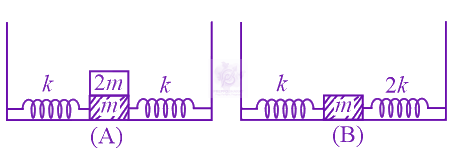
As per given figures, two springs of spring constants $K$ and $2K$ are connected to mass $m$. If the period of oscillation in figure (a) is $3s$, then the period of oscillation in figure (b) will be $\sqrt{x}s$. The value of $x$ is _____ . 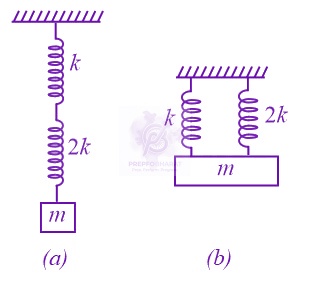
Two waves executing simple harmonic motion travelling in the same direction with same amplitude and frequency are superimposed. The resultant amplitude is equal to the $\sqrt{3}$ times of amplitude of individual motions. The phase difference between the two motions is _____ (degree)
The speed of a transverse wave passing through a string of length $50\mathrm{cm}$ and mass $10g$ is $60m{s}^{-1}$. The area of cross-section of the wire is $2.0{\mathrm{mm}}^{2}$ and its Young's modulus is $1.2\times {10}^{11}N{m}^{-2}$. The extension of the wire over its natural length due to its tension will be $x\times {10}^{-5}m$. The value of $x$ is _____ .
A longitudinal wave is represented by $y=10\mathrm{sin}2\pi (nt-\frac{x}{\lambda })\mathrm{cm}$. The maximum particle velocity will be four times the wave velocity if the determined value of wavelength is equal to
The first overtone frequency of an open organ pipe is equal to the fundamental frequency of a closed organ pipe. If the length of the closed organ pipe is $20\mathrm{cm}$. The length of the open organ pipe is _____ $\mathrm{cm}$
In the wave equation $y=0.5\mathrm{sin}\frac{2\pi }{\lambda }(400t-x)m$ the velocity of the wave will be :
A radar sends an electromagnetic signal of electric field $({E}_{0})=2.25V{m}^{-1}$ and magnetic field $({B}_{0})=1.5\times {10}^{-8}T$ which strikes a target on line of sight at a distance of $3\mathrm{km}$ in a medium. After that, a part of signal (echo) reflects back towards the radar with same velocity and by same path. If the signal was transmitted at time $t=0$ from radar, then after how much time echo will reach to the radar?
The time period of oscillation of a simple pendulum of length $L$ suspended from the roof of a vehicle, which moves without friction down an inclined plane of inclination $\alpha$, is given by :
The potential energy of a particle of mass $4\mathrm{kg}$ in motion along the $x$-axis is given by $U=4(1-\mathrm{cos}4x)J$. The time period of the particle for small oscillation $(\mathrm{sin}\theta \simeq \theta )$ $(\frac{\pi }{K})s$. The value of $K$ is _____ .
The velocity of sound in a gas, in which two wavelengths $4.08m$ and $4.16m$ produce $40$ beats in $12s$, will be
The motion of a simple pendulum executing S.H.M. is represented by the following equation $y=A\mathrm{sin}(\pi t+\phi )$, where time is measured in second. The length of pendulum is
The equation of a particle executing simple harmonic motion is given by $x=\mathrm{sin}\pi (t+\frac{1}{3})m$. At $t=1s$, the speed of particle will be (Given: $\pi =3.14$)
The equations of two waves are given by : ${y}_{1}=5\mathrm{sin}2\pi (x-vt)\mathrm{cm}$ ${y}_{2}=3\mathrm{sin}2\pi (x-vt+1.5)\mathrm{cm}$ These waves are simultaneously passing through a string. The amplitude of the resulting wave is :
If a wave gets refracted into a denser medium, then which of the following is true?
A wire of length $30\mathrm{cm}$, stretched between rigid supports, has it's ${n}^{\mathrm{th}}$ and ${(n+1)}^{\mathrm{th}}$ harmonics at $400\mathrm{Hz}$ and $450\mathrm{Hz}$, respectively. If tension in the string is $2700N$, it's linear mass density is _____ $\mathrm{kg}{m}^{-1}$.
In an experiment to determine the velocity of sound in air at room temperature using a resonance tube, the first resonance is observed when the air column has a length of $20.0\mathrm{cm}$ for a tuning fork of frequency $400\mathrm{Hz}$ is used. The velocity of the sound at room temperature is $336{ms}^{-1}$. The third resonance is observed when the air column has a length of _____ $\mathrm{cm}$
A particle executes simple harmonic motion. Its amplitude is $8\mathrm{cm}$ and time period is $6s$. The time it will take to travel from its position of maximum displacement to the point corresponding to half of its amplitude, is _____ $s$
A transverse wave is represented by $y=2\mathrm{sin}(\omega t-kx)\mathrm{cm}$. The value of wavelength (in $\mathrm{cm}$) for which the wave velocity becomes equal to the maximum particle velocity, will be
Sound travels in a mixture of two moles of helium and $n$ moles of hydrogen. If rms speed of gas molecules in the mixture is $\sqrt{2}$ times the speed of sound, then the value of $n$ will be