JEE Main 2014 — Waves & Oscillations
Physics Waves & Oscillations questions from JEE Main 2014.
Other Years
10 Waves & Oscillations Questions from 2014
The amplitude of a simple pendulum, oscillating in air with a small spherical bob, decreases from 10 cm to 8 cm in 40 seconds. Assuming that Stokes law is valid, and ratio of the coefficient of viscosity of air to that of carbon dioxide is 1.3, the time in which amplitude of this pendulum will reduce from 10 cm to 5 cm in carbondioxide will be close to (ln 5 = 1.601, ln 2 = 0.693).
A particle which is simultaneously subjected to two perpendicular simple harmonic motions represented by; $x={a}_{1}\mathrm{cos}\omega t$ and $y={a}_{2}\mathrm{cos}2\omega t$ traces a curve given by :
A transverse wave is represented by : $\text{y} = \frac{ 1 0 }{ \pi } sin ( \frac{ 2 \pi }{ \text{T} } \text{t} - \frac{ 2 \pi }{ \lambda } \text{x} )$ For what value of the wavelength the wave velocity is twice the maximum particle velocity?
The total length of a sonometer wire fixed between two bridges is $110\mathrm{cm}$. Now, two more bridges are placed to divide the length of the wire in the ratio $6:3:2$. If the tension in the wire is $400N$ and the mass per unit length of the wire is $0.01\mathrm{kg}{m}^{-1}$, then the minimum common frequency with which all the three parts can vibrate, is
A particle moves with simple harmonic motion in a straight line. In first $\tau s$, after starting from rest it travels a distance a, and in next $\tau s$ it travels 2a, in same direction, then :
Which of the following expressions corresponds to simple harmonic motion along a straight line, where $\mathrm{x}$ is the displacement and $\mathrm{a}, \mathrm{b}, \mathrm{c}$ are positive constants?
A pipe of length 85 cm is closed from one end. Find the number of possible natural oscillations of air column in the pipe whose frequencies lie below 1250 Hz. The velocity of sound in air is 340 m/s.
Two bodies of masses $1\mathrm{kg}$ and $4\mathrm{kg}$ are connected to a vertical spring, as shown in the figure. The smaller mass executes simple harmonic motion of angular frequency $25\mathrm{rad}{s}^{-1}$, and amplitude $1.6\mathrm{cm}$ while the bigger mass remains stationary on the ground. The maximum force exerted by the system on the floor is (take $g=10m{s}^{-2}$). 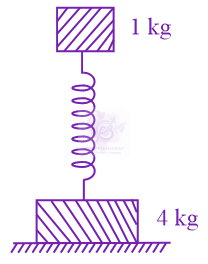
The angular frequency of the damped oscillator is given by, $\omega=\sqrt{\left(\frac{\mathrm{k}}{\mathrm{m}}-\frac{\mathrm{r}^2}{4 \mathrm{~m}^2}\right)}$ where $\mathrm{k}$ is the spring constant, $\mathrm{m}$ is the mass of the oscillator and $r$ is the damping constant. If the ratio $\frac{r^2}{\mathrm{mk}}$ is $8 \%$, the change in time period compared to the undamped oscillator is approximately as follows:
A body is in simple harmonic motion with time period $T=0.5 \text{s}$ and amplitude $A=1 \text{cm}$. Find the average velocity in the interval in which it moves from equilibrium position to half of its amplitude.