From the figure, A=2m
21mω2A2=10
21mω2(2)2=10
mω2=5
5(ω2)=5
ω2=1
ω=1
T=ω2π=2π
2πgpℓ=2π
2πgp4=2π
gp=4m/s2
JEE Main 2021 — Physics Waves & Oscillations
A mass of 5kg is connected to a spring. The potential energy curve of the simple harmonic motion executed by the system is shown in the figure. A simple pendulum of length 4m has the same period of oscillation as the spring system. What is the value of acceleration due to gravity on the planet where these experiments are performed ?
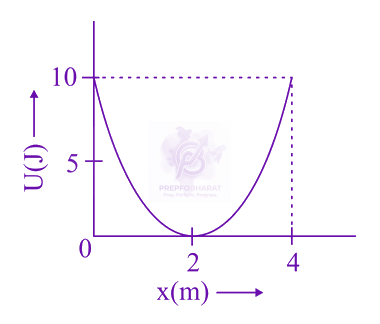
Held on 1 Sept 2021 · Verified 6 Jul 2026.
4ms−2
8ms−2
5ms−2
10ms−2
Sign in to track your attempts and accuracy.
Sign in to keep a private note on this question. Nothing you write is ever public.
The time period of a simple harmonic oscillator is $T=2 \pi \sqrt{\frac{k}{m}}$. Measured value of mass $(m)$ of the object is 10 g with an accuracy of 10 mg and time for 50 oscillations of the spring is found to be 60 s using a watch of 2 s resolution. Percentage error in determination of spring constant $(k)$ is $\_\_\_\_$ \%.
Two waves of same frequency and amplitude travel in opposite directions. The resulting pattern is:
A spring-mass system oscillates with angular frequency ω. If the mass is doubled and the spring constant is halved, the new angular frequency is:
In an open organ pipe $\nu_{3}$ and $\nu_{6}$ are $3^{\text {rd }}$ and $6^{\text {th }}$ harmonic frequencies, respectively. If $\nu_{6}-\nu_{3}=2200 \mathrm{~Hz}$ then length of the pipe is $\_\_\_\_$ mm . (Take velocity of sound in air is $330 \mathrm{~m} / \mathrm{s}$.)
A simple pendulum of string length 30 cm performs 20 oscillations in 10 s. The length of the string required for the pendulum to perform 40 oscillations in the same time duration is $\_\_\_\_$ cm. [Assume that the mass of the pendulum remains same.]
Work through every JEE Main Waves & Oscillations PYQ, year by year.