No Solution Available
The wavelengths involved in the spectrum of deuterium ( _1^2 D ) are slightly different from that of hydrogen spectrum, because
JEE Main 2003 — Physics Modern Physics
2003mcqmedium
The wavelengths involved in the spectrum of deuterium (12D) are slightly different from that of hydrogen spectrum, because
Official previous-year question
Held on 30 Apr 2003 · Verified 6 Jul 2026.
Options
- A
the size of the two nuclei are different
- B
the nuclear forces are different in the two cases
- C
the masses of the two nuclei are different
- D
the attraction between the electron and the nucleus is different in the two cases
Did you get this right?
Sign in to track your attempts and accuracy.
Your note
Sign in to keep a private note on this question. Nothing you write is ever public.
JEE Main Modern Physics in other years
More JEE Main Modern Physics questions
An electron is travelling with a velocity $v$ in free space and when it enters a medium, its velocity is reduced by $20\%$. The de Broglie wavelength of electron in the medium is $\alpha\lambda_0$, where $\lambda_0$ is its de Broglie wavelength in free space. The value of $\alpha$ is _______.
2026easy
The maximum rated power of the LED is $2$ mW and it is used in the circuit with input voltage of $5$ V as shown in the figure below. The current through resistance $R_S$ is $0.5$ mA. The minimum value of the resistance of $R_S$, to ensure that the LED is not damaged is _______ k$\Omega$. 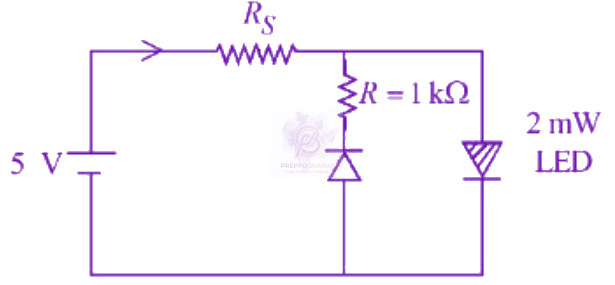
2026medium
Two $4$ bits binary numbers, $A = 1101$ and $B = 1010$ are given in the inputs of a logic circuit shown in figure below. The output $(Y)$ will be: 
2026easy
Assuming the experimental mass of ${}^{12}_{6}C$ as $12\text{ u}$, the mass defect of ${}^{12}_{6}C$ atom is _______ $\text{MeV}/c^2$. (Mass of proton $= 1.00727\text{ u}$, mass of neutron $= 1.00866\text{ u}$, $1\text{ u} = 931.5\text{ MeV}/c^2$ and $c$ is the speed of the light in vacuum).
2026medium
A light wave described by $E=60\left[\sin \left(3 \times 10^{15}\right) t+\sin \left(12 \times 10^{15}\right) t\right]$ (in SI units) falls on a metal surface of work function 2.8 eV. The maximum kinetic energy of ejected photoelectron is (approximately) $\_\_\_\_$ eV. $\left(h=6.6 \times 10^{-34} \mathrm{~J}\right.$. s. and $\left.e=1.6 \times 10^{-19} \mathrm{C}\right)$
2026medium
Other Physics topics for JEE Main
Keep practicing Modern Physics
Work through every JEE Main Modern Physics PYQ, year by year.