JEE Main 2021 — Calculus
Mathematics Calculus questions from JEE Main 2021.
Other Years
193 Calculus Questions from 2021
lim(x→0) (sin x)/x is equal to:
If f(x) = |x - 2|, then f(x) is not differentiable at x =:
Let $y=y(x)$ be the solution of the differential equation $\frac{dy}{dx}=1+x{e}^{y-x},-\sqrt{2}<x<\sqrt{2},y(0)=0$, then the minimum value of $y(x),x\in (-\sqrt{2},\sqrt{2})$ is equal to :
Let $f(x)={x}^{6}+2{x}^{4}+{x}^{3}+2x+3,x\in R$. Then the natural number $n$ for which $\underset{x\rightarrow 1}{\mathrm{lim}}\frac{{x}^{n}f(1)-f(x)}{x-1}=44$ is _____ .
Let $f(x)$ be a differentiable function at $x=a$ with ${f}^{'}(a)=2$ and $f(a)=4$. Then $\underset{x\rightarrow a}{\mathrm{lim}}\frac{xf(a)-af(x)}{x-a}$ equals:
Let $y=y(x)$ be solution of the differential equation ${\mathrm{log}}_{e}(\frac{dy}{dx})=3x+4y,$ with $y(0)=0$. If $y(-\frac{2}{3}{\mathrm{log}}_{e}2)=\alpha {\mathrm{log}}_{e}2$, then the value of $\alpha$ is equal to:
Let $f$ be any function defined on $R$ and let it satisfy the condition: $|f(x)-f(y)|\leq |{(x-y)}^{2}|,\forall (x,y)\in R$. If $f(0)=1,$ then :
The integral $\int \frac{(2x-1)\mathrm{cos}\sqrt{(2x-1{)}^{2}+5}}{\sqrt{4{x}^{2}-4x+6}}dx$ is equal to (where $c$ is a constant of integration)
The function $f(x),$ that satisfies the condition $f(x)=x+{\int }_{0}^{\pi /2}\mathrm{sin}x\mathrm{cos}yf(y)dy,$ is :
Let $y=y(x)$ be the solution of the differential equation ${e}^{x}\sqrt{1-{y}^{2}}dx+(\frac{y}{x})dy=0,y(1)=-1$ Then the value of ${(y(3))}^{2}$ is equal to:
Let $f:R\rightarrow R$ be defined as $f(x)={\begin{matrix}-\frac{4}{3}{x}^{3}+2{x}^{2}+3x, & x>0 \\ 3x{e}^{x}, & x\leq 0\end{matrix}.$ Then $f$ is increasing function in the interval
Let $M$ and $m$ respectively be the maximum and minimum values of the function $f(x)={\mathrm{tan}}^{-1}(\mathrm{sin}x+\mathrm{cos}x)$ in $[0,\frac{\pi }{2}]$. Then the value of $\mathrm{tan}(M-m)$ is equal to:
If $f(x)={\begin{matrix}{\int }_{0}^{x}(5+|1-t|)dt, & x>2 \\ 5x+1, & x\leq 2\end{matrix},$ then
The value of ${\int }_{-\pi /2}^{\pi /2}\frac{{\mathrm{cos}}^{2}x}{1+{3}^{x}}dx$ is:
The value of the integral ${\int }_{-1}^{1}{\mathrm{log}}_{e}(\sqrt{1-x}+\sqrt{1+x})dx$ is equal to:
If the curve $y=y(x)$ is the solution of the differential equation $2({x}^{2}+{x}^{5/4})dy-y(x+{x}^{1/4})dx=2{x}^{9/4}dx,x>0$ which passes through the point $(1,1-\frac{4}{3}{\mathrm{log}}_{e}2),$ then the value of $y(16)$ is equal to
For $x>0$, if $f(x)={\int }_{1}^{x}\frac{{\mathrm{log}}_{e}t}{(1+t)}dt$, then $f(e)+f(\frac{1}{e})$ is equal to
Let ${I}_{n}={\int }_{1}^{e}{x}^{19}(\mathrm{log}|x|{)}^{n}dx,$ where $n\in N$. If $(20){I}_{10}=\alpha {I}_{9}+\beta {I}_{8},$ for natural numbers $\alpha$ and $\beta$, then $\alpha -\beta$ equal to _______.
Let $P(x)={x}^{2}+bx+c$ be a quadratic polynomial with real coefficients such that ${\int }_{0}^{1}P(x)dx=1$ and $P(x)$ leaves remainder $5$ when it is divided by $(x-2)$ Then the value of $9(b+c)$ is equal to:
Let $F:[3,5]\rightarrow R$ be a twice differentiable function on $(3,5)$ such that $F(x)={e}^{-x}{\int }_{3}^{x}(3{t}^{2}+2t+4{F}^{'}(t))dt.$ If ${F}^{'}(4)=\frac{\alpha {e}^{\beta }-224}{{({e}^{\beta }-4)}^{2}}$, then $\alpha +\beta$ is equal to _____.
Let $f:R\rightarrow R$ be defined as $f(x)={\begin{matrix}\frac{{x}^{3}}{(1-\mathrm{cos}2x{)}^{2}}{\mathrm{log}}_{e}(\frac{1+2x{e}^{-2x}}{{(1-x{e}^{-x})}^{2}}) & ,x\neq 0 \\ \alpha & ,x=0\end{matrix}$ If $f$ is continuous at $x=0,$ then $\alpha$ is equal to:
The area (in sq. units) of the region, given by the set ${(x,y)\in R\times R\mid x\geq 0,2{x}^{2}\leq y\leq 4-2x}$ is :
If the function $f(x)={\begin{matrix}\frac{1}{x}{\mathrm{log}}_{e}(\frac{1+\frac{x}{a}}{1-\frac{x}{b}}),x<0 \\ k,x=0 \\ \frac{{\mathrm{cos}}^{2}x-{\mathrm{sin}}^{2}x-1}{\sqrt{{x}^{2}+1}-1},x>0\end{matrix}$ is continuous at $x=0,$ then $\frac{1}{a}+\frac{1}{b}+\frac{4}{k}$ is equal to :
$\underset{x\rightarrow 2}{\mathrm{lim}}(\sum _{n=1}^{9}\frac{x}{n(n+1){x}^{2}+2(2n+1)x+4})$ is equal to :
If $\underset{x\rightarrow 0}{\mathrm{lim}}\frac{{\mathrm{sin}}^{-1}x-{\mathrm{tan}}^{-1}x}{3{x}^{3}}$ is equal to $L,$ then the value of $(6L+1)$ is
Let a function $g:[0,4]\rightarrow R$ be defined as $g(x)={\begin{matrix}\underset{0\leq t\leq x}{\mathrm{max}{{t}^{3}-6{t}^{2}+9t-3}}, & 0\leq x\leq 3 \\ 4-x, & 3<x\leq 4\end{matrix}$ then the number of points in the interval $(0,4)$ where $g(x)$ is NOT differentiable, is _________.
Let $f:R\rightarrow R$ be a function defined as $f(x)={\begin{matrix}\frac{\mathrm{sin}(a+1)x+\mathrm{sin}2x}{2x} & ,\mathrm{if}x<0 \\ b & ,\mathrm{if}x=0 \\ \frac{\sqrt{x+b{x}^{3}}-\sqrt{x}}{b{x}^{5/2}} & ,\mathrm{if}x>0\end{matrix}$ If $f$ is continuous at $x=0$, then the value of $a+b$ is equal to :
Let a function $f:R\rightarrow R$ be defined as, $f(x)={\begin{matrix}\mathrm{sin}x-{e}^{x} & \mathrm{if}x\leq 0 \\ a+[-x] & \mathrm{if}0<x<1 \\ 2x-b & \mathrm{if}x\geq 1\end{matrix}$ Where $[x]$ is the greatest integer less than or equal to $x.$ If $f$ is continuous on $R$, then $(a+b)$ is equal to:
If $\alpha ,\beta$ are the distinct roots of ${x}^{2}+bx+c=0,$ then $\underset{x\rightarrow \beta }{\mathrm{lim}}\frac{{e}^{2({x}^{2}+bx+c)}-1-2({x}^{2}+bx+c)}{(x-\beta {)}^{2}}$ is equal to
Let $f:R\rightarrow R$ be defined as $f(x)={\begin{matrix}2\mathrm{sin}(-\frac{\pi x}{2}), & \mathrm{if}x<-1 \\ |a{x}^{2}+x+b|, & \mathrm{if}-1\leq x\leq 1 \\ \mathrm{sin}(\pi x), & \mathrm{if}x>1\end{matrix}$ If $f(x)$ is continuous on $R$, then $a+b$ equals :
$\underset{x\rightarrow 0}{\mathrm{lim}}\frac{{\mathrm{sin}}^{2}(\pi {\mathrm{cos}}^{4}x)}{{x}^{4}}$ is equal to :
If the integral ${\int }_{0}^{10}\frac{[\mathrm{sin}2\pi x]}{{e}^{x-[x]}}dx=\alpha {e}^{-1}+\beta {e}^{-\frac{1}{2}}+\gamma ,$ where $\alpha ,\beta ,\gamma$ are integers and $[x]$ denotes the greatest integer less than or equal to $x,$ then the value of $\alpha +\beta +\gamma$ is equal to:
The range of $a\in R$ for which the function $f(x)=(4a-3)(x+{\mathrm{log}}_{e}5)+2(a-7)\mathrm{cot}(\frac{x}{2}){\mathrm{sin}}^{2}(\frac{x}{2}),x\neq 2n\pi ,n\in N$, has critical points, is :
A wire of length $36m$ is cut into two pieces, one of the pieces is bent to form a square and the other is bent to form a circle. If the sum of the areas of the two figures is minimum, and the circumference of the circle is $k$ (meter), then $(\frac{4}{\pi }+1)k$ is equal to
$\underset{x\rightarrow 0}{\mathrm{lim}}\frac{{\int }_{0}^{{x}^{2}}(\mathrm{sin}\sqrt{t})dt}{{x}^{3}}$ is equal to:
The value of ${\int }_{-1}^{1}{x}^{2}{e}^{[{x}^{3}]}dx,$ where $[t]$ denotes the greatest integer $\leq t,$ is :
If $\int \frac{dx}{{({x}^{2}+x+1)}^{2}}=a{\mathrm{tan}}^{-1}(\frac{2x+1}{\sqrt{3}})+b(\frac{2x+1}{{x}^{2}+x+1})+C,x>0$ where $C$ is the constant of integration, then the value of $9(\sqrt{3}a+b)$ is equal to _________.
The function $f(x)={x}^{3}-6{x}^{2}+ax+b$ is such that $f(2)=f(4)=0$. Consider two statements: $({S}_{1})$ there exists ${x}_{1},{x}_{2}\in (2,4),{x}_{1}<{x}_{2},$ such that ${f}^{'}({x}_{1})=-1$ and ${f}^{'}({x}_{2})=0.$ $({S}_{2})$ there exists ${x}_{3},{x}_{4}\in (2,4),{x}_{3}<{x}_{4}$, such that $f$ is decreasing in $(2,{x}_{4})$, increasing in $({x}_{4},4)$ and $2{f}^{'}({x}_{3})=\sqrt{3}f({x}_{4})$ then
The sum of all the local minimum values of the twice differentiable function $f:R\rightarrow R$ defined by $f(x)={x}^{3}-3{x}^{2}-\frac{3{f}^{"}(2)}{2}x+{f}^{"}(1)$ is:
Consider the integral $I={\int }_{0}^{10}\frac{[x]{e}^{[x]}}{{e}^{x-1}}dx$ where $[x]$ denotes the greatest integer less than or equal to $x$. Then the value of $I$ is equal to :
Let $f:R\rightarrow R$ be a function such that $f(2)=4$ and ${f}^{'}(2)=1.$ Then, the value of $\underset{x\rightarrow 2}{\mathrm{lim}}\frac{{x}^{2}f(2)-4f(x)}{x-2}$ is equal to:
The area of the region bounded by $y-x=2$ and ${x}^{2}=y$ is equal to :-
If ${\int }_{0}^{\pi }({\mathrm{sin}}^{3}x){e}^{-{\mathrm{sin}}^{2}x}dx=\alpha -\frac{\beta }{e}{\int }_{0}^{1}\sqrt{t}{e}^{t}dt,$ then $\alpha +\beta$ is equal to
The rate of growth of bacteria in a culture is proportional to the number of bacteria present and the bacteria count is $1000$ at initial time $t=0.$ The number of bacteria is increased by $20%$ in $2$ hours. If the population of bacteria is $2000$ after $\frac{k}{{\mathrm{log}}_{e}(\frac{6}{5})}$ hours, then ${(\frac{k}{{\mathrm{log}}_{e}2})}^{2}$ is equal to:
Let $[t]$ denote the greatest integer $\leq t.$ The number of points where the function $f(x)=[x]|{x}^{2}-1|+\mathrm{sin}(\frac{\pi }{[x]+3})-[x+1],x\in (-2,2)$ is not continuous is _____ .
Let $a,b\in R,b\neq 0$. Defined a function, $f(x)={\begin{matrix}a\mathrm{sin}\frac{\pi }{2}(x-1),\mathrm{for}x\leq 0 \\ \frac{\mathrm{tan}2x-\mathrm{sin}2x}{b{x}^{3}},\mathrm{for}x>0\end{matrix}$ If $f$ is continuous at$x=0$, then $10-ab$ is equal to
Let $f:[0,\infty )\rightarrow [0,\infty )$ be defined as $f(x)={\int }_{0}^{x}[y]dy$ where $[x]$ is the greatest integer less than or equal to $x$. Which of the following is true?
Let $y=y(x)$ be the solution of the differential equation $\mathrm{cos}x(3\mathrm{sin}x+\mathrm{cos}x+3)dy=(1+y\mathrm{sin}x(3\mathrm{sin}x+\mathrm{cos}x+3))dx,0\leq x\leq \frac{\pi }{2},y(0)=0.$ Then, $y(\frac{\pi }{3})$ is equal to:
If $f(x)=\mathrm{sin}({\mathrm{cos}}^{-1}(\frac{1-{2}^{2x}}{1+{2}^{2x}}))$ and its first derivative with respect to $x$ is $-\frac{b}{a}{\mathrm{log}}_{e}2$ when $x=1,$ where $a$ and $b$ are integers, then the minimum value of $|{a}^{2}-{b}^{2}|$ is _______.
Let $f(x)=\mathrm{cos}(2{\mathrm{tan}}^{-1}\mathrm{sin}({\mathrm{cot}}^{-1}\sqrt{\frac{1-x}{x}})),0<x<1$. Then:
If $y=y(x)$ is an implicit function of $x$ such that ${\mathrm{log}}_{e}(x+y)=4xy$, then $\frac{{d}^{2}y}{d{x}^{2}}$ at $x=0$ is equal to
Let $f$ be a real valued function, defined on$R-{-1,1}$ and given by $f(x)=3{\mathrm{log}}_{e}|\frac{x-1}{x+1}|-\frac{2}{x-1}$. Then in which of the following intervals, function $f(x)$ is increasing?
Let $a$ be an integer such that all the real roots of the polynomial $2{x}^{5}+5{x}^{4}+10{x}^{3}+10{x}^{2}+10x+10$ lie in the interval $(a,a+1)$. Then, $|a|$ is equal to ______.
The minimum value of $\alpha$ for which the equation $\frac{4}{\mathrm{sin}x}+\frac{1}{1-\mathrm{sin}x}=\alpha$ has at least one solution in $(0,\frac{\pi }{2})$ is______.
If the value of $\underset{x\rightarrow 0}{\mathrm{lim}}{(2-\mathrm{cos}x\sqrt{\mathrm{cos}2x})}^{(\frac{x+2}{{x}^{2}})}$ is equal to ${e}^{a}$, then $a$ is equal to_____.
The number of points, at which the function $f(x)=|2x+1|-3|x+2|+|{x}^{2}+x-2|,x\in R$ is not differentiable, is
The integral $\int \frac{{e}^{3{\mathrm{log}}_{e}2x}+5{e}^{2{\mathrm{log}}_{e}2x}}{{e}^{4{\mathrm{log}}_{e}x}+5{e}^{3{\mathrm{log}}_{e}x}-7{e}^{2{\mathrm{log}}_{e}x}}dx,x>0$, is equal to (where $c$ is a constant of integration)
Let $f$ be a non-negative function in $[0,1]$ and twice differentiable in $(0,1).$ If ${\int }_{0}^{x}\sqrt{1-{({f}^{'}(t))}^{2}}\mathrm{dt}={\int }_{0}^{x}f(t)\mathrm{dt},0\leq x\leq 1$ and $f(0)=0,$ then $\underset{x\rightarrow 0}{\mathrm{lim}}\frac{1}{{x}^{2}}{\int }_{0}^{x}f(t)\mathrm{dt}:$
The value of the integral ${\int }_{0}^{1}\frac{\sqrt{x}dx}{(1+x)(1+3x)(3+x)}$ is:
The value of the definite integral ${\int }_{-\frac{\pi }{4}}^{\frac{\pi }{4}}\frac{dx}{(1+{e}^{x\mathrm{cos}x})({\mathrm{sin}}^{4}x+{\mathrm{cos}}^{4}x)}$ is equal to :
The value of the definite integral ${\int }_{\pi /24}^{5\pi /24}\frac{dx}{1+\sqrt[3]{\mathrm{tan}2x}}$ is
Let $a$ be a positive real number such that ${\int }_{0}^{a}{e}^{x-[x]}dx=10e-9$ where, $[x]$ is the greatest integer less than or equal to $x$. Then, $a$ is equal to:
Let $f:R\rightarrow R$ be defined as $f(x)={e}^{-x}\mathrm{sin}x.$ If $F:[0,1]\rightarrow R$ is a differentiable function such that $F(x)={\int }_{0}^{x}f(t)dt,$ then the value of ${\int }_{0}^{1}({F}^{'}(x)+f(x)){e}^{x}dx$ lies in the interval
If ${I}_{m,n}={\int }_{0}^{1}{x}^{m-1}{(1-x)}^{n-1}dx$, for $m,n\geqslant 1$, and ${\int }_{0}^{1}\frac{{x}^{m-1}+{x}^{n-1}}{{(1+x)}^{m+n}}dx=\alpha {I}_{m,n},\alpha \in R$, then $\alpha$ equals ________.
If the normal to the curve $y(x)={\int }_{0}^{x}(2{t}^{2}-15t+10)dt$ at a point $(a,b)$ is parallel to the line $x+3y=-5,a>1$, then the value of $|a+6b|$ is equal to ________.
The value of the integral ${\int }_{0}^{\pi }|\mathrm{sin}2x|dx$ is ________.
The area of the region $S={(x,y):3{x}^{2}\leq 4y\leq 6x+24}$ is______.
If the line $y=mx$ bisects the area enclosed by the lines $x=0,y=0,x=\frac{3}{2}$ and the curve $y=1+4x-{x}^{2},$ then $12m$ is equal to .
The area (in sq. units) of the region bounded by the curves ${x}^{2}+2y-1=0,{y}^{2}+4x-4=0$ and ${y}^{2}-4x-4=0$ in the upper half plane is _________.
If the solution curve of the differential equation $(2x-10{y}^{3})dy+ydx=0$, passes through the points $(0,1)$ and $(2,\beta )$, then $\beta$ is a root of the equation?
Let $y=y(x)$ be solution of the following differential equation ${e}^{y}\frac{dy}{dx}-2{e}^{y}\mathrm{sin}x+\mathrm{sin}x{\mathrm{cos}}^{2}x=0,y(\frac{\pi }{2})=0$. If $y(0)={\mathrm{log}}_{e}(\alpha +\beta {e}^{-2})$, then $4(\alpha +\beta )$ is equal to .
Let $y=y(x)$ be the solution of the differential equation ${cosec}^{2}xdy+2dx=(1+y\mathrm{cos}2x){cosec}^{2}xdx,$ with $y(\frac{\pi }{4})=0.$ Then, the value of ${(y(0)+1)}^{2}$ is equal to:
Let $y=y(x)$ be the solution of the differential equation $x\mathrm{tan}(\frac{y}{x})dy=(y\mathrm{tan}(\frac{y}{x})-x)dx$, $-1\leq x\leq 1,y(\frac{1}{2})=\frac{\pi }{6}.$ Then the area of the region bounded by the curves $x=0,x=\frac{1}{\sqrt{2}}$ and $y=y(x)$ in the upper half plane is:
If $y=y(x)$ is the solution of the differential equation $\frac{dy}{dx}+(\mathrm{tan}x)y=\mathrm{sin}x,0\leq x\leq \frac{\pi }{3},$ with $y(0)=0,$ then $y(\frac{\pi }{4})$ is equal to
If the curve, $y=y(x)$ represented by the solution of the differential equation $(2x{y}^{2}-y)dx+xdy=0$, passes through the intersection of the lines, $2x-3y=1$ and $3x+2y=8$, then $|y(1)|$ is equal to ___ .
If the area of the bounded region $R={(x,y):\mathrm{max}{0,{\mathrm{log}}_{e}x}\leq y\leq {2}^{x},\frac{1}{2}\leq x\leq 2}$ is, $\alpha {({\mathrm{log}}_{e}2)}^{-1}+\beta ({\mathrm{log}}_{e}2)+\gamma$ then the value of ${(\alpha +\beta -2\gamma )}^{2}$ is equal to:
Let $f:R\rightarrow R$ satisfy the equation $f(x+y)=f(x)\cdot f(y)$ for all $x,y\in R$ and $f(x)\neq 0$ for any $x\in R$. If the function $f$ is differentiable at $x=0$ and ${f}^{'}(0)=3$, then $\underset{h\rightarrow 0}{\mathrm{lim}}\frac{1}{h}(f(h)-1)$ is equal to ___ .
$\underset{n\rightarrow \infty }{\mathrm{lim}}{(1+\frac{1+\frac{1}{2}+\ldots \ldots +\frac{1}{n}}{{n}^{2}})}^{n}$ is equal to
Let ${A}_{1}$ be the area of the region bounded by the curves $y=\mathrm{sin}x,y=\mathrm{cos}x$ and $y$-axis in the first quadrant. Also, let ${A}_{2}$ be the area of the region bounded by the curves $y=\mathrm{sin}x,y=\mathrm{cos}x$, $x$-axis and $x=\frac{\pi }{2}$ in the first quadrant. Then,
If $y=y(x)$ is the solution of the differential equation, $\frac{dy}{dx}+2y\mathrm{tan}x=\mathrm{sin}x,y(\frac{\pi }{3})=0$, then the maximum value of the function $y(x)$ over $R$ is equal to :
The function $f(x)=|{x}^{2}-2x-3|\cdot {e}^{9{x}^{2}-12x+4}$ is not differentiable at exactly :
Let $y=y(x)$ be the solution of the differential equation $\frac{dy}{dx}=2(y+2\mathrm{sin}x-5)x-2\mathrm{cos}x$ such that $y(0)=7.$ Then $y(\pi )$ is equal to
Let $A=[{a}_{ij}]$ be a $3\times 3$ matrix, where ${a}_{ij}={\begin{matrix}1 & , & \mathrm{if}i=j \\ -x & , & \mathrm{if}|i-j|=1 \\ 2x+1 & , & \mathrm{otherwise}\end{matrix}$ Let a function $f:R\rightarrow R$ be defined as $f(x)=det(A)$. Then the sum of maximum and minimum values of $f$ on $R$ is equal to:
Let $y=y(x)$ be the solution of the differential equation $(x-{x}^{3})dy=(y+y{x}^{2}-3{x}^{4})dx,x>2$ If $y(3)=3,$ then $y(4)$ is equal to:
If the value of the integral ${\int }_{0}^{5}\frac{x+[x]}{{e}^{x-[x]}}dx=\alpha {e}^{-1}+\beta ,$ where $\alpha ,\beta \in R,5\alpha +6\beta =0,$ and $[x]$ denotes the greatest integer less than or equal to $x;$ then the value of $(\alpha +\beta {)}^{2}$ is equal to :
The value of ${\int }_{\frac{-1}{\sqrt{2}}}^{\frac{1}{\sqrt{2}}}{({(\frac{x+1}{x-1})}^{2}+{(\frac{x-1}{x+1})}^{2}-2)}^{\frac{1}{2}}dx$ is:
The triangle of maximum area that can be inscribed in a given circle of radius '$r$' is :
If $\underset{x\rightarrow 0}{\mathrm{lim}}\frac{ax-({e}^{4x}-1)}{ax({e}^{4x}-1)}$ exists and is equal to $b$, then the value of $a-2b$ is ___ .
The graphs of sine and cosine functions, intersect each other at a number of points and between two consecutive points of intersection, the two graphs enclose the same area $A$. Then ${A}^{4}$ is equal to
Let $f:S\rightarrow S$ where $S=(0,\infty )$ be a twice differentiable function such that $f(x+1)=xf(x)$. If $g:S\rightarrow R$ be defined as $g(x)={\mathrm{log}}_{e}f(x)$, then the value of $|{g}^{''}(5)-{g}^{''}(1)|$ is equal to :
Let $y=y(x)$ be the solution of the differential equation $xdy=(y+{x}^{3}\mathrm{cos}x)dx$ with $y(\pi )=0,$ then $y(\frac{\pi }{2})$ is equal to:
If $[\cdot ]$ represents the greatest integer function, then the value of $|{\int }_{0}^{\sqrt{\frac{\pi }{2}}}[[{x}^{2}]-\mathrm{cos}x]dx|$ is ___________.
If $y=y(x)$ is the solution curve of the differential equation ${x}^{2}dy+(y-\frac{1}{x})dx=0;x>0$ and $y(1)=1,$ then $y(\frac{1}{2})$ is equal to :
The number of real roots of the equation ${e}^{6x}-{e}^{4x}-2{e}^{3x}-12{e}^{2x}+{e}^{x}+1=0$ is:
If $f(x)=\int \frac{5{x}^{8}+7{x}^{6}}{{({x}^{2}+1+2{x}^{7})}^{2}}dx,(x\geq 0),f(0)=0$ and $f(1)=\frac{1}{K},$ then the value of $K$ is
If $x\phi (x)={\int }_{5}^{x}(3{t}^{2}-2{\phi }^{'}(t))dt,x>-2,$ $\phi (0)=4,$ then $\phi (2)$ is
Let ${C}_{1}$ be the curve obtained by the solution of differential equation $2xy\frac{dy}{dx}={y}^{2}-{x}^{2},x>0$. Let the curve ${C}_{2}$ be the solution of $\frac{2xy}{{x}^{2}-{y}^{2}}=\frac{dy}{dx}$. If both the curves pass through $(1,1),$ then the area (in sq. units) enclosed by the curves ${C}_{1}$ and ${C}_{2}$ is equal to :
Which of the following is true for $y(x)$ that satisfies the differential equation $\frac{dy}{dx}=xy-1+x-y;y(0)=0$
Let $f:R\rightarrow R$ be a function defined as $f(x)={\begin{matrix}3(1-\frac{|x|}{2}) & \text{if} & |x|\leq 2 \\ 0 & \text{if} & |x|>2\end{matrix}.$ Let $g:R\rightarrow R$ be given by $g(x)=f(x+2)-f(x-2).$ If $n$ and $m$ denote the number of points in $R$ where $g$ is not continuous and not differentiable, respectively, then $n+m$ is equal to ________.
If $R$ is the least value of $a$ such that the function $f(x)={x}^{2}+ax+1$ is increasing on $[1,2]$ and $S$ is the greatest value of $a$ such that the function $f(x)={x}^{2}+ax+1$ is decreasing on $[1,2]$, then the value of $|R-S|$ is
Let $a$ and $b$ respectively be the points of local maximum and local minimum of the function $f(x)=2{x}^{3}-3{x}^{2}-12x$. If $A$ is the total area of the region bounded by $y=f(x),$ the $x$-axis and the lines $x=a$ and $x=b,$ then $4A$ is equal to ______.
The area bounded by the lines $y=||x-1|-2|$ and $y=2$ is _____.
The value of $\underset{x\rightarrow 0}{\mathrm{lim}}(\frac{x}{\sqrt[8]{1-\mathrm{sin}x}-\sqrt[8]{1+\mathrm{sin}x}})$ is equal to :
Let $y(x)$ be the solution of the differential equation $2{x}^{2}dy+({e}^{y}-2x)dx=0,x>0.$ If $y(e)=1,$ then $y(1)$ is equal to:
Let $[t]$ denote the greatest integer less than or equal to $t.$ Let $f(x)=x-[x],g(x)=1-x+[x],$ and $h(x)=\mathrm{min}{f(x),g(x)},x\in [-2,2].$ Then $h$ is :
If $\frac{dy}{dx}=\frac{{2}^{x+y}-{2}^{x}}{{2}^{y}},y(0)=1,$ then $y(1)$ is equal to :
The area of the region: $R={(x,y):5{x}^{2}\leq y\leq 2{x}^{2}+9}$ is
The difference between degree and order of a differential equation that represents the family of curves given by ${y}^{2}=a(x+\frac{\sqrt{a}}{2}),a>0$ is _______.
Let the functions $f:R\rightarrow R$ and $g:R\rightarrow R$ be defined as : $f(x)={\begin{matrix}x+2, & x<0 \\ {x}^{2}, & x\geq 0\end{matrix}$ and $g(x)={\begin{matrix}{x}^{3}, & x<1 \\ 3x-2, & x\geq 1\end{matrix}$ Then, the number of points in $R$ where $(fog)(x)$ is NOT differentiable is equal to :
A box open from top is made from a rectangular sheet of dimension $a\times b$ by cutting squares each of side $x$ from each of the four corners and folding up the flaps. If the volume of the box is maximum, then $x$ is equal to:
If $\frac{dy}{dx}=\frac{{2}^{x}y+{2}^{y}\cdot {2}^{x}}{{2}^{x}+{2}^{x+y}{\mathrm{log}}_{e}2},y(0)=0,$ then for $y=1,$ the value of $x$ lies in the interval :
${\int }_{6}^{16}\frac{{\mathrm{log}}_{e}{x}^{2}}{{\mathrm{log}}_{e}{x}^{2}+{\mathrm{log}}_{e}({x}^{2}-44x+484)}dx$ is equal to
Which of the following statement is correct for the function $g(\alpha )$ for $\alpha \in R$ such that $g(\alpha )={\int }_{\frac{\pi }{6}}^{\frac{\pi }{3}}\frac{{\mathrm{sin}}^{\alpha }x}{{\mathrm{cos}}^{\alpha }x+{\mathrm{sin}}^{\alpha }x}dx$
The value of the integral $\int \frac{\mathrm{sin}\theta \cdot \mathrm{sin}2\theta ({\mathrm{sin}}^{6}\theta +{\mathrm{sin}}^{4}\theta +{\mathrm{sin}}^{2}\theta )\sqrt{2{\mathrm{sin}}^{4}\theta +3{\mathrm{sin}}^{2}\theta +6}}{1-\mathrm{cos}2\theta }d\theta$ is (where $c$ is a constant of integration)
Let us consider a curve, $y=f(x)$ passing through the point $(-2,2)$ and the slope of the tangent to the curve at any point $(x,f(x))$ is given by $f(x)+x{f}^{'}(x)={x}^{2}.$ Then
If $\alpha =\underset{x\rightarrow \pi /4}{\mathrm{lim}}\frac{{\mathrm{tan}}^{3}x-\mathrm{tan}x}{\mathrm{cos}(x+\frac{\pi }{4})}$ and $\beta =\underset{x\rightarrow 0}{\mathrm{lim}}{(\mathrm{cos}x)}^{\mathrm{cot}x}$ are the roots of the equation, $a{x}^{2}+bx-4=0,$ then the ordered pair $(a,b)$ is :
The value of $\underset{n\rightarrow \infty }{\mathrm{lim}}\frac{[r]+[2r]+...+[nr]}{{n}^{2}},$ where $r$ is non-zero real number and $[r]$ denotes the greatest integer less than or equal to $r,$ is equal to :
Let $f:[-1,1]\rightarrow R$ be defined as $f(x)=a{x}^{2}+bx+c$ for all $x\in [-1,1],$ where $a,b,c\in R$ such that $f(-1)=2,{f}^{'}(-1)=1$ and for $x\in (-1,1)$ the maximum value of ${f}^{"}(x)$ is $\frac{1}{2}.$ If $f(x)\leq \alpha ,x\in [-1,1],$ then the least value of $\alpha$ is equal to
Let $f(x)=3{\mathrm{sin}}^{4}x+10{\mathrm{sin}}^{3}x+6{\mathrm{sin}}^{2}x-3$, $x\in [-\frac{\pi }{6},\frac{\pi }{2}]$. Then, $f$ is :
Let $f:[0,\infty )\rightarrow [0,3]$ be a function defined by $f(x)={\begin{matrix}\mathrm{max}{\mathrm{sin}t:0\leq t\leq \pi },x\in [0,\pi ] \\ 2+\mathrm{cos}x,x>\pi \end{matrix}$. Then which of the following is true ?
Let $f(x)$ be a polynomial of degree $6$ in $x,$ in which the coefficient of ${x}^{6}$ is unity and it has extrema at $x=-1$ and $x=1$. If $\underset{x\rightarrow 0}{\mathrm{lim}}\frac{f(x)}{{x}^{3}}=1,$ then $5\cdot f(2)$ is equal to
If $f(x)={\begin{matrix}\frac{1}{|x|} & ; & |x|\geq 1 \\ a{x}^{2}+b & ; & |x|<1\end{matrix}$ is differentiable at every point of the domain, then the values of $a$ and $b$ are respectively:
Let $y=y(x)$ be the solution of the differential equation $\frac{dy}{dx}=(y+1)((y+1){e}^{{x}^{2}/2}-x),0<x<2.1$, with $y(2)=0$. Then the value of $\frac{dy}{dx}$ at $x=1$ is equal to
Let slope of the tangent line to a curve at any point $P(x,y)$ be given by $\frac{x{y}^{2}+y}{x}$. If the curve intersects the line $x+2y=4$ at $x=-2$, then the value of $y$, for which the point $(3,y)$ lies on the curve, is :
The population $P=P(t)$ at time $t$ of a certain species follows the differential equation $\frac{dP}{dt}=0.5P-450$. If $P(0)=850$, then the time at which population becomes zero is:
If $\int \frac{\mathrm{cos}x-\mathrm{sin}x}{\sqrt{8-\mathrm{sin}2x}}dx=a{\mathrm{sin}}^{-1}(\frac{\mathrm{sin}x+\mathrm{cos}x}{b})+c,$ where $c$ is a constant of integration, then the ordered pair $(a,b)$ is equal to:
Let $f:R\rightarrow R$ be defined as $f(x)={\begin{matrix}-55x, & \mathrm{if}x<-5 \\ 2{x}^{3}-3{x}^{2}-120x, & \mathrm{if}-5\leq x\leq 4 \\ 2{x}^{3}-3{x}^{2}-36x-336, & \mathrm{if}x>4\end{matrix}$ Let $A={x\in R:f$ is increasing}. Then $A$ is equal to:
If $y=y(x)$ is the solution of the equation ${e}^{\mathrm{sin}y}\mathrm{cos}y\frac{dy}{dx}+{e}^{\mathrm{sin}y}\mathrm{cos}x=\mathrm{cos}x,y(0)=0$; then $1+y(\frac{\pi }{6})+\frac{\sqrt{3}}{2}y(\frac{\pi }{3})+\frac{1}{\sqrt{2}}y(\frac{\pi }{4})$ is equal to _______.
The value of the integral ${\int }_{-1}^{1}\mathrm{log}(x+\sqrt{{x}^{2}+1})dx$ is:
Let $y=y(x)$ satisfies the equation $\frac{dy}{dx}-|A|=0,$ for all $x>0,$ where $A=[\begin{matrix}y & \mathrm{sin}x & 1 \\ 0 & -1 & 1 \\ 2 & 0 & \frac{1}{x}\end{matrix}]$. If $y(\pi )=\pi +2,$ then the value of $y(\frac{\pi }{2})$ is:
The value of the limit $\underset{\theta \rightarrow 0}{\mathrm{lim}}\frac{\mathrm{tan}(\pi {\mathrm{cos}}^{2}\theta )}{\mathrm{sin}(2\pi {\mathrm{sin}}^{2}\theta )}$ is equal to :
Let ${J}_{n,m}={\int }_{0}^{1/2}\frac{{x}^{n}}{{x}^{m}-1}dx,\forall n>m$ and $n,m\in N.$ Consider a matrix $A={[{a}_{ij}]}_{3\times 3}$ where ${a}_{ij}={\begin{matrix}{J}_{6+i,3}-{J}_{i+3,3} & ,i\leq j \\ 0 & ,i>j\end{matrix}$. Then $|adj{A}^{-1}|$ is :
If $\int \frac{\mathrm{sin}x}{{\mathrm{sin}}^{3}x+{\mathrm{cos}}^{3}x}dx=\alpha {\mathrm{log}}_{e}|1+\mathrm{tan}x|+\beta {\mathrm{log}}_{e}|1-\mathrm{tan}x+{\mathrm{tan}}^{2}x|+\gamma {\mathrm{tan}}^{-1}(\frac{2\mathrm{tan}x-1}{\sqrt{3}})+C,$ when $C$ is constant of integration, then the value of $18(\alpha +\beta +{\gamma }^{2})$ is
If $\underset{x\rightarrow 0}{\mathrm{lim}}\frac{a{e}^{x}-b\mathrm{cos}x+c{e}^{-x}}{x\mathrm{sin}x}=2$, then $a+b+c$ is equal to ________.
If a curve $y=f(x)$ passes through the point $(1,2)$ and satisfies $x\frac{dy}{dx}+y=b{x}^{4},$ then for what value of $b,{\int }_{1}^{2}f(x)dx=\frac{62}{5}?$
Let $f:[-3,1]\rightarrow R$ be given as $f(x)={\begin{matrix}min{(x+6),{x}^{2}}, & -3\leq x\leq 0 \\ max{\sqrt{x},{x}^{2}}, & 0\leq x\leq 1\end{matrix}.$If the area bounded by $y=f(x)$ and $x$-axis is $A$ sq units, then the value of $6A$ is equal to
If the function $f(x)=\frac{\mathrm{cos}(\mathrm{sin}x)-\mathrm{cos}x}{{x}^{4}}$ is continuous at each point in its domain and $f(0)=\frac{1}{k},$ then $k$ is _________.
Let $y=y(x)$ be the solution of the differential equation $dy={e}^{\alpha x+y}dx;\alpha \in N.$ If $y({\mathrm{log}}_{e}2)={\mathrm{log}}_{e}2$ and $y(0)={\mathrm{log}}_{e}(\frac{1}{2}),$ then the value of $\alpha$ is equal to ___.
The value of ${\int }_{-\frac{\pi }{2}}^{\frac{\pi }{2}}(\frac{1+{\mathrm{sin}}^{2}x}{1+{\pi }^{\mathrm{sin}x}})dx$ is :
If $y\frac{dy}{dx}=x[\frac{{y}^{2}}{{x}^{2}}+\frac{\phi (\frac{{y}^{2}}{{x}^{2}})}{{\phi }^{'}(\frac{{y}^{2}}{{x}^{2}})}],x>0,\phi >0,$ and $y(1)=-1,$ then $\phi (\frac{{y}^{2}}{4})$ is equal to:
If $[x]$ is the greatest integer $\leq x,$ then ${\pi }^{2}{\int }_{0}^{2}(\mathrm{sin}\frac{\pi x}{2}){(x-[x])}^{[x]}dx$ is equal to :
The local maximum value of the function, $f(x)={(\frac{2}{x})}^{{x}^{2}},x>0,$ is
$\int \frac{2{e}^{x}+3{e}^{-x}}{4{e}^{x}+7{e}^{-x}}dx=\frac{1}{14}(ux+v{\mathrm{log}}_{e}(4{e}^{x}+7{e}^{-x}))+C$, where $C$ is a constant of integration, then $u+v$ is equal to
If $y(x)={\mathrm{cot}}^{-1}(\frac{\sqrt{1+\mathrm{sin}x}+\sqrt{1-\mathrm{sin}x}}{\sqrt{1+\mathrm{sin}x}-\sqrt{1-\mathrm{sin}x}}),x\in (\frac{\pi }{2},\pi )$, then $\frac{dy}{dx}$ at $x=\frac{5\pi }{6}$ is:
The area of the region bounded by the parabola $(y-2{)}^{2}=(x-1)$, the tangent to it at the point whose ordinate is $3$ and the $x$-axis, is:
The function $f(x)=\frac{4{x}^{3}-3{x}^{2}}{6}-2\mathrm{sin}x+(2x-1)\mathrm{cos}x$:
A wire of length $20m$ is to be cut into two pieces. One of the pieces is to be made into a square and the other into a regular hexagon. Then the length of the side (in meters) of the hexagon, so that the combined area of the square and the hexagon is minimum, is
The value of the integral, ${\int }_{1}^{3}[{x}^{2}-2x-2]dx,$ where $[x]$ denotes the greatest integer less than or equal to $x,$ is
If $y=y(x),y\in [0,\frac{\pi }{2})$ is the solution of the differential equation $\mathrm{sec}y\frac{dy}{dx}-\mathrm{sin}(x+y)-\mathrm{sin}(x-y)=0,$ with $y(0)=0$, then $5{y}^{'}(\frac{\pi }{2})$ is equal to _____.
The value of ${\int }_{-2}^{2}|3{x}^{2}-3x-6|dx$ is
Let the curve $y=y(x)$ be the solution of the differential equation, $\frac{dy}{dx}=2(x+1)$. If the numerical value of area bounded by the curve $y=y(x)$ and $x$-axis is $\frac{4\sqrt{8}}{3}$, then the value of $y(1)$ is equal to ________.
Let $f(x)$ be a differentiable function defined on $[0,2]$ such that ${f}^{'}(x)={f}^{'}(2-x)$ for all $x\in (0,2),f(0)=1$ and $f(2)={e}^{2}.$ Then the value of ${\int }_{0}^{2}f(x)dx$ is
Let $y=y(x)$ be the solution of the differential equation $xdy-ydx=\sqrt{({x}^{2}-{y}^{2})}dx,x\geq 1$, with $y(1)=0$. If the area bounded by the line $x=1,x={e}^{\pi },y=0$ and $y=y(x)$ is $\alpha {e}^{2\pi }+\beta ,$ then the value of $10(\alpha +\beta )$ is equal to ___ .
Let $f$ be a twice differentiable function defined on $R$ such that $f(0)=1,{f}^{'}(0)=2$ and ${f}^{'}(x)\neq 0$ for all $x\in R.$ If $|\begin{matrix}f(x) & {f}^{'}(x) \\ {f}^{'}(x) & {f}^{''}(x)\end{matrix}|=0,$ for all $x\in R,$ then the value of $f(1)$ lies in the interval
Let $f:R\rightarrow R$ be a continuous function such that $f(x)+f(x+1)=2$ for all $x\in R$. If ${I}_{1}={\int }_{0}^{8}f(x)dx$ and ${I}_{2}={\int }_{-1}^{3}f(x)dx$, then the value of ${I}_{1}+2{I}_{2}$ is equal to ________.
Let a curve $y=y(x)$ be given by the solution of the differential equation $\mathrm{cos}(\frac{1}{2}{\mathrm{cos}}^{-1}({e}^{-x}))dx=(\sqrt{{e}^{2x}-1})dy$. If it intersects $y$-axis at $y=-1$, and the intersection point of the curve with $x-$axis is $(\alpha ,0)$, then ${e}^{\alpha }$ is equal to
Let $T$ be the tangent to the ellipse $E:{x}^{2}+4{y}^{2}=5$ at the point $P(1,1)$. If the area of the region bounded by the tangent $T$, ellipse $E$, lines $x=1$ and $x=\sqrt{5}$ is $\alpha \sqrt{5}+\beta +\gamma {\mathrm{cos}}^{-1}(\frac{1}{\sqrt{5}})$, then $|\alpha +\beta +\gamma |$ is equal to______.
If $\underset{x\rightarrow \infty }{\mathrm{lim}}(\sqrt{{x}^{2}-x+1}-ax)=b$, then the ordered pair $(a,b)$ is:
The value of $\underset{h\rightarrow 0}{\mathrm{lim}}{\frac{\sqrt{3}\mathrm{sin}(\frac{\pi }{6}+h)-\mathrm{cos}(\frac{\pi }{6}+h)}{\sqrt{3}h(\sqrt{3}\mathrm{cos}h-\mathrm{sin}h)}}$ is :
If $f:R\rightarrow R$ is a function defined by $f(x)=[x-1]\mathrm{cos}(\frac{2x-1}{2})\pi ,$ where $[\cdot ]$ denotes the greatest integer function, then $f$ is:
If ${I}_{n}={\int }_{\frac{\pi }{4}}^{\frac{\pi }{2}}{\mathrm{cot}}^{n}xdx$, then
Let $y=y(x)$ be the solution of the differential equation $((x+2){e}^{(\frac{y+1}{x+2})}+(y+1))dx=(x+2)dy,y(1)=1.$ If the domain of $y=y(x)$ is an open interval $(\alpha ,\beta ),$ then $|\alpha +\beta |$ is equal to ___________.
Let $f:[0,3]\rightarrow R$ be defined by $f(x)=\mathrm{min}{x-[x],1+[x]-x}$ where $[x]$ is the greatest integer less than or equal to $x.$ Let $P$ denote the set containing all $x\in [0,3]$ where $f$ is discontinuous, and $Q$ denote the set containing all $x\in (0,3)$ where $f$ is not differentiable. Then the sum of number of elements in $P$ and $Q$ is equal to _____.
The number of distinct real roots of the equation $3{x}^{4}+4{x}^{3}-12{x}^{2}+4=0$ is _________.
Let $f(x)$ and $g(x)$ be two functions satisfying $f({x}^{2})+g(4-x)=4{x}^{3}$ and $g(4-x)+g(x)=0,$ then the value of ${\int }_{-4}^{4}f({x}^{2})dx$ is
If ${\int }_{0}^{100\pi }\frac{{\mathrm{sin}}^{2}x}{{e}^{(\frac{x}{\pi }-[\frac{x}{\pi }])}}dx=\frac{\alpha {\pi }^{3}}{1+4{\pi }^{2}},\alpha \in R$ where $[x]$ is the greatest integer less than or equal to $x,$ then the value of $\alpha$ is:
Consider the function $f:R\rightarrow R$ defined by $f(x)={\begin{matrix}(2-\mathrm{sin}(\frac{1}{x}))|x|, & x\neq 0 \\ 0, & x=0\end{matrix}.$ Then $f$ is:
The area, enclosed by the curves $y=\mathrm{sin}x+\mathrm{cos}x$ and $y=|\mathrm{cos}x-\mathrm{sin}x|$ and the lines $x=0,x=\frac{\pi }{2},$ is :
Consider the function $f(x)=\frac{P(x)}{\mathrm{sin}(x-2)},x\neq 2$, and $f(x)=7,x=2$where $P(x)$ is a polynomial such that ${P}^{"}(x)$ is always a constant and $P(3)=9.$ If $f(x)$ is continuous at $x=2,$ then $P(5)$ is equal to __________.
If $\underset{x\rightarrow 0}{\mathrm{lim}}[\frac{\alpha x{e}^{x}-\beta {\mathrm{log}}_{e}(1+x)+\gamma {x}^{2}{e}^{-x}}{x{\mathrm{sin}}^{2}x}]=10,\alpha ,\beta ,\gamma \in R$, then the value of $\alpha +\beta +\gamma$ is __________.
A function $f$ is defined on $[-3,3]$ as $f(x)={\begin{matrix}\mathrm{min}{|x|,2-{x}^{2}},-2\leq x\leq 2 \\ [|x|],2<|x|\leq 3\end{matrix}$ where $[x]$ denotes the greatest integer $\leq x$. The number of points, where $f$ is not differentiable in $(-3,3)$ is ___ .
If $[x]$ denotes the greatest integer less than or equal to $x,$ then the value of the integral ${\int }_{-\pi /2}^{\pi /2}[[x]-\mathrm{sin}x]dx$ is equal to:
The value of $\underset{x\rightarrow {0}^{+}}{\mathrm{lim}}\frac{{\mathrm{cos}}^{-1}(x-[x{]}^{2})\cdot {\mathrm{sin}}^{-1}(x-[x{]}^{2})}{x-{x}^{3}},$ where $[x]$ denotes the greatest integer $\leq x$ is:
The integral $\int \frac{1}{\sqrt[4]{(x-1{)}^{3}(x+2{)}^{5}}}dx$ is equal to : (where $C$ is a constant of integration)
Let $\alpha \in R$ be such that the function $f(x)={\begin{matrix}\frac{{\mathrm{cos}}^{-1}(1-{{x}}^{2}){\mathrm{sin}}^{-1}(1-{x})}{{x}-{{x}}^{3}}, & x\neq 0 \\ \alpha , & x=0\end{matrix}$ is continuous at $x=0,$ where ${x}=x-[x],[x]$ is the greatest integer less than or equal to $x$. Then :
Let $f:(-\frac{\pi }{4},\frac{\pi }{4})\rightarrow R$ be defined as, $f(x)={\begin{matrix}{(1+|\mathrm{sin}x|)}^{\frac{3a}{|\mathrm{sin}x|}} & ,-\frac{\pi }{4}<x<0 \\ b & ,x=0 \\ {e}^{\mathrm{cot}4x/\mathrm{cot}2x} & ,0<x<\frac{\pi }{4}\end{matrix}$ If $f$ is continuous at $x=0$ then the value of $6a+{b}^{2}$ is equal to:
The area (in sq. units) of the part of the circle ${x}^{2}+{y}^{2}=36$, which is outside the parabola ${y}^{2}=9x$, is equal to
Let $f(x)={\int }_{0}^{x}{e}^{t}f(t)dt+{e}^{x}$ be a differentiable function for all $x\in R$. Then $f(x)$ equals :
Let $g(t)={\int }_{-\pi /2}^{\pi /2}(\mathrm{cos}\frac{\pi }{4}t+f(x))dx,$ where $f(x)={\mathrm{log}}_{e}(x+\sqrt{{x}^{2}+1}),x\in R.$ Then which one of the following is correct?
Let $f:R\rightarrow R$ be defined as $f(x)={\begin{matrix}\frac{\lambda |{x}^{2}-5x+6|}{\mu (5x-{x}^{2}-6)} & x<2 \\ {e}^{\frac{\mathrm{tan}(x-2)}{x-[x]}} & x>2 \\ \mu & x=2\end{matrix}$ where $[x]$ is the greatest integer less than or equal to $x$. If $f$ is continuous at $x=2$, then $\lambda +\mu$ is equal to :
Let $g(x)={\int }_{0}^{x}f(t)dt$, where $f$ is continuous function in $[0,3]$ such that $\frac{1}{3}\leq f(t)\leq 1$ for all $t\in [0,1]$ and $0\leq f(t)\leq \frac{1}{2}$ for all $t\in (1,3]$. The largest possible interval in which $g(3)$ lies is :
Let $f:R\rightarrow R$ be a continuous function. Then $\underset{x\rightarrow \pi /4}{\mathrm{lim}}\frac{\frac{\pi }{4}{\int }_{2}^{{\mathrm{sec}}^{2}x}f(x)dx}{{x}^{2}-\frac{{\pi }^{2}}{16}}$ is equal to:
For real numbers $\alpha ,\beta ,\gamma$ and $\delta ,$ if $\int \frac{({x}^{2}-1)+{\mathrm{tan}}^{-1}(\frac{{x}^{2}+1}{x})}{({x}^{4}+3{x}^{2}+1){\mathrm{tan}}^{-1}(\frac{{x}^{2}+1}{x})}dx=\alpha {\mathrm{log}}_{e}({\mathrm{tan}}^{-1}(\frac{{x}^{2}+1}{x}))+\beta {\mathrm{tan}}^{-1}(\frac{\gamma ({x}^{2}-1)}{x})+\delta {\mathrm{tan}}^{-1}(\frac{{x}^{2}+1}{x})+C$ where $C$ is an arbitrary constant, then the value of $10(\alpha +\beta \gamma +\delta )$ is equal to ______ .
The maximum slope of the curve $y=\frac{1}{2}{x}^{4}-5{x}^{3}+18{x}^{2}-19x$ occurs at the point
Let $P(x)$ be a real polynomial of degree $3$ which vanishes at $x=-3$. Let $P(x)$ have local minima at $x=1$, local maxima at $x=-1$ and ${\int }_{-1}^{1}P(x)dx=18$, then the sum of all the coefficients of the polynomial $P(x)$ is equal to ___ .
Let $f:R\rightarrow R$ and $g:R\rightarrow R$ be defined as $f(x)={\begin{matrix}x+a, & x<0 \\ |x-1|, & x\geq 0\end{matrix}$ and $g(x)={\begin{matrix}x+1, & x<0 \\ (x-1{)}^{2}+b, & x\geq 0\end{matrix}$, where $a,b$ are non-negative real numbers. If $gof(x)$ is continuous for all $x\in R,$ then $a+b$ is equal to ______ .
Let $[t]$ denote the greatest integer $\leq t.$ Then the value of $8\cdot {\int }_{-\frac{1}{2}}^{1}([2x]+|x|)dx$ is
The area (in sq. unit) bounded by the curve $4{y}^{2}={x}^{2}(4-x)(x-2)$ is equal to
Let $y=y(x)$ be a solution curve of the differential equation $(y+1){\mathrm{tan}}^{2}xdx+\mathrm{tan}xdy+ydx=0$, $x\in (0,\frac{\pi }{2})$. If $\underset{x\rightarrow {0}^{+}}{\mathrm{lim}}xy(x)=1$, then the value of $y(\frac{\pi }{4})$ is:
If ${y}^{1/4}+{y}^{-1/4}=2x,$ and $({x}^{2}-1)\frac{{d}^{2}y}{d{x}^{2}}+\alpha x\frac{dy}{dx}+\beta y=0,$ then $|\alpha -\beta |$ is equal to _______.
If a rectangle is inscribed in an equilateral triangle of side length $2\sqrt{2}$ as shown in the figure, then the square of the largest area of such a rectangle is _____. 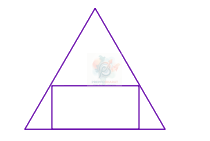
Let $a$ be a real number such that the function $f(x)=a{x}^{2}+6x-15,x\in R$ is increasing in $(-\infty ,\frac{3}{4})$ and decreasing in $(\frac{3}{4},\infty )$. Then the function $g(x)=a{x}^{2}-6x+15,x\in R$ has a
Let $f(x)$ be a cubic polynomial with $f(1)=-10,f(-1)=6,$ and has a local minima at $x=1,$ and ${f}^{'}(x)$ has a local minima at $x=-1.$ Then $f(3)$ is equal to .