Given f:[−1,1]→R, f(x)=ax2+bx+c,f′(x)=2ax+b and f′′(x)=2a
⇒f(−1)=a−b+c=2...(1),
⇒f′(−1)=−2a+b=1...(2) and
f′′(x)=2a
Given the maximum value of f′′(x)=2a=21 ⇒a=41,
From the equations (1) and (2) we get b=23 and c=413.
∴f(x)=4x2+23x+413
We know that, the vertex of the quadratic Ax2+Bx+C is at (−2AB,−4AB2−4AC)
Thus, the vertex of 4x2+23x+413 is at (−3,1), hence both the numbers ±1 are on the same side of the vertex and the graph of f(x) is given below.
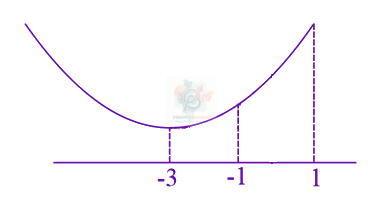
For, x∈[−1,1], we have f(-1)=2&f(1)=5
⇒2≤f(x)≤5
∴ Least value of α is5.