JEE Main 2023 — Calculus
Mathematics Calculus questions from JEE Main 2023.
Other Years
141 Calculus Questions from 2023
$\underset{x\rightarrow 0}{\mathrm{lim}}((\frac{1-{\mathrm{cos}}^{2}(3x)}{{\mathrm{cos}}^{3}(4x)})(\frac{{\mathrm{sin}}^{3}(4x)}{{({\mathrm{log}}_{e}(2x+1))}^{5}}))$ is equal to
The derivative of sin(x²) with respect to x is:
The area of the region given by ${(x,y):xy\leq 8,1\leq y\leq {x}^{2}}$ is :
∫₀¹ x² dx is equal to:
If $\alpha >\beta >0$ are the roots of the equation $a{x}^{2}+bx+1=0$, and $\underset{x\rightarrow \frac{1}{\alpha }}{\mathrm{lim}}{(\frac{1-\mathrm{cos}({x}^{2}+bx+a)}{2(1-\alpha x{)}^{2}})}^{\frac{1}{2}}=\frac{1}{k}(\frac{1}{\beta }-\frac{1}{\alpha })$, then $k$ is equal to
If the total maximum value of the function $f(x)={(\frac{\sqrt{3e}}{2\mathrm{sin}x})}^{{\mathrm{sin}}^{2}x},x\in (0,\frac{\pi }{2}),$ is $\frac{k}{e},$ then ${(\frac{k}{e})}^{8}+\frac{{k}^{8}}{{e}^{5}}+{k}^{8}$ is equal to
The value of the integral ${\int }_{-{\mathrm{log}}_{e}2}^{{\mathrm{log}}_{e}2}{e}^{x}({\mathrm{log}}_{e}({e}^{x}+\sqrt{1+{e}^{2x}}))dx$ is equal to
Let $a\in \mathbb{Z}$ and $[t]$ be the greatest integer $\leq t$, then the number of points, where the function $f(x)=[a+13\mathrm{sin}x],x\in (0,\pi )$ is not differentiable, is $____________$
If the function $f(x)={\begin{matrix}(1+|\mathrm{cos}x|)\frac{\lambda }{|\mathrm{cos}x|}, & 0<x<\frac{\pi }{2} \\ \mu , & x=\frac{\pi }{2} \\ {e}^{\frac{\mathrm{cot}6x}{\mathrm{cot}4x}}, & \frac{\pi }{2}<x<\pi \end{matrix}$is continuous at $x=\frac{\pi }{2}$, then $9\lambda +6{\mathrm{log}}_{c}\mu +{\mu }^{6}-{e}^{6\lambda }$ is equal to
Let $f:(-2,2)\rightarrow \mathbb{R}$ be defined by $f(x)={\begin{matrix}x[x] & , & -2<x<0 \\ (x-1)[x] & , & 0\leq x<2\end{matrix}$ where $[x]$ denotes the greatest integer function. If $m$ and $n$ respectively are the number of points in $(–2,2)$ at which $y=|f(x)|$ is not continuous and not differentiable, then $m+n$ is equal to ________.
If $\phi (x)=\frac{1}{\sqrt{x}}{\int }_{\frac{\pi }{4}}^{x}(4\sqrt{2}\mathrm{sin}t-3{\phi }^{'}(t))dt,x>0$ then ${\phi }^{'}(\frac{\pi }{4})$ is equal to
Let $y=y(x)$ be the solution of the differential equation $({x}^{2}–3{y}^{2})\mathrm{dx}+3\mathrm{xy}\mathrm{dy}=0,y(1)=1$. Then $6{y}^{2}(e)$ is equal to
$\underset{0\leq x\leq \pi }{\mathrm{max}}{x-2\mathrm{sin}x\mathrm{cos}x+\frac{1}{3}\mathrm{sin}3x}=$
Let f be a continuous function satisfying ${\int }_{0}^{{t}^{2}}(f(x)+{x}^{2})\mathrm{dx}=\frac{4}{3}{t}^{3},\forall t>0$ . Then $f(\frac{{\pi }^{2}}{4})$ is equal to
Let $f,g$ and $h$ be the real valued functions defined on $\mathbb{R}$ as $f(x)={\begin{matrix}\frac{x}{|x|}, & x\neq 0 \\ 1, & x=0\end{matrix},g(x)={\begin{matrix}\frac{\mathrm{sin}(x+1)}{(x+1)}, & x\neq -1 \\ 1, & x=-1\end{matrix}$and $h(x)=2[x]-f(x)$, where $[x]$ is the greatest integer $\leq x$. Then the value of $\underset{x\rightarrow 1}{\mathrm{lim}}g(h(x-1))$ is
Let $f(x)={\begin{matrix}{x}^{2}\mathrm{sin}(\frac{1}{x});x\neq 0 \\ 0;x=0\end{matrix}$, then at $x=0$
The number of points, where the curve $y={x}^{5}-20{x}^{3}+50x+2$ crosses the $x$-axis, is _____.
Let the area enclosed by the lines $x+y=2,y=0$, $x=0$ and the curve $f(x)=\mathrm{min}{{x}^{2}+\frac{3}{4},1+[x]}$ where $[x]$ denotes the greatest integer $\leq x$, be $A$. Then the value of $12A$ is
Let$y=y(x)$ be the solution of the differential equation $\frac{dy}{dx}+\frac{5}{x({x}^{5}+1)}y=\frac{{({x}^{5}+1)}^{2}}{{x}^{7}},x>0$. If $y(1)=2$, then $y(2)$ is equal to
Let $f(x)=\int \frac{2x}{({x}^{2}+1)({x}^{2}+3)}dx$. If $f(3)=\frac{1}{2}({\mathrm{log}}_{e}5-{\mathrm{log}}_{e}6)$, then $f(4)$ is equal to
Let $y=y(x)$ be a solution curve of the differential equation, $(1-{x}^{2}{y}^{2})dx=ydx+xdy$, If the line $x=1$ intersects the curve $y=y(x)$ at $y=2$ and the line $x=2$ intersects the curve $y=y(x)$ at $y=\alpha$, then a value of $\alpha$ is
Let $y(x)=(1+x)(1+{x}^{2})(1+{x}^{4})(1+{x}^{8})(1+{x}^{16})$. Then ${y}^{'}-{y}^{"}$ at $x=-1$ is equal to
The area enclosed between the curves ${y}^{2}+4x=4$ and $y-2x=2$ is
If ${\int }_{-0.15}^{0.15}|100{x}^{2}-1|dx=\frac{k}{3000},$ then $k$ is equal to _____.
The value of the integral ${\int }_{-\frac{\pi }{4}}^{\frac{\pi }{4}}\frac{x+\frac{\pi }{4}}{2-\mathrm{cos}2x}dx$ is :
Let $y=y(x)$ be the solution of the differential equation $x{\mathrm{log}}_{e}x\frac{dy}{dx}+y={x}^{2}{\mathrm{log}}_{e}x,(x>1)$. If $y(2)=2$, then $y(e)$ is equal to
The value of the integral ${\int }_{1/2}^{2}\frac{{\mathrm{tan}}^{-1}x}{x}dx$ is equal to
If the area enclosed by the parabolas ${P}_{1}:2y=5{x}^{2}$ and ${P}_{2}:{x}^{2}-y+6=0$ is equal to the area enclosed by ${P}_{1}$ and $y=\alpha x,\alpha >0$, then ${\alpha }^{3}$ is equal to _____ .
If [ $t$ denotes the greatest integer $\leq 1$, then the value of $\frac{3(e-1)}{e}{\int }_{1}^{2}{x}^{2}{e}^{[x]+[{x}^{3}]}dx$ is :
The area of the region $x,y:{x}^{2}\leq y\leq |{x}^{2}-4|,y\geq 1$ is
Let $x=2$ be a root of the equation ${x}^{2}+px+q=0$ and $f(x)={\begin{matrix}\frac{1-\mathrm{cos}({x}^{2}-4px+{q}^{2}+8q+16)}{{(x-2p)}^{4}}, & x\neq 2p \\ 0, & x=2p\end{matrix}$. Then $\underset{x\rightarrow 2{p}^{+}}{\mathrm{lim}}[f(x)]$ where $[\cdot ]$ denotes greatest integer function, is
In the figure, ${\theta }_{1}+{\theta }_{2}=\frac{\pi }{2}$ and $\sqrt{3}(\mathrm{BE})=4(\mathrm{AB})$. If the area of $\Delta \mathrm{CAB}$ is $2\sqrt{3}-3{\mathrm{unit}}^{2}$, when $\frac{{\theta }_{2}}{{\theta }_{1}}$ is the largest, then the perimeter (in unit) of $\Delta \mathrm{CED}$ is equal to 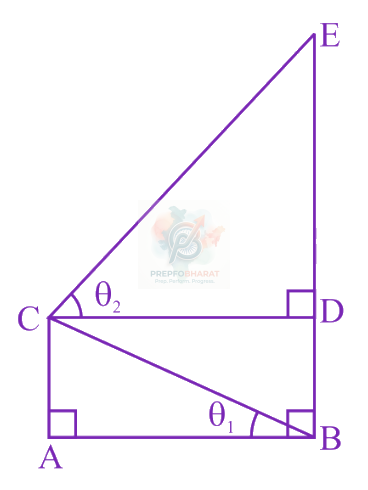
The value of $12{\int }_{0}^{3}|{x}^{2}-3x+2|\mathrm{dx}$ is ______
Let $g(x)=f(x)+f(1-x)$ and ${f}^{"}(x)>0,x\in (0,1)$. If $g$ is decreasing in the interval $(0,\alpha )$ and increasing in the interval $(\alpha ,1)$, then ${\mathrm{tan}}^{-1}2\alpha +{\mathrm{tan}}^{-1}(\frac{1}{\alpha })+{\mathrm{tan}}^{-1}(\frac{\alpha +1}{\alpha })$ is equal to
If ${a}_{\alpha }$ is the greatest term in the sequence ${a}_{n}=\frac{{n}^{3}}{{n}^{4}+147},n=1,2,3....,$ then $\alpha$ is equal to $______$
Let $f(x)=2x+{\mathrm{tan}}^{-1}x$ and $g(x)={\mathrm{log}}_{e}(\sqrt{1+{x}^{2}}+x),x\in [0,3]$. Then
Let $f(x)=|\begin{matrix}1+{\mathrm{sin}}^{2}x & {\mathrm{cos}}^{2}x & \mathrm{sin}2x \\ {\mathrm{sin}}^{2}x & 1+{\mathrm{cos}}^{2}x & \mathrm{sin}2x \\ {\mathrm{sin}}^{2}x & {\mathrm{cos}}^{2}x & 1+\mathrm{sin}2x\end{matrix}|,x\in [\frac{\pi }{6},\frac{\pi }{3}]$ . If $\alpha$ and $\beta$ respectively are the maximum and the minimum values of $f$, then
A square piece of tin of side $30\mathrm{cm}$ is to be made into a box without top by cutting a square from each corner and folding up the flaps to form a box. If the volume of the box is maximum, then its surface area (in ${\mathrm{cm}}^{2}$) is equal to
Let $[x]$ be the greatest integer $\leq x$. Then the number of points in the interval $(–2,1)$ where the function $f(x)=|[x]|+\sqrt{x-[x]}$ is discontinuous, is _____.
The integral $\int ({(\frac{x}{2})}^{x}+{(\frac{2}{x})}^{x}){\mathrm{log}}_{2}xdx$ is equal to
If ${\int }_{0}^{\pi }\frac{{5}^{\mathrm{cos}x}(1+\mathrm{cos}x\mathrm{cos}3x+{\mathrm{cos}}^{2}x+{\mathrm{cos}}^{3}x\mathrm{cos}3x)dx}{1+{5}^{\mathrm{cos}x}}=\frac{k\pi }{16}$, then $k$ is equal to _____ .
If ${\int }_{0}^{1}({x}^{21}+{x}^{14}+{x}^{7}){(2{x}^{14}+3{x}^{7}+6)}^{1/7}dx=\frac{1}{l}{(11)}^{m/n}$ where $l,m,n\in N,m$ and $n$ are co-prime then $l+m+n$ is equal to _____ .
Let a differentiable function $f$ satisfy $f(x)+{\int }_{3}^{x}\frac{f(t)}{t}dt=\sqrt{x+1},x\geq 3$. Then $12f(8)$ is equal to:
The value of $\frac{8}{\pi }{\int }_{0}^{\frac{\pi }{2}}\frac{{(\mathrm{cos}x)}^{2023}}{{(\mathrm{sin}x)}^{2023}+{(\mathrm{cos}x)}^{2023}}dx$ is ______.
Let the function $f(x)=2{x}^{3}+(2p-7){x}^{2}+3(2p-9)x-6$ have a maxima for some value of $x<0$ and a minima for some value of $x>0$. Then, the set of all values of $p$ is
The area of the region enclosed by the curve $y={x}^{3}$ and its tangent at the point $(–1,–1)$ is
The area of the region ${(x,y):{x}^{2}\leq y\leq 8-{x}^{2},y\leq 7}$ is
Let the area of the region ${(x,y):|2x-1|\leq y\leq |{x}^{2}-x|,0\leq x\leq 1}$ be $A$. Then ${(6A+11)}^{2}$ is equal to _____ .
The area of the region $A={(x,y):|\mathrm{cos}x-\mathrm{sin}x|\leq y\leq \mathrm{sin}x,0\leq x\leq \frac{\pi }{2}}$
Let $y={y}_{1}(x)$ and $y={y}_{2}(x)$ be the solution curves the differential equation $\frac{dy}{dx}=y+7$ with initial conditions ${y}_{1}(0)=0$ and ${y}_{2}(0)=1$ respectively. Then the curves $y={y}_{1}(x)$ and $y={y}_{2}(x)$ intersect at
The slope of tangent at any point $(x,y)$ on a curve $y=y(x)$ is $\frac{{x}^{2}+{y}^{2}}{2xy},x>0$. If $y(2)=0$, then a value of $y(8)$ is
Let $f$ be a differentiable function such that ${x}^{2}f(x)-x=4{\int }_{0}^{x}tf(t)dt,f(1)=\frac{2}{3}$. Then $18f(3)$ is equal to
If the solution curve of the differential equation $(y-2{\mathrm{log}}_{e}x)dx+(x{\mathrm{log}}_{e}{x}^{2})dy=0,x>1$ passes through the points $(e,\frac{4}{3})$ and $({e}^{4},\alpha )$, then $\alpha$ is equal to $_______$
If $y=y(x)$ is the solution curve of the differential equation $\frac{dy}{dx}+y\mathrm{tan}x=x\mathrm{sec}x,0\leq x\leq \frac{\pi }{3},y(0)=1$, then $y(\frac{\pi }{6})$ is equal to
Let $y=y(t)$ be a solution of the differential equation $\frac{dy}{dt}+\alpha y=\gamma {e}^{-\beta t}$ Where, $\alpha >0,\beta >0$ and $\gamma >0$. Then ${Lim}_{t\rightarrow \infty }y(t)$
Let $A={(x,y)\in {\mathbb{R}}^{2}:y\geq 0,2x\leq y\leq \sqrt{4-{(x-1)}^{2}}}$ and $B={(x,y)\in \mathbb{R}\times \mathbb{R}:0\leq y\leq \mathrm{min}{2x,\sqrt{4-{(x-1)}^{2}}}}$. Then the ratio of the area of $A$ to the area of $B$ is
Let $y=y(x)$ be a solution of the differential equation $(x\mathrm{cos}x)dy+(xy\mathrm{sin}x+y\mathrm{cos}x-1)dx=0,0<x<\frac{\pi }{2}.$ If $\frac{\pi }{3}y(\frac{\pi }{3})=\sqrt{3},$ then $|\frac{\pi }{6}{y}^{"}(\frac{\pi }{6})+2{y}^{'}(\frac{\pi }{6})|$ is equal to $_______.$
Let the solution curve $y=y(x)$ of the differential equation $\frac{dy}{dx}-\frac{3{x}^{5}{\mathrm{tan}}^{-1}({x}^{3})}{{(1+{x}^{6})}^{\frac{3}{2}}}y=2x$ $\mathrm{exp}\frac{{x}^{3}-{\mathrm{tan}}^{-1}{x}^{3}}{\sqrt{(1+x{)}^{6}}}$ pass through the origin. Then $y(1)$ is equal to:
${\int }_{\frac{3\sqrt{2}}{4}}^{\frac{3\sqrt{3}}{4}}\frac{48}{\sqrt{9-4{x}^{2}}}dx$ is equal to
If the area of the region ${(x,y):|{x}^{2}-2|\leq y\leq x}$ is $A$, then $6A+16\sqrt{2}$ is equal to ______________
If ${\int }_{\frac{1}{3}}^{3}|{\mathrm{log}}_{e}x|\mathrm{dx}=\frac{m}{n}{\mathrm{log}}_{e}(\frac{{n}^{2}}{e})$, where $m$ and $n$ are coprime natural numbers, then ${m}^{2}+{n}^{2}-5$ is equal to _____ .
The set of values of $a$ for which $\underset{x\rightarrow a}{\mathrm{lim}}([x-5]-[2x+2])=0$, where, $[\zeta ]$ denotes the greatest integer less than or equal to $\zeta$ is equal to
The value of $\underset{n\rightarrow \infty }{\mathrm{lim}}\frac{1+2-3+4+5-6+\ldots +(3n-2)+(3n-1)-3n}{\sqrt{2{n}^{4}+4n+3-}\sqrt{{n}^{4}+5n+4}}$ is
Let $f(x)=[{x}^{2}-x]+|-x+[x]|$, where $x\in \mathbb{R}$ and $[t]$ denotes the greatest integer less than or equal to $t$. Then, $f$ is
Let $y=y(x)$ be the solution curve of the differential equation $\frac{dy}{dx}=\frac{y}{x}(1+{x}^{2}(1+{\mathrm{log}}_{e}x))$, $x>0,y(1)=3$. Then $\frac{{y}^{2}(x)}{9}$ is equal to :
If $y=y(x)$ is the solution of the differential equation $\frac{dy}{dx}+\frac{4x}{({x}^{2}-1)}y=\frac{x+2}{{({x}^{2}-1)}^{\frac{5}{2}}},x>1$ such that $y(2)=\frac{2}{9}{\mathrm{log}}_{e}(2+\sqrt{3})$ and $y(\sqrt{2})=\alpha {\mathrm{log}}_{e}(\sqrt{\alpha }+\beta )+\beta -\sqrt{\gamma },\alpha ,\beta ,\gamma \in \mathbb{N}$, then $\alpha \beta \gamma$ is equal to
The value of ${\int }_{\frac{\pi }{3}}^{\frac{\pi }{2}}\frac{(2+3\mathrm{sin}x)}{\mathrm{sin}x(1+\mathrm{cos}x)}dx$ is equal to
Let $f:[2,4]\rightarrow \mathbb{R}$ be a differentiable function such that $(x{\mathrm{log}}_{e}x){f}^{'}(x)+({\mathrm{log}}_{e}x)f(x)+f(x)\geq 1,x\in [2,4]$ with $f(2)=\frac{1}{2}$ and $f(4)=\frac{1}{2}$. Consider the following two statements: (A) $f(x)\leq 1,\text{for all}x\in [2,4]$ (B) $f(x)\geq 1/8,\text{for all}x\in [2,4]$ Then,
If $I(x)=\int {e}^{{\mathrm{sin}}^{2}x}(\mathrm{cos}x\mathrm{sin}2x-\mathrm{sin}x)dx$ and $I(0)=1$, then $I(\frac{\pi }{3})$ is equal to
A wire of length $20m$ is to be cut into two pieces. A piece of length ${\ell }_{1}$ is bent to make a square of area ${A}_{1}$ and the other piece of length ${\ell }_{2}$ is made into a circle of area ${A}_{2}$. If $2{A}_{1}+3{A}_{2}$ is minimum then $(\pi {\ell }_{1}):{\ell }_{2}$ is equal to:
If $\int \sqrt{\mathrm{sec}2x-1}dx=\alpha {\mathrm{log}}_{e}|\mathrm{cos}2x+\beta +\sqrt{\mathrm{cos}2x(1+\mathrm{cos}\frac{1}{\beta }x)}|$ $+$ constant, then $\beta -\alpha$ is equal to ______.
Let $A$ be the area of the region ${(x,y):y\geq {x}^{2},y\geq (1-x{)}^{2},y\leq 2x(1-x)}$. Then $540A$ is equal to
Let $y=f(x)={\mathrm{sin}}^{3}(\frac{\pi }{3}(\mathrm{cos}(\frac{\pi }{3\sqrt{2}}{(-4{x}^{3}+5{x}^{2}+1)}^{\frac{3}{2}})))$. Then, at $x=1$,
Let ${f}_{n}={\int }_{0}^{\frac{\pi }{2}}(\sum _{k=1}^{n}{\mathrm{sin}}^{k-1}x)(\sum _{k=1}^{n}(2k-1){\mathrm{sin}}^{k-1}x)\mathrm{cos}xdx,n\in \mathbb{N}.$ Then ${f}_{21}-{f}_{20}$ is equal to
Suppose f is a function satisfying $f(x+y)=f(x)+f(y)$ for all $x,y\in \mathbb{N}$ and $f(1)=\frac{1}{5}$. If $\sum _{n=1}^{m}\frac{f(n)}{n(n+1)(n+2)}=\frac{1}{12}$ then $m$ is equal to ______.
Let $[t]$ denote the greatest integer function. If ${\int }_{0}^{2.4}[{x}^{2}]dx=\alpha +\beta \sqrt{2}+\gamma \sqrt{3}+\delta \sqrt{5}\text{, then }\alpha +\beta +\gamma +\delta$ is equal to
Let $y=y(x),y>0,$ be a solution curve of the differential equation $(1+{x}^{2})dy=y(x-y)dx$. If $y(0)=1$ and $y(2\sqrt{2})=\beta ,$ then
If $\underset{x\rightarrow 0}{\mathrm{lim}}\frac{{e}^{ax}-\mathrm{cos}(bx)-\frac{cx{e}^{-cx}}{2}}{1-\mathrm{cos}(2x)}=17$, then $5{a}^{2}+{b}^{2}$ is equal to
Let $[x]$ denote the greatest integer function and $f(x)=\mathrm{max}{1+x+[x],2+x,x+2[x]},0\leq x\leq 2$, where $f$ is not continuous and $n$ be the number of points in $(0,2)$, where $f$ is not differentiable. Then ${(m+n)}^{2}+2$ is equal to
The area of the region enclosed by the curve $f(x)=\mathrm{max}{\mathrm{sin}x,\mathrm{cos}x},-\pi \leq x\leq \pi$ and the $x-$axis is
Let $k$ and $m$ be positive real numbers such that the function $f(x)={\begin{matrix}3{x}^{2}+k\sqrt{x+1}, & 0<x<1 \\ m{x}^{2}+{k}^{2}, & x\geq 1\end{matrix}$ is differentiable for all $x>0$. Then $\frac{8{f}^{'}(8)}{{f}^{'}(\frac{1}{8})}$ is equal to
If the area bounded by the curve $2{y}^{2}=3x$, lines $x+y=3,y=0$ and outside the circle ${(x-3)}^{2}+{y}^{2}=2$ is A, then $4(\pi +4A)$ is equal to __________.
Let $\alpha x=\mathrm{exp}({x}^{\beta }{y}^{\gamma })$ be the solution of the differential equation $2{x}^{2}ydy-(1-x{y}^{2})dx=0$, $x>0,y(2)=\sqrt{{\mathrm{log}}_{e}2}$. Then $\alpha +\beta -\gamma$ equals :
$\underset{x\rightarrow \infty }{\mathrm{lim}}\frac{{(\sqrt{3x+1}+\sqrt{3x-1})}^{6}+{(\sqrt{3x+1}-\sqrt{3x-1})}^{6}}{{(x+\sqrt{{x}^{2}-1})}^{6}+{(x-\sqrt{{x}^{2}-1})}^{6}}{x}^{3}$
Let $A$ be the area bounded by the curve $y=x|x-3|$, the $x$-axis and the ordinates $x=-1$ and $x=2$. Then $12A$ is equal to _____ .
For $m,n>0$, let $\alpha (m,n)={\int }_{0}^{2}{t}^{m}{(1+3t)}^{n}dt$. If ,$11\alpha (10,6)+18\alpha (11,5)=p{(14)}^{6}$, then $p$ is equal to
Let $f$ be a differentiable function defined on $[0,\frac{\pi }{2}]$ such that $f(x)>0$ and $f(x)+{\int }_{0}^{x}f(t)\sqrt{1-{({\mathrm{log}}_{e}(f(t)))}^{2}}dt=e$ $\forall x\in [0,\frac{\pi }{2}]$, then ${{6{\mathrm{log}}_{e}(f(\frac{\pi }{6}))}}^{2}$ is equal to
Let $f(x)=\frac{x}{{(1+{x}^{n})}^{\frac{1}{n}}},x\in \mathbb{R}-{-1},n\in \mathbb{N},n>2$. If ${f}^{n}(x)=(fofof....$ upto $n$ times) $(x)$, then $\underset{n\rightarrow \infty }{\mathrm{lim}}{\int }_{0}^{1}{x}^{n-2}({f}^{n}(x))dx$ is equal to
Let the tangent at any point $P$ on a curve passing through the points $(1,1)$ and $(\frac{1}{10},100)$, intersect positive $x$-axis and $y$-axis at the points $A$ and $B$ respectively. If $PA:PB=1:k$ and $y=y(x)$ is the solution of the differential equation ${e}^{\frac{dy}{dx}}=kx+\frac{k}{2},y(0)=k$, then $4y(1)-5{\mathrm{log}}_{e}3$ is equal to _______________
Let $\alpha >0$. If ${\int }_{0}^{\alpha }\frac{x}{\sqrt{x+\alpha }-\sqrt{x}}dx=\frac{16+20\sqrt{2}}{15}$ then $\alpha$ is equal to :
Let $[t]$ denote the greatest integer $\leq t$. Then $\frac{2}{\pi }{\int }_{\frac{\pi }{6}}^{\frac{5\pi }{6}}(8[\mathrm{cosec}x]-5[\mathrm{cot}x])dx$ is equal to $_______$
Let $y=f(x)$ be the solution of the differential equation $y(x+1)dx-{x}^{2}dy=0,y(1)=e$. Then $\underset{x\rightarrow {0}^{+}}{\mathrm{lim}}f(x)$ is equal to
The minimum value of the function $f(x)={\int }_{0}^{2}{e}^{|x-t|}dt$ is
If the solution curve $f(x,y)=0$ of the differential equation $(1+{\mathrm{log}}_{e}x)\frac{dx}{dy}-x{\mathrm{log}}_{e}x={e}^{y},x>0,$ passes through the points $(1,0)$ and $(a,2)$, then ${a}^{a}$ is equal to
The value of $\frac{{e}^{-\frac{\pi }{4}}+{\int }_{0}^{\frac{\pi }{4}}{e}^{-x}\mathrm{tan}{}^{50}xdx}{{\int }_{0}^{\frac{\pi }{4}}{e}^{-x}({\mathrm{tan}}^{49}x+{\mathrm{tan}}^{51}x)dx}$
Let $f$ and $g$ be twice differentiable functions on $R$ such that ${f}^{"}(x)={g}^{"}(x)+6x$ ${f}^{'}(1)=4{g}^{'}(1)-3=9$ $f(2)=3g(2)=12$ Then which of the following is NOT true ?
The absolute minimum value, of the function $f(x)=|{x}^{2}-x+1|+[{x}^{2}-x+1]$, where $[t]$ denotes the greatest integer function, in the interval $[-1,2]$, is
For $\alpha ,\beta ,\gamma ,\delta \in \mathbb{N}$, if $\int ({(\frac{x}{e})}^{2x}+{(\frac{e}{x})}^{2x}){\mathrm{log}}_{e}xdx=\frac{1}{\alpha }{(\frac{x}{e})}^{\beta x}-\frac{1}{\gamma }{(\frac{e}{x})}^{\delta x}+C$, where $e=\sum _{n=0}^{\infty }\frac{1}{n!}$ and $C$ is constant of integration, then $\alpha +2\beta +3\gamma -4\delta$ is equal to
The solution of the differential equation $\frac{dy}{dx}=-(\frac{{x}^{2}+3{y}^{2}}{3{x}^{2}+{y}^{2}}),y(1)=0$ is
Let $f$ and $g$ be two functions defined by $f(x)={\begin{matrix}x+1,x<0 \\ |x-1|,x\geq 0\end{matrix}$and $g(x)={\begin{matrix}x+1,x<0 \\ 1,x\geq 0\end{matrix}$.Then $(gof)(x)$ is
${\int }_{0}^{\infty }\frac{6}{{e}^{3x}+6{e}^{2x}+11{e}^{x}+6}dx=$
If $f(x)={x}^{2}+{g}^{'}(1)x+{g}^{"}(2)$ and $g(x)=f(1){x}^{2}+x{f}^{'}(x)+{f}^{"}(x)$, then the value of $f(4)-g(4)$ is equal to _____ .
If the area of the region $S={(x,y):2y-{y}^{2}\leq {x}^{2}\leq 2y,x\geq y}$ is equal to $\frac{n+2}{n+1}-\frac{\pi }{n-1},$ then the natural number $n$ is equal to $_______$
The value of the integral ${\int }_{1}^{2}(\frac{{t}^{4}+1}{{t}^{6}+1})dt$ is :
Let $f(x)=x+\frac{a}{{\pi }^{2}-4}\mathrm{sin}x+\frac{b}{{\pi }^{2}-4}\mathrm{cos}x$, $x\in \mathbb{R}$ be a function which satisfies $f(x)=x+{\int }_{0}^{\pi /2}\mathrm{sin}(x+y)f(y)dy$. Then $(a+b)$ is equal to
The integral $16{\int }_{1}^{2}\frac{dx}{{x}^{3}{({x}^{2}+2)}^{2}}$ is equal to
Let $T$ and $C$ respectively, be the transverse and conjugate axes of the hyperbola $16{x}^{2}-{y}^{2}+64x+4y+44=0$. Then the area of the region above the parabola ${x}^{2}=y+4$, below the transverse axis $T$ and on the right of the conjugate axis $C$ is:
Area of the region ${(x,y):{x}^{2}+{(y-2)}^{2}\leq 4,{x}^{2}\geq 2y}$ is
Let $\alpha$ be the area of the larger region bounded by the curve ${y}^{2}=8x$ and the lines $y=x$ and $x=2$, which lies in the first quadrant. Then the value of $3\alpha$ is equal to
Let $x=x(y)$ be the solution of the differential equation $2(y+2){\mathrm{log}}_{e}(y+2)dx+(x+4-2{\mathrm{log}}_{e}(y+2))dy=0$, $y>-1$ with $x({e}^{4}-2)=1$. Then $x({e}^{9}-2)$ is equal to
The set of all $a\in \mathbb{R}$ for which the equation $x|x-1|+|x+2|+a=0$ has exactly one real root, is
Let $f(x)=\frac{\mathrm{sin}x+\mathrm{cos}-\sqrt{2}}{\mathrm{sin}x-\mathrm{cos}x},x\in [0,\pi ]-{\frac{\pi }{4}}$, then $f(\frac{7\pi }{12}){f}^{"}(\frac{7\pi }{12})$ is equal to
$\underset{n\rightarrow \infty }{\mathrm{lim}}{({2}^{\frac{1}{2}}-{2}^{\frac{1}{3}})({2}^{\frac{1}{2}}-{2}^{\frac{1}{5}})....({2}^{\frac{1}{2}}-{2}^{\frac{1}{2n+1}})}$ is equal to
Let $f(x)=\int \frac{dx}{(3+4{x}^{2})\sqrt{4-3{x}^{2}}},|x|<\frac{2}{\sqrt{3}}$. If $f(0)=0$ and $f(1)=\frac{1}{\alpha \beta }{\mathrm{tan}}^{-1}(\frac{\alpha }{\beta }),\alpha ,\beta >0$, then ${\alpha }^{2}+{\beta }^{2}$ is equal to _______.
Let $f(x)$ be a function satisfying $f(x)+f(\pi -x)={\pi }^{2},\forall x\in \mathbb{R}$. Then ${\int }_{0}^{\pi }f(x)\mathrm{sin}xdx$ is equal to
If $A$ is the area in the first quadrant enclosed by the curve $C:2{x}^{2}-y+1=0$, the tangent to $C$ at the point $(1,3)$ and the line $x+y=1$, then the value of $60A$ is................
Let the function $f:[0,2]\rightarrow \mathbb{R}$ be defined as $f(x)={\begin{matrix}{e}^{\mathrm{min}{{x}^{2},x-[x]}}, & x\in [0,1) \\ {e}^{[x-{\mathrm{log}}_{e}x]}, & x\in [1,2]\end{matrix}$, where $[t]$ denotes the greatest integer less than or equal to $t$. Then the value of the integral ${\int }_{0}^{2}xf(x)dx$ is
If the area of the region bounded by the curves ${y}^{2}-2y=-x$ and $x+y=0$ is $A$, then $8A=$
Let $I(x)=\int \sqrt{\frac{x+7}{x}}dx$ and $I(9)=12+7{\mathrm{log}}_{e}7$. If $I(1)=\alpha +7{\mathrm{log}}_{e}(1+2\sqrt{2}),$ then ${\alpha }^{4}$ is equal to _____.
Let $q$ be the maximum integral value of $p$ in $[0,10]$ for which the roots of the equation ${x}^{2}-px+\frac{5}{4}p=0$ are rational. Then the area of the region ${(x,y):0\leq y\leq (x-q{)}^{2},0\leq x\leq q}$ is
$\underset{x\rightarrow 0}{\mathrm{lim}}\frac{48}{{x}^{4}}{\int }_{0}^{x}\frac{{t}^{3}}{{t}^{6}+1}dt$ is equal to
The area bounded by the curves $y=|x-1|+|x-2|$ and $y=3$ is equal to
The area enclosed by the closed curve $C$ given by the differential equation $\frac{dy}{dx}+\frac{x+a}{y-2}=0,y(1)=0$ is $4\pi$. Let $P$ and $Q$ be the points of intersection of the curve $C$ and the $y$-axis. If normals at $P$ and $Q$ on the curve $C$ intersect $x$-axis at points $R$ and $S$ respectively, then the length of the line segment $RS$ is
Let $I(x)=\int \frac{x+1}{x{(1+x{e}^{x})}^{2}}dx,x>0.$ If $\underset{x\rightarrow \infty }{\mathrm{lim}}I(x)=0$ then $I(1)$ is equal to
If $y(x)={x}^{x},x>0$, then ${y}^{"}(2)-2{y}^{'}(2)$ is equal to :
Let [x] denote the greatest integer $\leq x$. Consider the function $f(x)=\mathrm{max}{{x}^{2},1+[x]}$. Then the value of the integral ${\int }_{0}^{2}f(x)dx$ is :
Let $\Delta$ be the area of the region ${(x,y)\in {\mathbb{R}}^{2}:{x}^{2}+{y}^{2}\leq 21,{y}^{2}\leq 4x,x\geq 1}$. Then $\frac{1}{2}(\Delta -21{\mathrm{sin}}^{-1}\frac{2}{\sqrt{7}})$ is equal to
Let the solution curve $x=x(y),0<y<\frac{\pi }{2}$, of the differential equation ${({\mathrm{log}}_{e}(\mathrm{cos}y))}^{2}\mathrm{cos}ydx-(1+3x{\mathrm{log}}_{e}(\mathrm{cos}y))\mathrm{sin}ydy=0$ satisfy $x(\frac{\pi }{3})=\frac{1}{2{\mathrm{log}}_{e}2}$. If $x(\frac{\pi }{6})=\frac{1}{{\mathrm{log}}_{e}m-{\mathrm{log}}_{e}n}$, where $m$ and $n$ are coprime, then $mn$ is equal to
If $2{x}^{y}+3{y}^{x}=20,$ then $\frac{dy}{dx}$ at $(2,2)$ is equal to:
$\underset{t\rightarrow 0}{\mathrm{lim}}{({1}^{\frac{1}{{\mathrm{sin}}^{2}t}}+{2}^{\frac{1}{{\mathrm{sin}}^{2}t}}+{3}^{\frac{1}{{\mathrm{sin}}^{2}t}}......{n}^{\frac{1}{{\mathrm{sin}}^{2}t}})}^{{\mathrm{sin}}^{2}t}$ is equal to
If the functions $f(x)=\frac{{x}^{3}}{3}+2bx+\frac{a{x}^{2}}{2}$ and $g(x)=\frac{{x}^{3}}{3}+ax+b{x}^{2},a\neq 2b$ have a common extreme point, then $a+2b+7$ is equal to
The sum of the abosolute maximum and minimum values of the function $f(x)=|{x}^{2}-5x+6|-3x+2$ in the interval $[-1,3]$ is equal to :
Let $x=2$ be a local minima of the function $f(x)=2{x}^{4}-18{x}^{2}+8x+12,x\in (-4,4)$. If $M$ is local maximum value of the function $f$ in $(-4,4)$, then $M=$
If ${\int }_{0}^{1}\frac{1}{(5+2x-2{x}^{2})(1+{e}^{(2-4x)})}dx=\frac{1}{\alpha }{\mathrm{log}}_{e}(\frac{\alpha +1}{\beta }),\alpha ,\beta >0$, then ${\alpha }^{4}-{\beta }^{4}$ is equal to
Let $y=p(x)$ be the parabola passing through the points $(–1,0),(0,1)$ and $(1,0)$. If the area of the region ${(x,y):{(x+1)}^{2}+{(y-1)}^{2}\leq 1,y\leq p(x)}$ is $A$, then $12(\pi -4A)$ is equal to ________ .
Let for $x\in R$, $f(x)=\frac{x+|x|}{2}$ and $g(x)={\begin{matrix}x, \\ {x}^{2},\end{matrix}\begin{matrix}x<0 \\ x\geq 0\end{matrix}$. Then area bounded by the curve $y=(fog)(x)$ and the lines $y=0,2y-x=15$ is equal to _____ .
Let $\alpha \in (0,1)$ and $\beta ={\mathrm{log}}_{e}(1-\alpha )$. Let ${P}_{n}(x)=x+\frac{{x}^{2}}{2}+\frac{{x}^{3}}{3}+\ldots .+\frac{{x}^{n}}{n},x\in (0,1)$. Then the integral ${\int }_{0}^{\alpha }\frac{{t}^{50}}{1-t}dt$ is equal to
If $f:\mathbb{R}\rightarrow \mathbb{R}$ be a continuous function satisfying ${\int }_{0}^{\frac{\pi }{2}}f(\mathrm{sin}2x)\mathrm{sin}xdx+\alpha {\int }_{0}^{\frac{\pi }{4}}f(\mathrm{cos}2x)\mathrm{cos}xdx=0$, then the value of $\alpha$ is
Let $y=y(x)$ be the solution of the differential equation ${x}^{3}dy+(xy–1)dx=0,x>0,$ $y(\frac{1}{2})=3-e$. Then $y(1)$ is equal to
Let $y=y(x)$ be the solution of the differential equation $(3{y}^{2}-5{x}^{2})ydx+2x({x}^{2}-{y}^{2})dy=0$ such that $y(1)=1$. Then $|(y(2){)}^{3}-12y(2)|$ is equal to :
Let $I(x)=\int \frac{{x}^{2}(x{\mathrm{sec}}^{2}+\mathrm{tan}x)}{(x\mathrm{tan}x+1{)}^{2}}dx$ If $I(0)=0,$ then $I(\frac{\pi }{4})$ is equal to