JEE Main 2022 — Calculus
Mathematics Calculus questions from JEE Main 2022.
Other Years
168 Calculus Questions from 2022
∫ eˣ dx is equal to:
The maximum value of sin x + cos x is:
$\underset{x\rightarrow \frac{\pi }{2}}{\mathrm{lim}}({\mathrm{tan}}^{2}x({(2{\mathrm{sin}}^{2}x+3\mathrm{sin}x+4)}^{\frac{1}{2}}-{({\mathrm{sin}}^{2}x+6\mathrm{sin}x+2)}^{\frac{1}{2}}))$ is equal to
The function $f:R\rightarrow R$ defined by $f(x)=\underset{n\rightarrow \infty }{\mathrm{lim}}\frac{\mathrm{cos}(2\pi x)-{x}^{2n}\mathrm{sin}(x-1)}{1+{x}^{2n+1}-{x}^{2n}}$ is continuous for all $x$ in
Let $f(x)={\begin{matrix}|4{x}^{2}-8x+5|, & \mathrm{if}8{x}^{2}-6x+1\geq 0 \\ [4{x}^{2}-8x+5], & \mathrm{if}8{x}^{2}-6x+1<0\end{matrix}$, where $[\alpha ]$ denotes the greatest integer less than or equal to $\alpha$. Then the number of points in $R$ where $f$ is not differentiable is _____ .
$f,g:R\rightarrow R$ be two real valued function defined as $f(x)={\begin{matrix}-|x+3| & , & x<0 \\ {e}^{x} & , & x\geq 0\end{matrix}$ and $g(x)={\begin{matrix}{x}^{2}+{k}_{1}x & , & x<0 \\ 4x+{k}_{2} & , & x\geq 0\end{matrix}$, where ${k}_{1}$ and ${k}_{2}$ are real constants. If $gof$ is differentiable at $x=0$, then $gof(-4)+$$gof(4)$ is equal to
If the solution curve of the differential equation $\frac{dy}{dx}=\frac{x+y-2}{x-y}$ passes through the point $(2,1)$ and $(k+1,2),k>0$, then
If ${b}_{n}={\int }_{0}^{\frac{\pi }{2}}\frac{{\mathrm{cos}}^{2}nx}{\mathrm{sin}x}dx,n\in \mathbb{N}$, then
Let ${A}_{1}={(x,y):|x|\leq {y}^{2},|x|+2y\leq 8}$ and ${A}_{2}={(x,y):|x|+|y|\leq k}.$ If $27$ (Area ${A}_{1}$) $=5$(Area ${A}_{2}$), then $k$ is equal to
The area enclosed by the curves $y={\mathrm{log}}_{e}(x+{e}^{2}),x={\mathrm{log}}_{e}(\frac{2}{y})$ and $x={\mathrm{log}}_{e}2$, above the line $y=1$ is
Let $y=y(x)$ be the solution of the differential equation $x(1-{x}^{2})\frac{dy}{dx}+(3{x}^{2}y-y-4{x}^{3})=0,x>1$ with $y(2)=-2$. Then $y(3)$ is equal to
Let $f(x)=[2{x}^{2}+1]$ and $g(x)={\begin{matrix}2x-3, & x<0 \\ 2x+3, & x\geq 0\end{matrix}$, where $[t]$ is the greatest integer $\leq t$. Then, in the open interval $(-1,1)$, the number of points where fog is discontinuous is equal to ______.
The number of distinct real roots of ${x}^{4}-4x+1=0$ is
$\underset{x\rightarrow 0}{\mathrm{lim}}\frac{\mathrm{cos}(\mathrm{sin}x)-\mathrm{cos}x}{{x}^{4}}$ is equal to
Let the function $f(x)={\begin{matrix}\frac{{\mathrm{log}}_{e}(1+5x)-{\mathrm{log}}_{e}(1+\alpha x)}{x} & \mathrm{if}x\neq 0 \\ 10 & \mathrm{if}x=0\end{matrix}$ be continuous at $x=0$. Then $\alpha$ is equal to
If the maximum value of $a$, for which the function ${f}_{a}(x)={\mathrm{tan}}^{-1}2x-3ax+7$ is non-decreasing in $(-\frac{\pi }{6},\frac{\pi }{6})$, is $\bar{a}$, then ${f}_{\bar{a}}(\frac{\pi }{8})$ is equal to
If the solution curve $y=y(x)$ of the differential equation ${y}^{2}dx+({x}^{2}-xy+{y}^{2})dy=0$, which passes through the point $(1,1)$ and intersects the line $y=\sqrt{3}x$ at the point $(\alpha ,\sqrt{3}\alpha )$, then value of ${\mathrm{log}}_{e}(\sqrt{3}\alpha )$ is equal to
If $\int \frac{1}{x}\sqrt{\frac{1-x}{1+x}}dx=g(x)+c,g(1)=0$, then $g(\frac{1}{2})$ is equal to
Let $[t]$ denote the greatest integer $\leq t$ and ${t}$ denote the fractional part of $t$. Then integral value of $\alpha$ for which the left hand limit of the function $f(x)=[1+x]+\frac{{\alpha }^{2[x]+{x}}+[x]-1}{2[x]+{x}}$ at $x=0$ is equal to $\alpha -\frac{4}{3}$ is _____
If $f(\theta )=\mathrm{sin}\theta +{\int }_{-\frac{\pi }{2}}^{\frac{\pi }{2}}(\mathrm{sin}\theta +t\mathrm{cos}\theta )\cdot f(t)dt$, then $|{\int }_{0}^{\frac{\pi }{2}}f(\theta )d\theta |$ is
If $\underset{x\rightarrow 1}{\mathrm{lim}}(\frac{\mathrm{sin}(3{x}^{2}-4x+1)-{x}^{2}+1}{2{x}^{3}-7{x}^{2}+ax+b})=-2$, then the value of $(a-b)$ is equal to
Let $a$ be an integer such that $\underset{x\rightarrow 7}{\mathrm{lim}}\frac{18-[1-x]}{[x-3a]}$ exists, where $[t]$ is greatest integer $\leq t$. Then $a$ is equal to
Let $\underset{0\leqslant x\leqslant 2}{Max}{\frac{9-{x}^{2}}{5-x}}=\alpha$ and $\underset{0\leqslant x\leqslant 2}{\mathrm{Min}}{\frac{9-{x}^{2}}{5-x}}=\beta$. If ${\int }_{\beta -\frac{8}{3}}^{2\alpha -1}Max{\frac{9-{x}^{2}}{5-x},x}dx={\alpha }_{1}+{\alpha }_{2}{\mathrm{log}}_{e}(\frac{8}{15})$, then ${\alpha }_{1}+{\alpha }_{2}$ is equal to ______
Let the slope of the tangent to a curve $y=f(x)$ at $(x,y)$ be given by $2\mathrm{tan}x(\mathrm{cos}x-y)$. if the curve passes through the point $(\frac{\pi }{4},0)$, then the value of ${\int }_{0}^{\frac{\pi }{2}}ydx$ is equal to
The slope of the tangent to a curve $C:y=y(x)$ at any point $[x,y)$ on it is $\frac{2{e}^{2x}-6{e}^{-x}+9}{2+9{e}^{-2x}}$. If $C$ passes through the points $(0,\frac{1}{2}+\frac{\pi }{2\sqrt{2}})$ and $(\alpha ,\frac{1}{2}{e}^{2\alpha })$ then ${e}^{\alpha }$ is equal to
The area of the region enclosed between the parabolas ${y}^{2}=2x-1$ and ${y}^{2}=4x-3$ is.
If $f(\alpha )={\int }_{1}^{\alpha }\frac{{\mathrm{log}}_{10}t}{1+t}dt,\alpha >0$, then $f({e}^{3})+f({e}^{-3})$ is equal to
Let the solution curve $y=y(x)$ of the differential equation $(1+{e}^{2x})(\frac{dy}{dx}+y)=1$ pass through the point $(0,\frac{\pi }{2})$. Then, $\underset{x\rightarrow \infty }{\mathrm{lim}}{e}^{x}y(x)$ is equal to
The number of points, where the function $f:R\rightarrow R,f(x)=|x-1|\mathrm{cos}|x-2|\mathrm{sin}|x-1|+(x-3)|{x}^{2}-5x+4|$, is NOT differentiable, is
Let $f:R\rightarrow R$ be a function defined by : $f(x)={\begin{matrix}\underset{t\leq x}{\mathrm{max}}{{t}^{3}-3t}; & x\leq 2 \\ {x}^{2}+2x-6; & 2<x<3 \\ [x-3]+9; & 3\leq x\leq 5 \\ 2x+1; & x>5\end{matrix}$ Where $[t]$ is the greatest integer less than or equal to $t$. Let $m$ be the number of points where $f$ is not differentiable and $I={\int }_{-2}^{2}f(x)dx$. Then the ordered pair $(m,I)$ is equal to
Let $f:\mathbb{R}\rightarrow \mathbb{R}$ be defined as $f(x)=[\begin{matrix}[{e}^{x}], & x<0 \\ a{e}^{x}+[x-1], & 0\leq x<1 \\ b+[\mathrm{sin}(\pi x)], & 1\leq x<2 \\ [{e}^{-x}]-c, & x\geq 2\end{matrix}$ where $a,b,c\in \mathbb{R}$ and $[t]$ denotes greatest integer less than or equal to $t$. Then, which of the following statements is true?
If $y={\mathrm{tan}}^{-1}(\mathrm{sec}{x}^{3}-\mathrm{tan}{x}^{3}),\frac{\pi }{2}<{x}^{3}<\frac{3\pi }{2}$, then
Let the function $f(x)=2{x}^{2}-{\mathrm{log}}_{e}x,x>0$, be decreasing in $(0,a)$ and increasing in $(a,4)$. A tangent to the parabola ${y}^{2}=4ax$ at a point $P$ on it passes through the point $(8a,8a-1)$ but does not pass through the point $(-\frac{1}{a},0)$. If the equation of the normal at $P$ is $\frac{x}{\alpha }+\frac{y}{\beta }=1$, then $\alpha +\beta$ is equal to
Let $f:R\rightarrow R$ be a function defined by $f(x)={(x-3)}^{{n}_{1}}{(x-5)}^{{n}_{2}},{n}_{1},{n}_{2}\in N$. The, which of the following is NOT true?
The curve $y(x)=a{x}^{3}+b{x}^{2}+cx+5$ touches the $x$-axis at the point $P(-2,0)$ and cuts the $y$-axis at the point $\mathrm{Q}$, where ${y}^{'}$ is equal to $3$. Then the local maximum value of $y(x)$ is
If the sum of all the roots of the equation ${e}^{2x}-11{e}^{x}-45{e}^{-x}+\frac{81}{2}=0$ is ${\mathrm{log}}_{e}P$, then $P$ is equal to _____.
Let $f:R\rightarrow R$ and $g:R\rightarrow R$ be two functions defined by $f(x)={\mathrm{log}}_{e}({x}^{2}+1)-{e}^{-x}+1$ and $g(x)=\frac{1-2{e}^{2x}}{{e}^{x}}\cdot$ Then, for which of the following range of $\alpha$, the inequality $f(g(\frac{{(\alpha -1)}^{2}}{3}))>f(g(\alpha -\frac{5}{3}))$ holds?
For the function $f(x)=4{\mathrm{log}}_{e}(x-1)-2{x}^{2}+4x+5,x>1$, which one of the following is NOT correct?
If $y=y(x)$ is the solution of the differential equation $x\frac{dy}{dx}+2y=x{e}^{x},y(1)=0$ then the local maximum value of the function $z(x)={x}^{2}y(x)-{e}^{x},x\in R$ is
The slope of normal at any point $(x,y),x>0,y>0$ on the curve $y=y(x)$ is given by $\frac{{x}^{2}}{xy-{x}^{2}{y}^{2}-1}$. If the curve passes through the point $(1,1)$, then $e\cdot y(e)$ is equal to
The integral $\int \frac{(1-\frac{1}{\sqrt{3}})(\mathrm{cos}x-\mathrm{sin}x)}{(1+\frac{2}{\sqrt{3}}\mathrm{sin}2x)}dx$ is equal to
Let $g:(0,\infty )\rightarrow R$ be a differentiable function such that $\int (\frac{x(\mathrm{cos}x-\mathrm{sin}x)}{{e}^{x}+1}+\frac{g(x)({e}^{x}+1-x{e}^{x})}{{({e}^{x}+1)}^{2}})dx=\frac{xg(x)}{{e}^{x}+1}+C$, for all $x>0$, where $C$ is an arbitrary constant. Then
The odd natural number a, such that the area of the region bounded by $y=1,y=3,x=0,x={y}^{a}$ is $\frac{364}{3}$, equal to:
$I={\int }_{\frac{\pi }{4}}^{\frac{\pi }{3}}(\frac{8\mathrm{sin}x-\mathrm{sin}2x}{x})dx$. Then
Let $f(x)=\mathrm{min}{[x-1],[x-2],\ldots ,[x-10]}$ where $[t]$ denotes the greatest integer $\leq t$. Then ${\int }_{0}^{10}f(x)dx+{\int }_{0}^{10}{(f(x))}^{2}dx+{\int }_{0}^{10}|f(x)|dx$ is equal _______. to
If ${\int }_{0}^{2}(\sqrt{2x}-\sqrt{2x-{x}^{2}})dx=$ ${\int }_{0}^{1}(1-\sqrt{1-{y}^{2}}-\frac{{y}^{2}}{2})dy+{\int }_{1}^{2}(2-\frac{{y}^{2}}{2})dy+I$, then $I$ equal to
The value of the integral $\frac{48}{{\pi }^{4}}{\int }_{0}^{\pi }(\frac{3\pi {x}^{2}}{2}-{x}^{3})\frac{\mathrm{sin}x}{1+{\mathrm{cos}}^{2}x}dx$ is equal to ______.
The area of the region given by $A={(x,y):{x}^{2}\leq y\leq \mathrm{min}{x+2,4-3x}}$ is
The area bounded by the curve $y=|{x}^{2}-9|$ and the line $y=3$ is
Let $f:[0,1]\rightarrow R$ be a twice differentiable function in $(0,1)$ such that $f(0)=3$ and $f(1)=5$. If the line $y=2x+3$ intersects the graph of $f$ at only two distinct points in $(0,1)$, then the least number of points $x\in (0,1)$, at which ${f}^{''}(x)=0$, is
The area of the bounded region enclosed by the curve $y=3-|x-\frac{1}{2}|-|x+1|$ and the $x$-axis is
Let $y=y(x)$ be the solution curve of the differential equation $\frac{dy}{dx}+(\frac{2{x}^{2}+11x+13}{{x}^{3}+6{x}^{2}+11x+6})y=\frac{(x+3)}{x+1},x>-1$, which passes through the point $(0,1)$. Then $y(1)$ is equal to
If $\frac{dy}{dx}+2y\mathrm{tan}x=\mathrm{sin}x,0<x<\frac{\pi }{2}$ and $y(\frac{\pi }{3})=0$, then the maximum value of $y(x)$ is
Let $y=y(x)$ be the solution of the differential equation $\frac{dy}{dx}=\frac{4{y}^{3}+2y{x}^{2}}{3x{y}^{2}+{x}^{3}},y(1)=1$. If for some $n\in N,y(2)\in [n-1,n)$, then $n$ is equal to _______.
Let the solution curve of the differential equation $x\frac{dy}{dx}-y=\sqrt{{y}^{2}+16{x}^{2}},y(1)=3$ be $y=y(x)$. Then $y(2)$ is equal to
If $y=y(x)$ is the solution of the differential equation $(1+{e}^{2x})\frac{dy}{dx}+2(1+{y}^{2}){e}^{x}=0$ and $y(0)=0$, then $6(y'(0)+{(y({\mathrm{log}}_{c}\sqrt{3}))}^{2})$ is equal to:
Let $y=y(x)$ be the solution of the differential equation $\frac{dy}{dx}+\frac{\sqrt{2}y}{2{\mathrm{cos}}^{4}x-\mathrm{cos}2x}=x{e}^{{\mathrm{tan}}^{-1}(\sqrt{2}\mathrm{cot}2x)},0<x<\frac{\pi }{2}$ with $y(\frac{\pi }{4})=\frac{{\pi }^{2}}{32}$. If $y(\frac{\pi }{3})=\frac{{\pi }^{2}}{18}{e}^{-{\mathrm{tan}}^{-1}(\alpha )}$, then the value of $3{\alpha }^{2}$ is equal to ______.
Let $y=y(x)$ be the solution of the differential equation $(1-{x}^{2})dy=(xy+({x}^{3}+2)\sqrt{1-{x}^{2}})dx,-1<x<1$ and $y(0)=0$. If ${\int }_{-\frac{1}{2}}^{\frac{1}{2}}\sqrt{1-{x}^{2}}y(x)dx=k$ then ${k}^{-1}$ is equal to
Let the solution curve $y=y(x)$ of the differential equation $(4+{x}^{2})dy-2x({x}^{2}+3y+4)dx=0$ pass through the origin. Then $y(2)$ is equal to _____.
Let $y=y(x)$ be the solution of the differential equation $(x+1){y}^{'}-y={e}^{3x}{(x+1)}^{2}$, with $y(0)=\frac{1}{3}$. Then, the point $x=-\frac{4}{3}$ for the curve $y=y(x)$ is
Let ${a}_{n}={\int }_{-1}^{n}(1+\frac{x}{2}+\frac{{x}^{2}}{3}+\ldots +\frac{{x}^{n-1}}{n})dx$ for every $n\in N$. Then the sum of all the elements of the set ${n\in N:{a}_{n}\in (2,30)}$ is _________.
Let $y=y(x)$ be the solution curve of the differential equation $\frac{dy}{dx}+\frac{1}{{x}^{2}-1}y={(\frac{x-1}{x+1})}^{\frac{1}{2}}$, $x>1$ passing through the point $(2,\sqrt{\frac{1}{3}})$. Then $\sqrt{7}y(8)$ is equal to
${\int }_{0}^{2}(|2{x}^{2}-3x|+[x-\frac{1}{2}])dx$, where $[t]$ is the greatest integer function, is equal to
Let $y={y}_{1}(x)$ and $y={y}_{2}(x)$ be two distinct solutions of the differential equation $\frac{dy}{dx}=x+y$, with ${y}_{1}(0)=0$ and ${y}_{2}(0)=1$ respectively. Then, the number of points of intersection of $y={y}_{1}(x)$ and $y={y}_{2}(x)$ is
Let $f(x)=\mathrm{min}{1,1+x\mathrm{sin}x},0\leq x\leq 2\pi$. If $m$ is the number of points, where $f$ is not differentiable and $n$ is the number of points, where $f$ is not continuous, then the ordered pair $(m,n)$ is equal to
Let $f$ be a differentiable function in $(0,\frac{\pi }{2})$. If ${\int }_{\mathrm{cos}x}^{1}{t}^{2}f(t)dt={\mathrm{sin}}^{3}x+\mathrm{cos}x$, then $\frac{1}{\sqrt{3}}{f}^{'}(\frac{1}{\sqrt{3}})$ is equal to
Let $f$ be a twice differentiable function on $R$. If ${f}^{'}(0)=4$ and $f(x)+{\int }_{0}^{x}(x-t){f}^{'}(t)dt$ $=({e}^{2x}+{e}^{-2x})\mathrm{cos}2x+\frac{2}{a}x$, then ${(2a+1)}^{5}{a}^{2}$ is equal to _______.
The area enclosed by ${y}^{2}=8x$ and $y=\sqrt{2}x$ that lies outside the triangle formed by $y=\sqrt{2}x,x=1,y=2\sqrt{2}$, is equal to
Suppose $y=y(x)$ be the solution curve to the differential equation $\frac{dy}{dx}-y=2-{e}^{-x}$ such that $\underset{x\rightarrow \infty }{\mathrm{lim}}y(x)$ is finite. If $a$ and $b$ are respectively the $x-$ and $y-$intercept of the tangent to the curve at $x=0$, then the value of $a-4b$ is equal to _______.
For any real number $x$, let $[x]$ denote the largest integer less than or equal to $x$. Let $f$ be a real-valued function defined on the interval $[-10,10]$ by $f(x)={\begin{matrix}x-[x], & \text{if}[x]\text{is odd} \\ 1+[x]-x, & \text{if}[x]\text{is even}\end{matrix}$ Then, the value of $\frac{{\pi }^{2}}{10}{\int }_{-10}^{10}f(x)cos\pi xdx$ is
$\underset{x\rightarrow 0}{\mathrm{lim}}{(\frac{{(x+2\mathrm{cos}x)}^{3}+2{(x+2\mathrm{cos}x)}^{2}+3\mathrm{sin}(x+2\mathrm{cos}x)}{{(x+2)}^{3}+2{(x+2)}^{2}+3\mathrm{sin}(x+2)})}^{\frac{100}{x}}$ is equal to
If $y=y(x)$ is the solution of the differential equation $2{x}^{2}\frac{dy}{dx}-2xy+3{y}^{2}=0$ such that $y(e)=\frac{e}{3}$, then $y(1)$ is equal to
For the curve $C:({x}^{2}+{y}^{2}-3)+{({x}^{2}-{y}^{2}-1)}^{5}=0$, the value of $3{y}^{'}-{y}^{3}{y}^{''}$, at the point $(\alpha ,\alpha ),\alpha >0$, on $C$, is equal to ________.
Let $f$ be a real valued continuous function on $[0,1]$ and $f(x)=x+{\int }_{0}^{1}(x-t)f(t)dt$. Then which of the following points $(x,y)$ lies on the curve $y=f(x)$?
If for $p\neq q\neq 0$, then function $f(x)=\frac{\sqrt[7]{p(729+x)}-3}{\sqrt[3]{729+qx}-9}$ is continuous at $x=0$, then
If $[t]$ denotes the greatest integer $\leq t$, then the value of ${\int }_{0}^{1}[2x-|3{x}^{2}-5x+2|+1]dx$ is
Let $f:\mathbb{R}\rightarrow \mathbb{R}$ satisfy $f(x+y)={2}^{x}f(y)+{4}^{y}(f(x),\forall x$, $y\in \mathbb{R}$. If $f(2)=3$, then $14\cdot \frac{{f}^{'}(4)}{{f}^{'}(2)}$ is equal to _____.
Let $[t]$ denote the greatest integer less than or equal to $t$. Then the value of the integral ${\int }_{-3}^{101}([\mathrm{sin}(\pi x)]+{e}^{[\mathrm{cos}(2\pi x)]})dx$ is equal to
The minimum value of the twice differentiable function $f(x)={\int }_{0}^{x}{e}^{x-t}{f}^{'}(t)dt-({x}^{2}-x+1){e}^{x},x\in R$, is
Let $f:R\rightarrow R$ be defined as $f(x)={x}^{3}+x-5$. If $g(x)$ is a function such that $f(g(x))=x,\forall x\in R$, then ${g}^{'}(63)$ is equal to ______
Consider a cuboid of sides $2x,4x$ and $5x$ and a closed hemisphere of radius $r$. If the sum of their surface areas is constant $k$, then the ratio $x:r$, for which the sum of their volumes is maximum, is
A water tank has the shape of a right circular cone with axis vertical and vertex downwards. Its semivertical angle is ${\mathrm{tan}}^{-1}\frac{3}{4}$. Water is poured in it at a constant rate of $6$ cubic meter per hour. The rate (in square meter per hour), at which the wet curved surface area of the tank is increasing, when the depth of water in the tank is $4$ meters, is _______.
Let $f(x)={3}^{{({x}^{2}-2)}^{3}+4},x\in R$. Then which of the following statements are true? $P:x=0$ is a point of local minima of $f$ $Q:x=\sqrt{2}$ is a point of inflection of $f$ $R:{f}^{'}$ is increasing for $x>\sqrt{2}$
If ${\mathrm{cos}}^{-1}(\frac{y}{2})={\mathrm{log}}_{e}{(\frac{x}{5})}^{5},|y|<2$, then
Water is being filled at the rate of $1{\mathrm{cm}}^{3}{\mathrm{sec}}^{-1}$ in a right circular conical vessel (vertex downwards) of height $35\mathrm{cm}$ and diameter $14\mathrm{cm}$. When the height of the water level is $10\mathrm{cm}$, the rate (in ${\mathrm{cm}}^{2}{\mathrm{sec}}^{-1}$) at which the wet conical surface area of the vessel increases is
${\int }_{0}^{5}\mathrm{cos}(\pi (x-[\frac{x}{2}]))dx$, where $[t]$ denotes greatest integer less than or equal to $t$, is equal to
Let $f,g:R\rightarrow R$ be functions defined by $f(x)={\begin{matrix}[x] & ,x<0 \\ |1-x| & ,x\geq 0\end{matrix}$ and $g(x)={\begin{matrix}{e}^{x}-x, & x<0 \\ {(x-1)}^{2}-1, & x\geq 0\end{matrix}$ where $[x]$ denote the greatest integer less than or equal to $x$. Then, the function fog is discontinuous at exactly
The value of the integral ${\int }_{-2}^{2}\frac{|{x}^{3}+x|}{({e}^{x|x|}+1)}dx$ is equal to
The area of the region ${(x,y):|x-1|\leq y\leq \sqrt{5-{x}^{2}}}$ is equal to
If $\frac{dy}{dx}+{e}^{x}({x}^{2}-2)y=({x}^{2}-2x)({x}^{2}-2){e}^{2x}$ and $y(0)=0$, then the value of $y(2)$ is
The area (in sq. units) of the region enclosed between the parabola ${y}^{2}=2x$ and the line $x+y=4$ is ______.
The area bounded by the curves $y=|{x}^{2}-1|$ and $y=1$ is
A wire of length $22m$ is to be cut into two pieces. One of the pieces is to be made into a square and the other into an equilateral triangle. Then, the length of the side of the equilateral triangle, so that the combined area of the square and the equilateral triangle is minimum, is
$\int \frac{({x}^{2}+1){e}^{x}}{{(x+1)}^{2}}dx=f(x){e}^{x}+C$, where $C$ is a constant, then $\frac{{d}^{3}f}{d{x}^{3}}$ at $x=1$ is equal to
Let $\beta =\underset{x\rightarrow 0}{\mathrm{lim}}\frac{\alpha x-({e}^{3x}-1)}{\alpha x({e}^{3x}-1)}$ for some $\alpha \in \mathbb{R}$. Then the value of $\alpha +\beta$ is:
The number of distinct real roots of the equation ${x}^{5}({x}^{3}-{x}^{2}-x+1)+x(3{x}^{3}-4{x}^{2}-2x+4)-1=0$ is
If $\underset{n\rightarrow \infty }{\mathrm{lim}}(\sqrt{{n}^{2}-n-1}+n\alpha +\beta )=0$ then $8(\alpha +\beta )$ is equal to
Let $f(x)=\mathrm{max}{|x+1|,|x+2|,\ldots ,|x+5|}$. Then ${\int }_{-6}^{0}f(x)dx$ is equal to ______.
The lengths of the sides of a triangle are $10+{x}^{2}$, $10+{x}^{2}$ and $20-2{x}^{2}$. If for $x=k$, the area of the triangle is maximum, then $3{k}^{2}$ is equal to
For real numbers $a,b(a>b>0)$, let Area ${(x,y):{x}^{2}+{y}^{2}\leq {a}^{2}$ and $\frac{{x}^{2}}{{a}^{2}}+\frac{{y}^{2}}{{b}^{2}}\geq 1}=30\pi$ and Area ${(x,y):{x}^{2}+{y}^{2}\geq {b}^{2}$ and $\frac{{x}^{2}}{{a}^{2}}+\frac{{y}^{2}}{{b}^{2}}\leq 1}=18\pi$ Then the value of $(a-b){}^{2}$ is equal to _____.
Let $S=(0,2\pi )-{\frac{\pi }{2},\frac{3\pi }{4},\frac{3\pi }{2},\frac{7\pi }{4}}$. Let $y=y(x)$, $x\in S$, be the solution curve of the differential equation $\frac{dy}{dx}=\frac{1}{1+\mathrm{sin}2x},y(\frac{\pi }{4})=\frac{1}{2}$. If the sum of abscissas of all the points of intersection of the curve $y=y(x)$ with the curve $y=\sqrt{2}\mathrm{sin}x$ is $\frac{k\pi }{12}$, then $k$ is equal to _____.
If the function $f(x)={\begin{matrix}\frac{{\mathrm{log}}_{e}(1-x+{x}^{2})+{\mathrm{log}}_{e}(1+x+{x}^{2})}{secx-\mathrm{cos}x}, & x\in (\frac{-\pi }{2},\frac{\pi }{2})-{0} \\ k & ,x=0\end{matrix}$ is continuous at $x=0$, then $k$ is equal to:
Let the solution curve $y=f(x)$ of the differential equation $\frac{dy}{dx}+\frac{xy}{{x}^{2}-1}=\frac{{x}^{4}+2x}{\sqrt{1-{x}^{2}}},x\in (-1,1)$ pass through the origin. Then ${\int }_{-\frac{\sqrt{3}}{2}}^{\frac{\sqrt{3}}{2}}f(x)dx$ is equal to
The sum of the absolute minimum and the absolute maximum values of the function $f(x)=|3x-{x}^{2}+2|-x$ in the interval $[-1,2]$ is
The value of the integral${\int }_{-\frac{\pi }{2}}^{\frac{\pi }{2}}\frac{dx}{(1+{e}^{x})({\mathrm{sin}}^{6}x+{\mathrm{cos}}^{6}x)}$ is equal to
Let $y=y(x)$ be the solution curve of the differential equation $\mathrm{sin}(2{x}^{2}){\mathrm{log}}_{e}(\mathrm{tan}{x}^{2})dy+(4xy-4\sqrt{2}x\mathrm{sin}({x}^{2}-\frac{\pi }{4}))dx=0,0<x<\sqrt{\frac{\pi }{2}}$ , which passes through the point $(\sqrt{\frac{\pi }{6}},1)$. Then $|y(\sqrt{\frac{\pi }{3}})|$ is equal to _______.
Let $f:\mathbb{R}\rightarrow \mathbb{R}$ be a function defined as $f(x)=a\mathrm{sin}(\frac{\pi [x]}{2})+[2-x],a\in \mathbb{R}$, where $[t]$ is the greatest integer less than or equal to $t$. If $\underset{x\rightarrow -1}{\mathrm{lim}}f(x)$ exists, then the value of ${\int }_{0}^{4}f(x)dx$ is equal to
If $x=x(y)$ is the solution of the differential equation $y\frac{dx}{dy}=2x+{y}^{3}(y+1){e}^{y},x(1)=0$; then $x(e)$ is equal to
Let the solution curve $y=y(x)$ of the differential equation, $[\frac{x}{\sqrt{{x}^{2}-{y}^{2}}}+{e}^{\frac{y}{x}}]x\frac{dy}{dx}=x+[\frac{x}{\sqrt{{x}^{2}-{y}^{2}}}+{e}^{\frac{y}{x}}]y$ pass through the points $(1,0)$ and $(2\alpha ,\alpha ),\alpha >0$. Then $\alpha$ is equal to
Let $f(x)=2{\mathrm{cos}}^{-1}x+4{\mathrm{cot}}^{-1}x-3{x}^{2}-2x+10,x\in [-1,1]$. If $[a,b]$ is the range of the function, then $4a-b$ is equal to
$\underset{x\rightarrow \frac{\pi }{4}}{\mathrm{lim}}\frac{8\sqrt{2}-{(\mathrm{cos}x+\mathrm{sin}x)}^{7}}{\sqrt{2}-\sqrt{2}\mathrm{sin}2x}$ is equal to
The area of the smaller region enclosed by the curves ${y}^{2}=8x+4$ and ${x}^{2}+{y}^{2}+4\sqrt{3}x-4=0$ is equal to
Let $\frac{dy}{dx}=\frac{ax-by+a}{bx+cy+a}$, where $a,b,c$ are constants. represent a circle passing through the point $(2,5)$. Then the shortest distance of the point $(11,6)$ from this circle is
The integral $\frac{24}{\pi }{\int }_{0}^{\sqrt{2}}\frac{(2-{x}^{2})\mathrm{dx}}{(2+{x}^{2})\sqrt{4+{x}^{4}}}$ is equal to ______.
If $n(2n+1){\int }_{0}^{1}{(1-{x}^{n})}^{2n}dx=1177{\int }_{0}^{1}{(1-{x}^{n})}^{2n+1}dx$, then $n\in N$ is equal to _______.
Let $f(x)=2+|x|-|x-1|+|x+1|,x\in R$. Consider $(S1):{f}^{'}(-\frac{3}{2})+{f}^{'}(-\frac{1}{2})+{f}^{'}(\frac{1}{2})+{f}^{'}(\frac{3}{2})=2$ $(S2):{\int }_{-2}^{2}f(x)dx=12$ Then,
The value of $\underset{x\rightarrow 1}{\mathrm{lim}}\frac{({x}^{2}-1){\mathrm{sin}}^{2}(\pi x)}{{x}^{4}-2{x}^{3}+2x-1}$ is equal to:
$\underset{x\rightarrow \frac{1}{\sqrt{2}}}{\mathrm{lim}}\frac{\mathrm{sin}({\mathrm{cos}}^{-1}x)-x}{1-\mathrm{tan}({\mathrm{cos}}^{-1}x)}$ is equal to
The surface area of a balloon of spherical shape being inflated, increases at a constant rate. If initially, the radius of balloon is $3$ units and after $5$ seconds, it becomes $7$ units, then its radius after $9$ seconds is
Consider a curve $y=y(x)$ in the first quadrant as shown in the figure. Let the area ${A}_{1}$ is twice the area ${A}_{2}$. Then the normal to the curve perpendicular to the line $2x-12y=15$ does NOT pass through the point __ 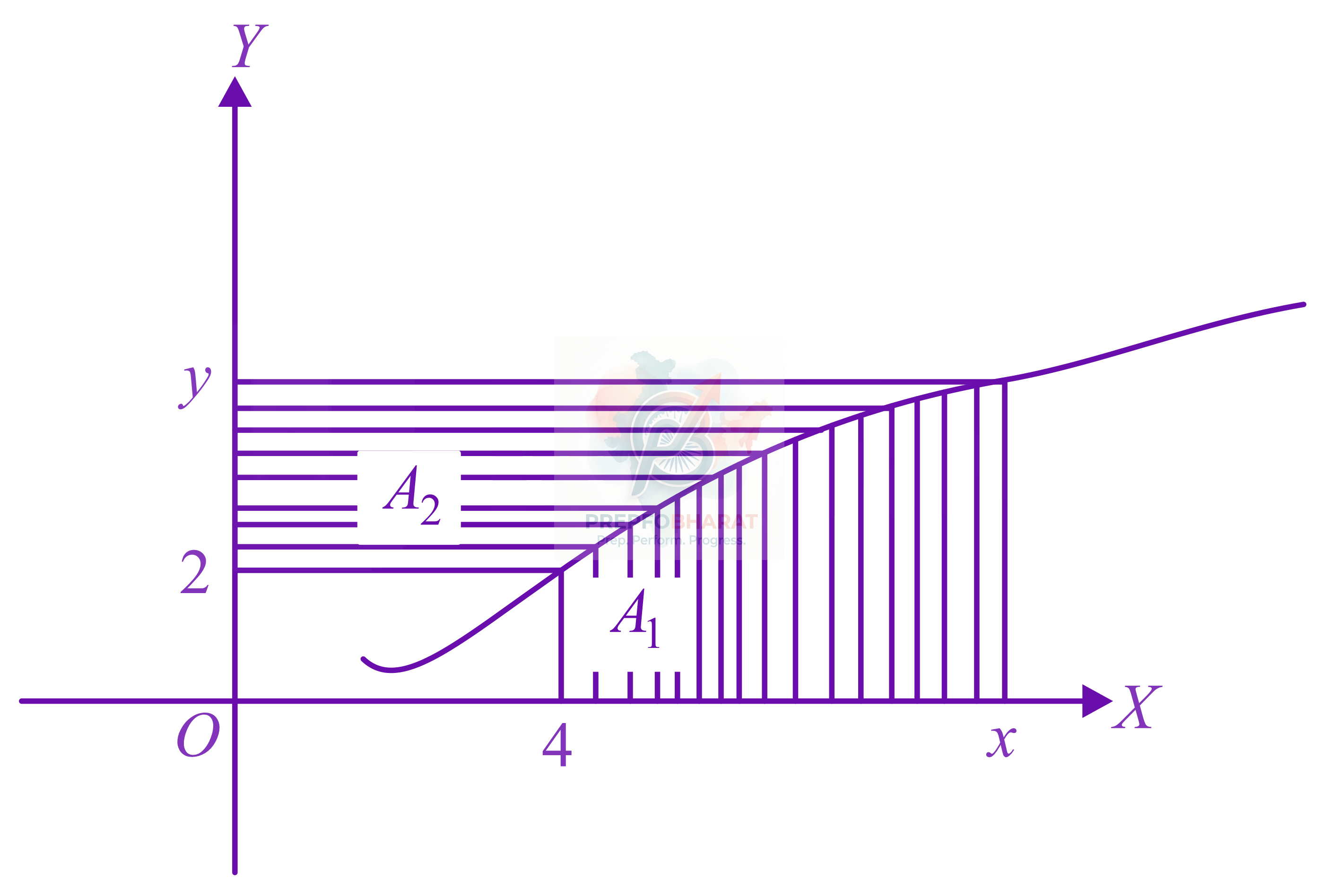
Let a function $f:\mathbb{R}\rightarrow \mathbb{R}$ be defined as: $f(x)={\begin{matrix}{\int }_{0}^{x}(5-|t-3|)dt, & x>4 \\ {x}^{2}+bx, & x\leq 4\end{matrix}$ where $b\in \mathbb{R}$. If $f$ is continuous at $x=4$, then which of the following statements is NOT true?
The integral ${\int }_{0}^{1}\frac{1}{{7}^{[\frac{1}{x}]}}dx$, where $[\cdot ]$ denotes the greatest integer function, is equal to
The area of the region bounded by ${y}^{2}=8x$ and ${y}^{2}=16(3-x)$ is equal to
The value of ${\mathrm{log}}_{e}2\frac{d}{\mathrm{dx}}({\mathrm{log}}_{\mathrm{cos}x}cosecx)$ at $x=\frac{\pi }{4}$ is
If the solution curve of the differential equation $(({\mathrm{tan}}^{-1}y)-x)dy=(1+{y}^{2})dx$ passes through the point $(1,0)$ then the abscissa of the point on the curve whose ordinate is $\mathrm{tan}(1)$ is
Let $f(x)$ be a polynomial function such that $f(x)+{f}^{'}(x)+{f}^{''}(x)={x}^{5}+64$. Then, the value of $\underset{x\rightarrow 1}{\mathrm{lim}}\frac{f(x)}{x-1}$ is equal to
Let $P$ and $Q$ be any points on the curves ${(x-1)}^{2}+{(y+1)}^{2}=1$ and $y={x}^{2}$, respectively. The distance between $P$ and $Q$ is minimum for some value of the abscissa of $P$ in the interval
Let $x(t)=2\sqrt{2}\mathrm{cos}t\sqrt{\mathrm{sin}2t}$ and $y(t)=2\sqrt{2}\mathrm{sin}t\sqrt{\mathrm{sin}2t},t\in (0,\frac{\pi }{2})$. Then $\frac{1+{(\frac{dy}{dx})}^{2}}{\frac{{d}^{2}y}{{\mathrm{dx}}^{2}}}$ at $t=\frac{\pi }{4}$ is equal to
If $f(x)={\begin{matrix}x+a, & x\leq 0 \\ |x-4|, & x>0\end{matrix}$ and $g(x)={\begin{matrix}x+1, & x<0 \\ {(x-4)}^{2}+b, & x\geq 0\end{matrix}$ are continuous on $R$, then $(gof)(2)+(fog)(-2)$ is equal to:
Let $f(x)={\begin{matrix}{x}^{3}-{x}^{2}+10x-7, & x\leq 1 \\ -2x+{\mathrm{log}}_{2}({b}^{2}-4), & x>1\end{matrix}$ Then the set of all values of $b$, for which $f(x)$ has maximum value at $x=1$, is:
If $y=y(x),x\in (0,\frac{\pi }{2})$ be the solution curve of the differential equation $({\mathrm{sin}}^{2}2x)\frac{dy}{dx}+(8{\mathrm{sin}}^{2}2x+2\mathrm{sin}4x)y=$ $2{e}^{-4x}(2\mathrm{sin}2x+\mathrm{cos}2x),$ with $y(\frac{\pi }{4})={e}^{-\pi }$, then $y(\frac{\pi }{6})$ is equal to
If $\frac{dy}{dx}+\frac{{2}^{x-y}({2}^{y}-1)}{{2}^{x}-1}=0,x,y>0,y(1)=1$, then $y(2)$ is equal to
Let a smooth curve $y=f(x)$ be such that the slope of the tangent at any point $(x,y)$ on it is directly proportional to $(\frac{-y}{x})$. If the curve passes through the points $(1,2)$ and $(8,1)$, then $|y(\frac{1}{8})|$ is equal to
If ${\int }_{0}^{\sqrt{3}}\frac{15{x}^{3}}{\sqrt{1+{x}^{2}+\sqrt{{(1+{x}^{2})}^{3}}}}dx=\alpha \sqrt{2}+\beta \sqrt{3}$, where $\alpha ,\beta$ are integers, then $\alpha +\beta$ is equal to
The sum of the absolute maximum and absolute minimum values of the function $f(x)={\mathrm{tan}}^{-1}(\mathrm{sin}x-\mathrm{cos}x)$ in the interval $[0,\pi ]$ is
Let $f(x)={\begin{matrix}\frac{\mathrm{sin}(x-[x])}{x-[x]}, & x\in (-2,-1) \\ \mathrm{max}(2x,3[|x|]), & |x|<1 \\ 1, & \mathrm{otherwise}\end{matrix}$ where $[t]$ denotes greatest integer $\leq t$. If $m$ is the number of points where $f$ is not continuous and $n$ is the number of points where $f$ is not differentiable, the ordered pair $(m,n)$ is:
Let $y=y(x),x>1$, be the solution of the differential equation $(x-1)\frac{dy}{dx}+2xy=\frac{1}{x-1}$, with $y(2)=\frac{1+{e}^{4}}{2{e}^{4}}$. If $y(3)=\frac{{e}^{\alpha }+1}{\beta {e}^{\alpha }}$. then the value of $\alpha +\beta$ is equal to ______.
Let the solution curve of the differential equation $xdy=(\sqrt{{x}^{2}+{y}^{2}}+y)dx,x>0$, intersect the line $x=1$ at $y=0$ and the line $x=2$ at $y=\alpha$. Then the value of $\alpha$ is
If $y(x)={({x}^{x})}^{x},x>0$ then $\frac{{d}^{2}x}{d{y}^{2}}+20$ at $x=1$ is equal to
The number of distinct real roots of the equation ${x}^{7}-7x-2=0$ is
The number of real solutions of ${x}^{7}+5{x}^{3}+3x+1=0$ is equal to _____.
Let a curve $y=y(x)$ pass through the point $(3,3)$ and the area of the region under this curve, above the $x$-axis and between the abscissae $3$ and $x(>3)$ be ${(\frac{y}{x})}^{3}$. If this curve also passes through the point $(\alpha ,6\sqrt{10})$ in the first quadrant, then $\alpha$ is equal to _______.
If $[t]$ denotes the greatest integer $\leq t$, then number of points, at which the function $f(x)=4|2x+3|+$ $9[x+\frac{1}{2}]-12[x+20]$ is not differentiable in the open interval $(-20,20)$, is ______.
Let $[t]$ denote the greatest integer less than or equal to $t$. Then, the value of the integral ${\int }_{0}^{1}[-8{x}^{2}+6x-1]dx$ is equal to
If $m$ and $n$ respectively are the number of local maximum and local minimum points of the function $f(x)={\int }_{0}^{{x}^{2}}\frac{{t}^{2}-5t+4}{2+{e}^{t}}dt$, then the ordered pair $(m,n)$ is equal to
Let ${\lambda }^{*}$ be the largest value of $\lambda$ for which the function ${f}_{\lambda }(x)=4\lambda {x}^{3}-36\lambda {x}^{2}+36x+48$ is increasing for all $x\in \mathbb{R}$. Then ${f}_{{\lambda }^{*}}(1)+{f}_{\lambda ,*}(-1)$ is equal to:
Let $f:R\rightarrow R$ be a differentiable function such that $f(\frac{\pi }{4})=\sqrt{2},f(\frac{\pi }{2})=0$ and ${f}^{'}(\frac{\pi }{2})=1$ and let $g(x)={\int }_{x}^{\frac{\pi }{4}}({f}^{'}(t)\mathrm{sec}t+\mathrm{tan}t\mathrm{sec}tf(t))dt$ for $x\in [\frac{\pi }{4},\frac{\pi }{2}).$ Then $\underset{x\rightarrow {(\frac{\pi }{2})}^{-}}{\mathrm{lim}}g(x)$ is equal to
The function $f(x)=x{e}^{x(1-x)},x\in R$, is
The value of ${\int }_{0}^{\pi }\frac{{e}^{\mathrm{cos}x}\mathrm{sin}x}{(1+{\mathrm{cos}}^{2}x)({e}^{\mathrm{cos}x}+{e}^{-\mathrm{cos}x})}dx$ is equal to
The number of points where the function $f(x)={\begin{matrix}|2{x}^{2}-3x-7| & \mathrm{if}x\leqslant -1 \\ [4{x}^{2}-1] & \mathrm{if}-1<x<1 \\ |x+1|+|x-2| & \mathrm{if}x\geqslant 1\end{matrix}$, where $[t]$ denotes the greatest integer $\leqslant t$, is discontinuous is ______
The value of the integral ${\int }_{0}^{\frac{\pi }{2}}60\frac{\mathrm{sin}(6x)}{\mathrm{sin}x}dx$ is equal to
If the absolute maximum value of the function $f(x)=({x}^{2}-2x+7){e}^{(4{x}^{3}-12{x}^{2}-180x+31)}$in the interval $[-3,0]$ is $f(\alpha )$, then
The value of $b>3$ for which $12{\int }_{3}^{b}\frac{1}{({x}^{2}-1)({x}^{2}-4)}dx={\mathrm{log}}_{e}(\frac{49}{40})$, is equal to _____.
Let $x=x(y)$ be the solution of the differential equation $2y{e}^{\frac{x}{{y}^{2}}}dx+({y}^{2}-4x{e}^{\frac{x}{{y}^{2}}})dy=0$ such that $x(1)=0$. Then, $x(e)$ is equal to
Let ${I}_{n}(x)={\int }_{0}^{x}\frac{1}{{({t}^{2}+5)}^{n}}dt,n=1,2,3,\ldots .$ Then
Let $f:R\rightarrow R$ be continuous function satisfying $f(x)+f(x+k)=n$, for all $x\in R$ where $k>0$ and $n$ is a positive integer. If ${I}_{1}={\int }_{0}^{4nk}f(x)dx$ and ${I}_{2}={\int }_{-k}^{3k}f(x)dx$, then
For $I(x)=\int \frac{{\mathrm{sec}}^{2}x-2022}{{\mathrm{sin}}^{2022}x}dx$, if $I(\frac{\pi }{4})={2}^{1011}$, then
${\int }_{0}^{20\pi }{(|\mathrm{sin}x|+|\mathrm{cos}x|)}^{2}dx$ is equal to:
If $\underset{x\rightarrow 0}{\mathrm{lim}}\frac{\alpha {e}^{x}+\beta {e}^{-x}+\gamma \mathrm{sin}x}{x{\mathrm{sin}}^{2}x}=\frac{2}{3}$, where $\alpha ,\beta ,\gamma \in R$, then which of the following is NOT correct?
The integral ${\int }_{0}^{\frac{\pi }{2}}\frac{1}{3+2\mathrm{sin}x+\mathrm{cos}x}dx$ is equal to:
Let $S$ be the region bounded by the curves $y={x}^{3}$ and ${y}^{2}=x$. The curve $y=2|x|$ divides $S$ into two regions of areas ${R}_{1}$ and ${R}_{2}$. If $\mathrm{max}|{R}_{1},{R}_{2}|={R}_{2}$, then $\frac{{R}_{2}}{{R}_{1}}$ is equal to ______
If the area of the region ${(x,y):{x}^{\frac{2}{3}}+{y}^{\frac{2}{3}}\leq 1,x+y\geq 0,y\geq 0}$ is $A$, then $\frac{256A}{\pi }$ is
The sum of absolute maximum and absolute minimum values of the function $f(x)=|2{x}^{2}+3x-2|+\mathrm{sin}x\mathrm{cos}x$ in the interval $[0,1]$ is
Let $f(x)=|(x-1)({x}^{2}-2x-3)|+x-3,x\in \mathbb{R}$. If $m$ and $M$ are respectively the number of points of local minimum and local maximum of $f$ in the interval $(0,4)$, then $m+M$ is equal to _____.
The area of the region $S={(x,y):{y}^{2}\leq 8x,y\geq \sqrt{2}x,x\geq 1}$ is
Let $f$ be a differentiable function satisfying $f(x)=\frac{2}{\sqrt{3}}{\int }_{0}^{\sqrt{3}}f(\frac{{\lambda }^{2}x}{3})d\lambda ,x>0$ and $f(1)=\sqrt{3}$. If $y=f(x)$ passes through the point $(\alpha ,6)$, then $\alpha$ is equal to _______.
The general solution of the differential equation $(x-{y}^{2})dx+y(5x+{y}^{2})dy=0$ is
The area of the region enclosed by $y\leq 4{x}^{2},{x}^{2}\leq 9y$ and $y\leq 4$, is equal to