Given,
f(x)=3(x2−2)3+4
Now on rearranging we get,
f(x)=81.3(x2−2)3
Now differentiating both side we get,
f′(x)=81.3(x2−2)3⋅ln3⋅3(x2−2)2⋅2x
=(81×6)3(x2−2)3×(x2−2)2ln3
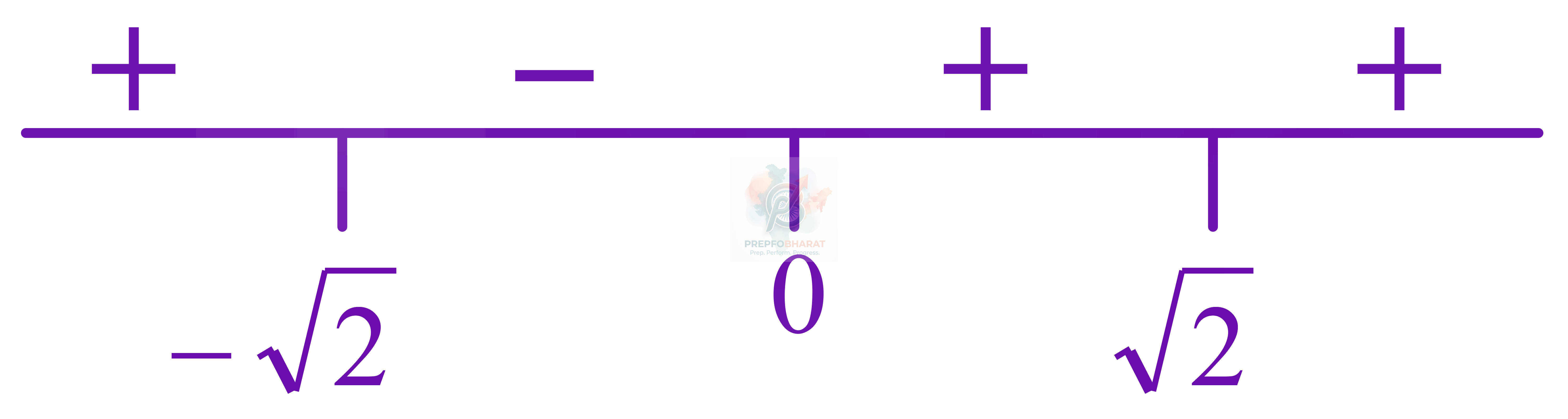
So by using first derivate test we get x=0 is point of local minima
Now differentiating the function f′(x)=k⏟(486⋅ln3)g(x)⏟3(x2−2)3x(x2−2)2
We get,g′(x)=3(x2−2)3(x2−2)2+x⋅3(x2−2)3⋅4x⋅(x2−2)
+x⋅(x2−2)2⋅3(x2−2)3ln3⋅3(x2−2)2⋅2x
=3(x2−2)3(x2−2)[x2−2+4x2+6x2ln3(x2−2)3]
g′(x)=3(x2−2)3(x2−2)[5x2−2+6x2ln3(x2−2)3]
f′′(x)=k⋅g′(x)
f′′(2)=0,f′′(2+)>0,f′′(2−)<0
Since double derivate is changing the sign at given point so we can say that x=2 is point of inflection
Also, f′′(x)>0 for x>2 so f′(x) is increasing