Given,
f:(−2,2)→R be defined by f(x)={\begin{matrix}x[x] & , & -2<x<0 \\ (x-1)[x] & , & 0\leq x<2\end{matrix}
\Rightarrow f(x)={\begin{matrix}\begin{matrix}-2x,-2<x<-1 \\ -x,-1\leq x<0\end{matrix} \\ \begin{matrix}0,0<x<1 \\ x-1,1\leq x<2\end{matrix}\end{matrix}
Now plotting the diagram of the above function we get,
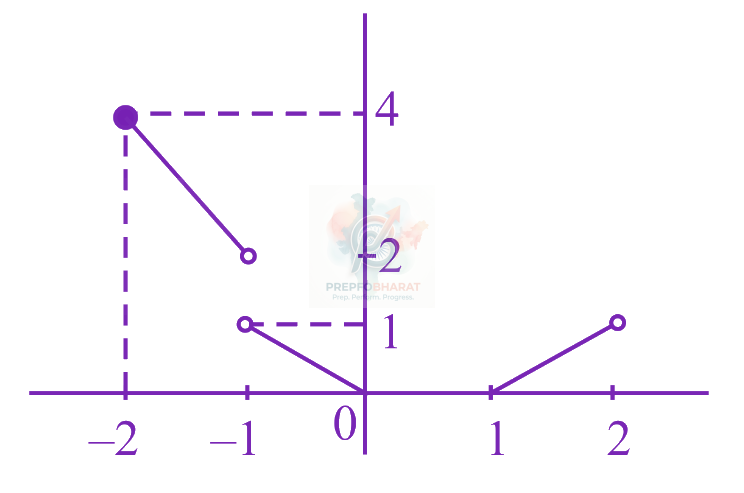
Now from above diagram we can say that, y=f(x) is same as y=∣f(x)∣
Hence, the function is not continuous at one point and non differentiable at three points, so m=1,n=3
Hence, m+n=4