Given,
The tangent at any point P on a curve passing through the points (1,1) and (101,100), intersect positive x-axis and y-axis at the points A and B respectively,
And PA:PB=1:k and y=y(x) is the solution of the differential equation edxdy=kx+2k,y(0)=k,
Now on plotting the diagram we get,
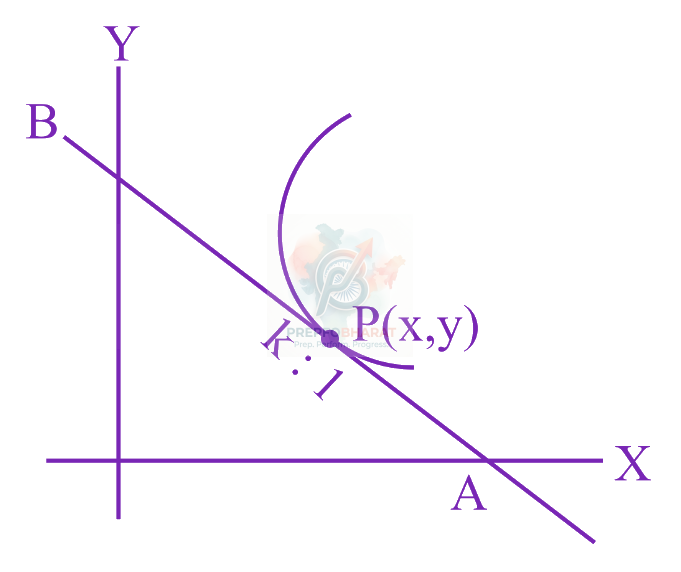
Equation of tangent at P(x,y) is :
Y−y=dxdy(X−x)
Coordinate of A=(x−ydydx,0)
Coordinate of B=(0,y−xdxdy)
∴(x,y)=(k+1kx−kydydx,k+1y−xdxdy)
So, y=k+1y−xdxdy
⇒y(k+1)=y−xdxdy
⇒ky=−xdxdy
⇒kxdx=−ydy
Now integrating both side, we get
kln∣x∣+ln∣y∣=lnC......(i)
Now given equation (i) passes through (1,1) and (101,100)
So, C=1 and k=2
Now putting the value of k, we get
edxdy=kx+2k
⇒edxdy=2x+1ask=2
⇒dxdy=ln(2x+1)
Integrating the above equation we get,
y=21(2x+1)(ln∣2x+1∣−1)+C
And the above equation passes through (0,2)
⇒C=25
So, 2y=(2x+1)(ln∣2x+1∣−1)+5
⇒2y(1)=3(ln3−1)+5
⇒2y(1)=3ln(3)+2
Hence, 4y(1)−5loge3=2[3ln3+2]−5ln3
⇒4y(1)−5loge3=6ln3+4−5ln3
⇒4y(1)−5loge3=4+ln3≈5
Note: This question was bonus in Jee Mains 2023 April session.