e6x−e4x−2e3x−12e2x+ex+1=0
(e3x)2−2e3x+1−e4x+ex=12e2x
⇒(e3x−1)2−ex(e3x−1)=12e2x
⇒(e3x−1)(e3x−1−ex)=12e2x
⇒e2x(e3x−1−ex)=(e3x−1)12
⇒ex−e−x−e−2x=e3x−112
Assume, f(x)={e}^{x}-{e}^{-x}-{e}^{-2x}&g(x)=\frac{12}{{e}^{3x}-1}
f(x)=ex−e−x−e−2x
f′(x)=ex+e−x+2e−2x
Clearly, {f}^{'}(x)>0\forall x\in R(\because {e}^{x}&{e}^{-x}>0\forall x\in R)
So, here f(x) is increasing and f(0)=−1and clearly g(x) is decreasing function because it is reciprocal function.
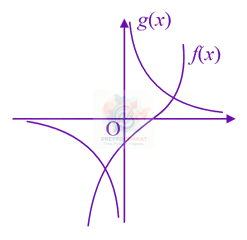
From the graph, we can say that number of real roots =2