For The Reaction
21N2(g)+23H2(g)→NH3(g);ΔHf∘=−46KJmol−1
ΔHf∘=−46=∑B.E−∑B.E
Reactants Product
∑B.E=∑B.E+46
Product Reactants
=21(712)+23(436)+46
= 356 + 654 + 46 = 1056
Averge B.E for N-H Bond =31056=352KJmol−1
JEE Main 2014 — Chemistry Physical Chemistry
The standard enthalpy of formation ofNH3 is −46.0kJ/mol. If bond enthalpy of H2 is −436kJ/mol and that of N2 is −712kJ/mol , the average bond enthalpy of N−H bond in NH3 is :
Held on 9 Apr 2014 · Verified 6 Jul 2026.
−964kJ/mol
−1102kJ/mol
+1056kJ/mol
+352kJ/mol
Sign in to track your attempts and accuracy.
Sign in to keep a private note on this question. Nothing you write is ever public.
What is the ratio of wave number of first line (lowest energy line) of Balmer series of H atomic spectrum to first line of its Brackett series?
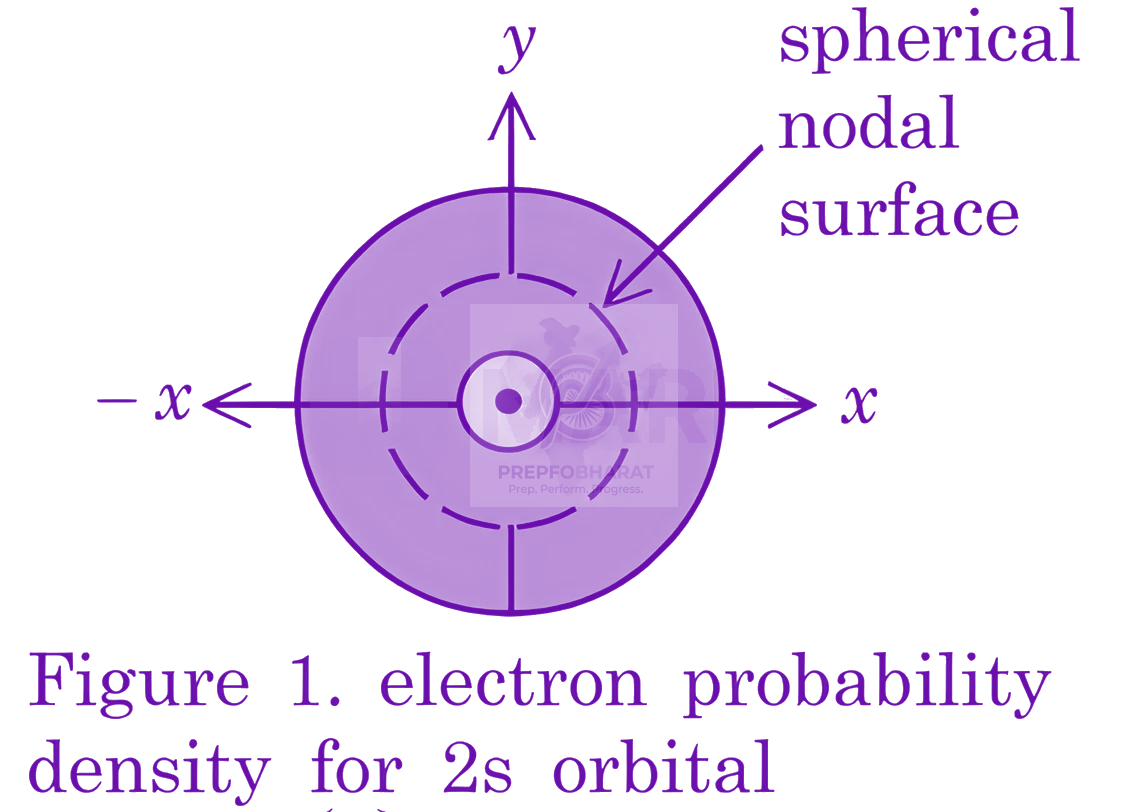 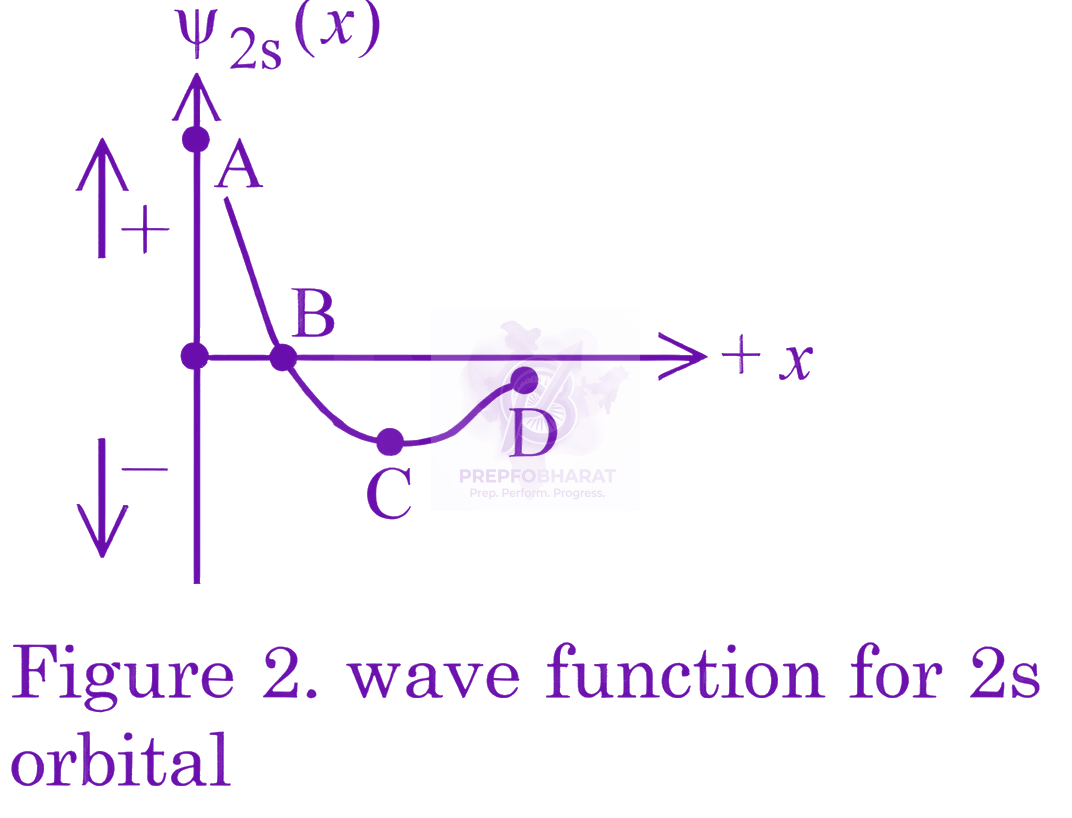 Which of the following point in Figure 2 most accurately represents the nodal surface as shown in Figure 1?
At 298 K, the mole percentage of $\mathrm{N}_{2}(\mathrm{~g})$ in air is $80 \%$. Water is in equilibrium with air at a pressure of 10 atm. What is the mole fraction of $\mathrm{N}_{2}(\mathrm{~g})$ in water at 298 K ? ($\mathrm{K}_{\mathrm{H}}$ for $\mathrm{N}_{2}$ is $6.5 \times 10^{7} \mathrm{~mm} \mathrm{Hg}$)
Electricity is passed through an acidic solution of $\mathrm{Cu}^{2+}$ till all the $\mathrm{Cu}^{2+}$ was exhausted, leading to the deposition of 300 mg of Cu metal. However, a current of 600 mA was continued to pass through the same solution for another 28 minutes by keeping the total volume of the solution fixed at 200 mL. The total volume of oxygen evolved at STP during the entire process is $\_\_\_\_$ mL. (Nearest integer) [Given: $\mathrm{Cu}^{2+}(\mathrm{aq})+2 \mathrm{e}^{-} \rightarrow \mathrm{Cu}(\mathrm{s}) \mathrm{E}_{\text {red }}^{\mathrm{o}}=+0.34 \mathrm{~V}$ $\mathrm{O}_{2}(\mathrm{~g})+4 \mathrm{H}^{+}+4 \mathrm{e}^{-} \rightarrow 2 \mathrm{H}_{2} \mathrm{O} \mathrm{E}_{\text {red }}^{\mathrm{o}}=+1.23 \mathrm{~V}$ Molar mass of $\mathrm{Cu}=63.54 \mathrm{~g} \mathrm{~mol}^{-1}$ Molar mass of $\mathrm{O}_{2}=32 \mathrm{~g} \mathrm{~mol}^{-1}$ Faraday Constant $=96500 \mathrm{C} \mathrm{mol}^{-1}$ Molar volume at $\mathrm{STP}=22.4 \mathrm{~L}$]
Arrange the following resultant mixtures in increasing order of their pH values A. $10$ mL $0.2$ M Ca(OH)$_2$ + $25$ mL $0.1$ M HCl B. $10$ mL $0.01$ M H$_2$SO$_4$ + $10$ mL $0.01$ M Ca(OH)$_2$ C. $10$ mL $0.1$ M H$_2$SO$_4$ + $10$ mL $0.1$ M KOH Choose the correct answer from the options given below:
Work through every JEE Main Physical Chemistry PYQ, year by year.