Moment of Momentum is angular momentum. OP is the same whether the mass is at A or B 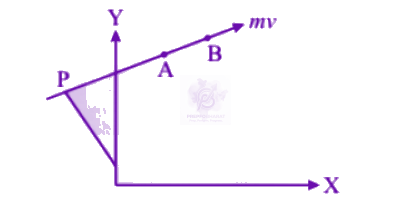
A particle of mass m moves in the X Y plane with a velocity v along the straight line AB. If the angular momentum of the particle with respect to…
NEET UG 2007 — Physics Mechanics
2007mcqmedium
A particle of mass m moves in the XY plane with a velocity v along the straight line AB. If the angular momentum of the particle with respect to origin O is LA when it is at A and LB when it is at B, then: 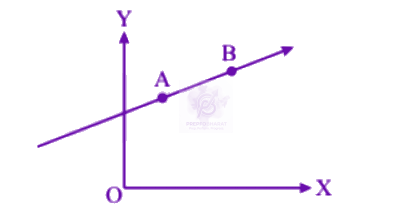
Official previous-year question
Held on 30 Apr 2007 · Verified 9 Jul 2026.
Options
- A
LA=LB
- B
the relationship between LA and LB depends upon the slope of the line AB
- C
LA<LB
- D
LA>LB∗
Did you get this right?
Sign in to track your attempts and accuracy.
Your note
Sign in to keep a private note on this question. Nothing you write is ever public.
NEET UG Mechanics in other years
More NEET UG Mechanics questions
A bullet of mass 10 g moving with 400 m/s penetrates a wall and comes to rest. The loss in kinetic energy is:
2026easy
A body weighs 48 N on the surface of the earth. The gravitational force experienced by the body due to the earth at a height equal to one-third the radius of the earth from its surface is :
2025medium
There are two inclined surface of equal length (L) and same angle of inclination $45^{\circ}$ with the horizontal. One of them is rough and the other is perfectly smooth. A given body takes 2 times as much time to slide down on rough surface than on the smooth surface. The coefficient of kinetic friction $\left(\mu_k\right)$ between the object and the rough surface is close to :
2025medium
In some appropriate units, time $(t)$ and position ( x ) relation of a moving particle is given by $t=x^2+x$. The acceleration of the particle is
2025medium
Two cities X and Y are connected by a regular bus service with a bus leaving in either direction every T min. A girl is driving scooty with a speed of 60 $\mathrm{km} / \mathrm{h}$ in the direction X to Y notices that a bus goes past her every 30 minutes in the direction of her motion, and every 10 minutes in the opposite direction. Choose the correct option for the period T of the bus service and the speed (assumed constant) of the buses.
2025hard
Other Physics topics for NEET UG
Keep practicing Mechanics
Work through every NEET UG Mechanics PYQ, year by year.