NEET UG 2019 — Mechanics
Physics Mechanics questions from NEET UG 2019.
Other Years
32 Mechanics Questions from 2019
A body of mass $m$ is kept on a rough horizontal surface (coefficient of friction $=\mu$ ). Horizontal force is applied on the body, but it does not move. The resultant of normal reaction and the frictional force acting on the object is given $\mathrm{F}$, where $\mathrm{F}$ is
A particle moving with velocity $\vec{V}$ is acted by three forces shown by the vector triangle $PQR$. The velocity of the particle will 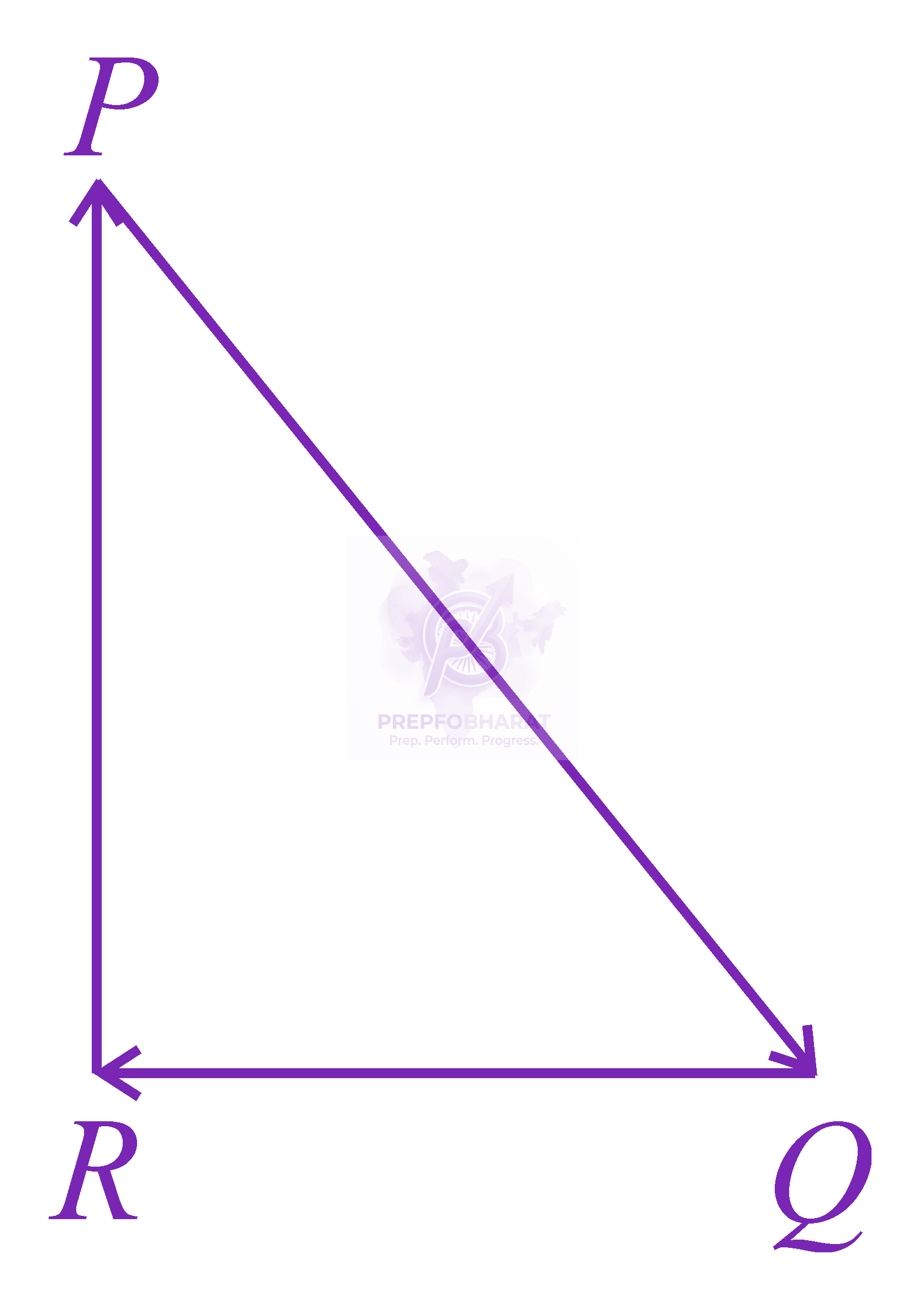
A small hole of area cross-section $2 m{m}^{2}$ is present near the bottom of a fully filled open tank of height $2 m.$ Taking $g=10 m{s}^{-2}$, the rate of flow of water through the open hole would be nearly
In an experiment, the percentage of error occurred in the measurement of physical quantities $A,B,C$ and $D$ are 1%, 2%, 3% and 4%, respectively. Then the maximum percentage of error in the measurement $X$, where $X=\frac{{A}^{2}{B}^{\frac{1}{2}}}{{C}^{\frac{1}{3}}{D}^{3}}$ will be
A solid cylinder of mass $2 \mathrm{~kg}$ and radius $50 \mathrm{~cm}$ rolls up an inclined plane of angle inclination $30^{\circ}$. The centre of mass of cylinder has speed of $4 \mathrm{~m} / \mathrm{s}$. The distance travelled by the cylinder on the inclined surface will be : (Take $g=10 \mathrm{~m} / \mathrm{s}^2$ )
A force $F=20+10y$ acts on a particle in $y$-direction where $F$ is in Newton and $y$ is in meter. Work done by this force to move the particle from $y=0$ to $y=1 m$ is
A soap bubble having radius of $1 mm$ is blown from a detergent solution having a surface tension of $2.5\times {10}^{-2} N{m}^{-1}.$ The pressure inside the bubble equals at a point ${Z}_{0}$ below the free surface of water in a container. Taking $g=10 m{s}^{-2},$ density of water $={10}^{3} kg{m}^{-3},$ the value of ${Z}_{0}$ is
The unit of thermal conductivity is
A particle of mass $5 \mathrm{~m}$ at rest suddenly breaks on its own into three fragments. Two fragments of mass m each move along mutually perpendicular direction with each speed v. The energy released during the process is
The stress-strain curves are drawn for two different materials $\mathrm{X}$ and $\mathrm{Y}$. It is observed that the ultimate strength point and the fracture point are close to each other for material X but are far apart for material Y. We can say that materials $\mathrm{X}$ and $\mathrm{Y}$ are likely to be (respectively)
Assuming that the gravitational potential energy of an object at infinity is zero, the change in potential energy (final - initial) of an object of mass $m$, when taken to a height $\mathrm{h}$ from the surface of earth (of radius $\mathrm{R}$ ) is given by,
The time period of a geo-stationary satellite is $24 \mathrm{~h}$, at a height $6 R_E-R_E$ is the radius of earth) from surface of earth. The time period of another satellite whose height is $2.5 \mathrm{R}_{\mathrm{E}}$ from surface will be
A person standing on the floor of an elevator drops a coin. The coin reaches the floor in time $t_1$ if the elevator is at rest and in time $t_2$ if the elevator is moving uniformly. The which of the following option is correct?
When a block of mass $M$ is suspended by a long wire of length $L$, the length of the wire becomes $(L+l).$ The elastic potential energy stored in the extended wire is
In a u-tube as shown in a figure, water and oil are in the left side and right side of the tube respectively. The heights from the bottom for water and oil columns are $15 \mathrm{~cm}$ and $20 \mathrm{~cm}$ respectively. The density of the oil is $\left[\right.$ take $\left.\rho_{\text {water }}=1000 \mathrm{~kg} / \mathrm{m}^3\right]$ 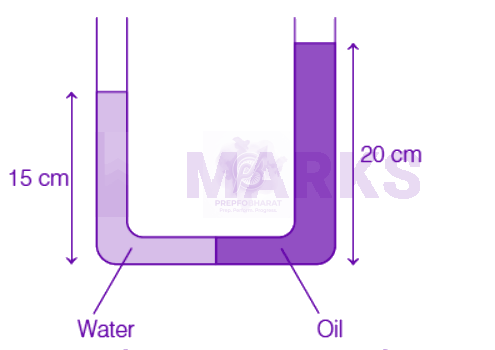
The speed of a swimmer in still water is $20 m{s}^{-1}.$ The speed of river water is $10 m{s}^{-1}$ and is flowing due east. If he is standing on the south bank and wishes to cross the river along the shortest path, the angle at which he should make his strokes with respect to the north is given by
Two small spherical metal balls, having equal masses, are made from materials of densities $\rho_1$ and $\rho_2\left(\rho_1=8 \rho_2\right)$ and have radii of $1 \mathrm{~mm}$ and $2 \mathrm{~mm}$, respectively. They are made to fall vertically (from rest) in viscous medium whose coefficient of viscosity equals $\eta$ and whose density is $0.1 \rho_2$. The ratio of their terminal velocities would be
A particle starting from rest, moves in a circle of radius ' $r$ '. It attains a velocity of $\mathrm{v}_0 \mathrm{~m} / \mathrm{s}$ in the $\mathrm{n}^{\text {th }}$ round. Its angular acceleration will be
A person travelling in a straight line moves with a constant velocity $\mathrm{v}_1$ for certain distance ' $\mathrm{x}$ ' and with a constant velocity $\mathrm{v}_2$ for next equal distance. The average velocity $v$ is given by the relation
Two bullets are fired horizontally and simultaneously towards each other from roof tops of two buildings $100 \mathrm{~m}$ apart and of same height of $200 \mathrm{~m}$ with the same velocity of $25 \mathrm{~m} / \mathrm{s}$. When and where will the two bullets collides. $\left(\mathrm{g}=10 \mathrm{~m} / \mathrm{s}^2\right)$
The work done to raise a mass $m$ from the surface of the earth to a height $h$, which is equal to the radius of the earth is:
A disc of radius $2 m$ and mass $100 kg$ rolls on a horizontal floor. Its centre of mass has speed of $20 cm{s}^{-1}.$ How much work is needed to stop it?
Body $A$ of mass $4m$ moving with speed $u$ collides with another body $B$ of mass $2m$ at rest. The collision is head on and elastic in nature. After the collision, the fraction of energy lost by the colliding body $A$ is
The main scale of a vernier calliper has $\mathrm{n}$ divisions/cm. n divisions of the vernier scale coincide with $(n-1)$ divisions of main scale. The least count of the vernier callipers is
An object flying in air with velocity $(20 \hat{i}+25 \hat{j}-12 \hat{k})$ suddenly breaks in two pieces whose masses are in the ratio $1: 5$. The smaller mass flies off with a velocity $(100 \hat{i}+35 \hat{j}+8 \hat{k})$. The velocity of the larger piece will be
A solid cylinder of mass $2 kg$ and radius $4 cm$ is rotating about its axis at the rate of $3\mathrm{rpm}$. The torque required to stop after $2\pi$ revolutions is
When an object is shot from the bottom of a long smooth inclined plane kept at an angle $60^{\circ}$ with horizontal, it can travel a distance ${x}_{1}$ along the plane. But, when the inclination is decreased to $30^{\circ}$ and the same object is shot with the same velocity, it can travel ${x}_{2}$ distance. Then ${x}_{1}:{x}_{2}$ will be
An object of mass $500 \mathrm{~g}$, initially at rest acted upon by a variable force whose $\mathrm{X}$ component varies with $\mathrm{X}$ in the manner shown. The velocities of the object a point $X=8 \mathrm{~m}$ and $X=12 \mathrm{~m}$, would be the respective values of (nearly) 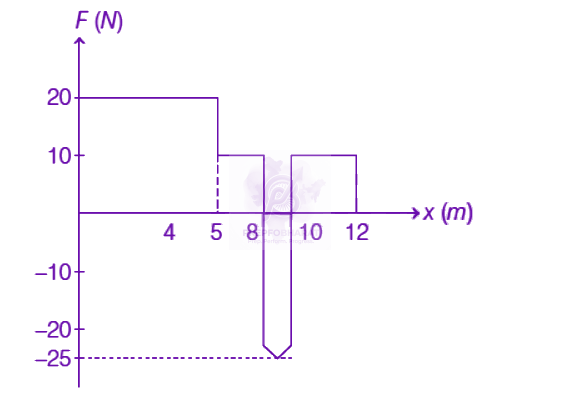
A block of mass $10 kg$ is in contact against the inner wall of a hollow cylindrical drum of radius$1m$. The coefficient of friction between the block and the inner wall of the cylinder is $0.1$. The minimum angular velocity needed for the cylinder to keep the block stationary when the cylinder is vertical and rotating about its axis will be $(g=10 m{s}^{-2})$,
Two particles $A$ and $B$ are moving in uniform circular motion in concentric circles of radii ${r}_{A}$ and ${r}_{B}$ with speed ${v}_{A}$ and ${v}_{B}$, respectively. Their time period of rotation is the same. The ratio of angular speed of $A$ to that of $B$ will be,
A mass $m$ is attached to a thin wire and whirled in a vertical circle. The wire is most likely to break, when
A body weighs $200 N$ on the surface of the earth. How much will it weigh half way down to the centre of the earth?