NEET UG 2022 — Mechanics
Physics Mechanics questions from NEET UG 2022.
Other Years
32 Mechanics Questions from 2022
If the kinetic energy of a body becomes four times, its momentum becomes
The position-time $(x-t)$ graph for positive acceleration is:
A gravitational field is present in a region and a mass is shifted from $A$ to $B$ through different paths as shown. If $W_1, W_2$ and $W_3$ represent the work done by the gravitational force along the respective paths, then 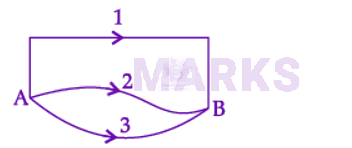
The distance covered by a body of mass $5 \mathrm{~g}$ having linear momentum $0.3 \mathrm{~kg} \mathrm{~m} / \mathrm{s}$ in $5 \mathrm{~s}$ is:
Match List - I with List - II : <table class="pyq-table"><tbody><tr><td colspan="2" rowspan="1">List - I</td><td colspan="2" rowspan="1">List - II</td></tr><tr><td>(a)</td><td>Gravitational constant (G)</td><td>(i)</td><td>$[{L}^{2}{T}^{-2}]$</td></tr><tr><td>(b)</td><td>Gravitational potential energy</td><td>(ii)</td><td>$[{M}^{-1}{L}^{3}{T}^{-2}]$</td></tr><tr><td>(c)</td><td>Gravitational potential</td><td>(iii)</td><td>$[{\mathrm{LT}}^{-2}]$</td></tr><tr><td>(d)</td><td>Gravitational intensity</td><td>(iv)</td><td>$[{\mathrm{ML}}^{2}{T}^{-2}]$</td></tr></tbody></table>Choose the correct answer from the options given below:
The angular speed of a fly wheel moving with uniform angular acceleration changes from $1200\mathrm{rpm}$ to $3120\mathrm{rpm}$ in $16$ seconds. The angular acceleration in $\mathrm{rad}{s}^{-2}$ is:
The percentage error in the measurement of $g$ is $\left(\right.$ Given that $g=\frac{4 \pi^2 \mathrm{~L}}{\mathrm{~T}^2}, \mathrm{~L}=(10 \pm 0.1) \mathrm{cm}$, $\mathrm{T}=(100 \pm 1) \mathrm{s}):$
If $\overrightarrow{\mathrm{F}}=2 \hat{i}+\hat{j}-\hat{k}$ and $\vec{r}=3 \hat{i}+2 \hat{j}-2 \hat{k}$, then the scalar and vector products of $\vec{F}$ and $\vec{r}$ have the magnitudes respectively as:
A ball is projected with a velocity, $10{ms}^{-1}$, at an angle of $60^{\circ}$ with the vertical direction. Its speed at the highest point of its trajectory will be
The ratio of the radius of gyration of a thin uniform disc about an axis passing through its centre and normal to its plane to the radius of gyration of the disc about its diameter is
Two objects of mass $10\mathrm{kg}$ and $20\mathrm{kg}$ respectively are connected to the two ends of a rigid rod of length $10m$ with negligible mass. The distance of the center of mass of the system from the $10\mathrm{kg}$ mass is:
A cricket ball is thrown by a player at a speed of $20 \mathrm{~m} / \mathrm{s}$ in a direction $30^{\circ}$ above the horizontal. The maximum height attained by the ball during its motion is $\left(g=10 \mathrm{~m} / \mathrm{s}^2\right)$ :
The physical quantity that has the same dimensional formula as pressure is:
If a soap bubble expands, the pressure inside the bubble
A body of mass $60g$ experiences a gravitational force of $3.0N$, when placed at a particular point. The magnitude of the gravitational field intensity at that point is
Plane angle and solid angle have:
A spherical ball is dropped in a long column of a highly viscous liquid. The curve in the graph shown, which represents the speed of the ball $(v)$ as a function of time $(t)$ is 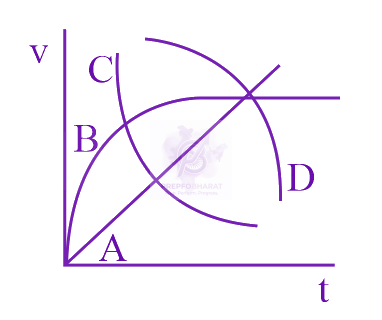
The terminal velocity of a copper ball of radius $5 \mathrm{~mm}$ falling through a tank of oil at room temperature is $10 \mathrm{~cm} \mathrm{~s}^{-1}$. If the viscosity of oil at room temperature is $0.9 \mathrm{~kg} \mathrm{~m}^{-1} \mathrm{~s}^{-1}$, the viscous drag force is:
In the diagram shown, the normal reaction force between $2 \mathrm{~kg}$ and $1 \mathrm{~kg}$ is (Given $g=10 \mathrm{~ms}^{-2}$) (Consider the surface, to be smooth): 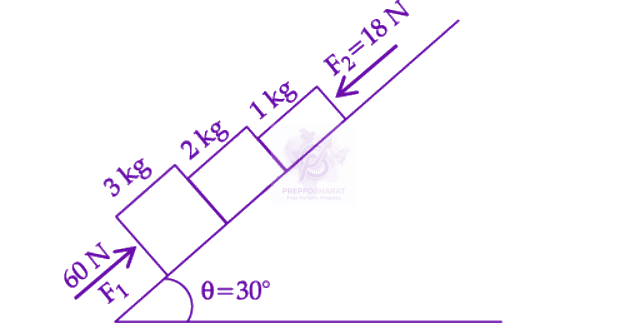
The area of a rectangular field (in ${m}^{2}$) of length $55.3m$ and breadth $25m$ after rounding off the value for correct significant digits is:
Given below are two statements: one is labelled as Assertion (A) and the other is labelled as Reason (R), Assertion (A): When a fire cracker (rocket) explodes in mid air, its fragments fly in such a way that they continue moving in the same path, which the fire cracker would have followed, had it not exploded Reason (R): Explosion of cracker (rocket) occurs due to internal forces only and no external force acts for this explosion. In the light of the above statements, choose the most appropriate answer from the options given below:
The dimensions $[\mathrm{MLT}{A-2}^{-2}]$ belong to the
Given below are two statements : One is labelled as Assertion (A) and the other is labelled as Reason (R). Assertion (A): The stretching of a spring is determined by the shear modulus of the material of the spring. Reason (R): A coil spring of copper has more tensile strength than a steel spring of same dimensions. In the light of the above statements, choose the most appropriate answer from the options given below :
Two copper vessels $A$ and $B$ have the same base area but of different shapes. A takes twice the volume of water as that $B$ requires to fill upto a particular common height. Then the correct statement among the following is:
A shell of mass $m$ is at rest initially. It explodes into three fragments having mass in the ratio $2:2:1$. If the fragments having equal mass fly off along mutually perpendicular directions with speed $v$, the speed of the third (lighter) fragment is:
The displacement-time graphs of two moving particles make angles of $30^{\circ}$ and $45^{\circ}$ with the $x$-axis as shown in the figure. The ratio of their respective velocity is: 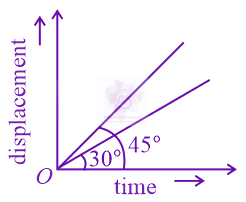
An electric lift with a maximum load of $2000\mathrm{kg}$ (lift $+$ passengers) is moving up with a constant speed of $1.5{ms}^{-1}$. The frictional force opposing the motion is $3000N$. The minimum power delivered by the motor to the lift in watts is : $(g=10{ms}^{-2})$
The energy that will be ideally radiated by a $100\mathrm{kW}$ transmitter in $1$ hour is
The ratio of the distances travelled by a freely falling body in the ${1}^{\mathrm{st}},{2}^{\mathrm{nd}},{3}^{\mathrm{rd}}$ and ${4}^{\mathrm{th}}$ second
In a gravitational field, the gravitational potential is given by, $\mathrm{V}=\frac{\mathrm{K}}{x}(\mathrm{~J} / \mathrm{kg})$. The gravitational field intensity at point $(2,0,3) \mathrm{m}$ is:
The restoring force of a spring with a block attached to the free end of the spring is represented by:
An energy of $484 \mathrm{~J}$ is spent in increasing the speed of a flywheel from $60 \mathrm{rpm}$ to $360 \mathrm{rpm}$. The moment of inertia of the flywheel is: