NEET UG 2018 — Mechanics
Physics Mechanics questions from NEET UG 2018.
Other Years
14 Mechanics Questions from 2018
A solid sphere is rotating freely about its symmetric axis in free space. The radius of the sphere is increased keeping its mass same. Which of the following physical quantities would remain constant for the sphere?
If the mass of the Sun were ten times smaller and the universal gravitational constant were ten times larger in magnitude, which of the following is not correct?
Three objects, $A$: (a solid sphere), $B$: (a thin circular disk) and $C$: (a circular ring), each have the same mass $M$ and radius $R$. They all spin with the same angular speed $\omega$ about their own symmetric axes. The amounts of work $(W)$ required to bring them to rest, would satisfy the relation
The moment of the force, $\vec{F}=4\hat{i}+5\hat{j}-6\hat{k}$ at $( 2,0,-3 ),$ about the point $( 2,-2,-2 ),$ is given by
A body initially at rest and sliding along a frictionless track from a height $h$ (as shown in the figure) just completes a vertical circle of diameter $AB=D$. The height $h$ is equal to, 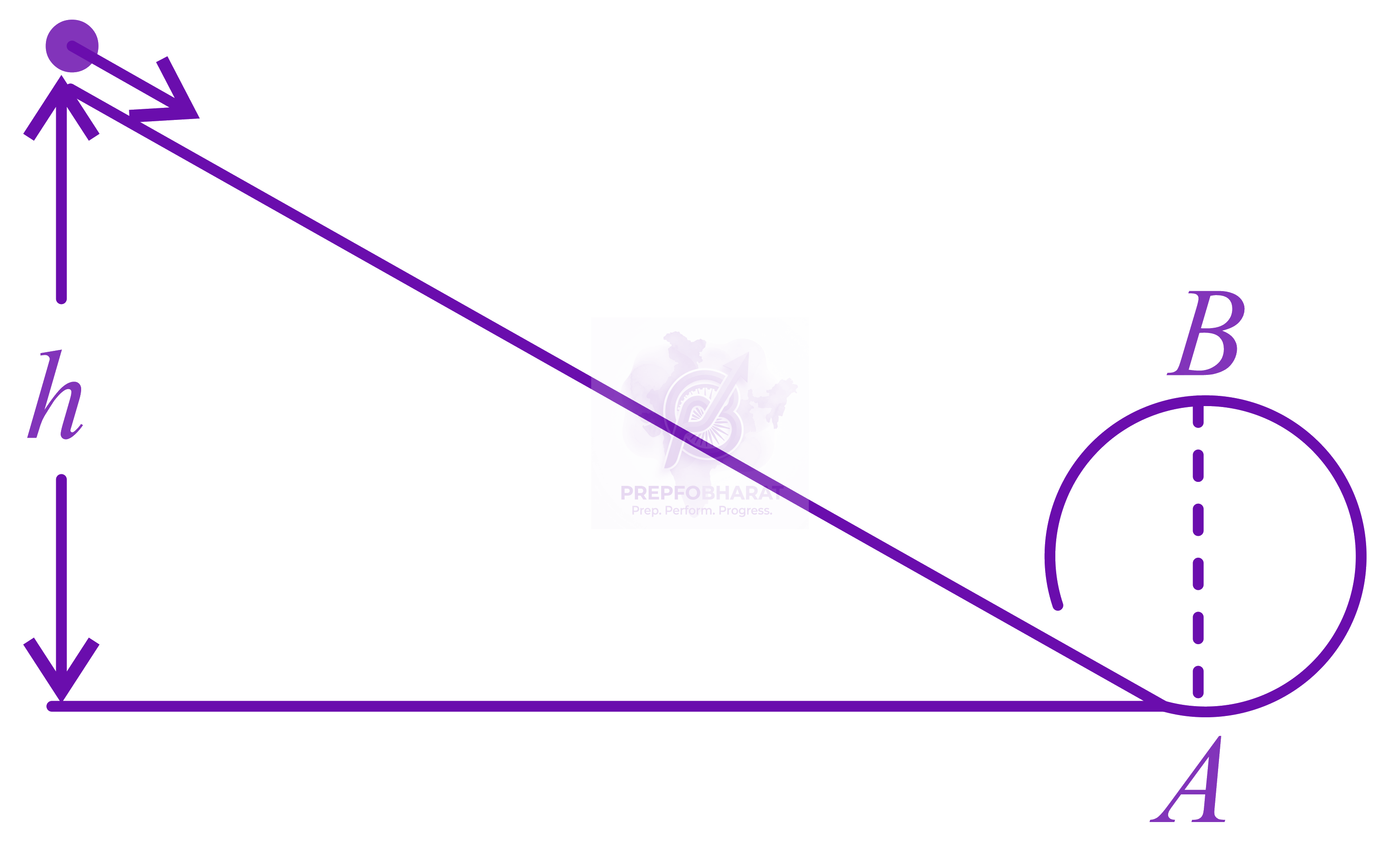
The kinetic energies of a planet in an elliptical orbit about the Sun, at positions, $A, B$ and $C$ are ${K}_{A}, {K}_{B} and {K}_{C}$, respectively. $AC$ is the major axis and $SB$ is perpendicular to $AC$ at the position of the Sun $S$ as shows in the figure. Then 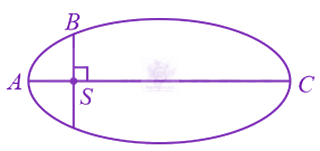
A small sphere of radius $r$ falls from rest in a viscous liquid. As a result, heat is produced due to viscous force. The rate of production of heat when the sphere attains terminal velocity, is proportional to
Two wires are made of the same material and have the same volume. The first wire has cross-sectional area $A$ and the second wire has cross-sectional area $3A.$ If the length of the first wire is increased by $\Delta l$ on applying a force $F,$ how much force is needed to stretch the second wire by the same amount?
A moving block having mass $m,$ collides with another stationary block having mass $4m.$ The lighter block comes to rest after collision. When the initial velocity of the lighter block is $v,$ then the value of coefficient of restitution $(e)$ will be
A toy car with charge q moves on a frictionless horizontal plane surface under the influence of a uniform electric field $\vec{E}$. Due to the force $q\vec{E}$, its velocity increases from 0 to $6 m{s}^{-1}$ in one second duration. At that instant the direction of the field is reversed. The car continues to move for two more seconds under the influence of this field. The average velocity and the average speed of the toy car between $0$ to $3$ seconds are respectively
A solid sphere is in rolling motion. In rolling motion a body possesses translational kinetic energy $({K}_{t})$ as well as rotational kinetic energy $({K}_{r})$ simultaneously. The ratio ${K}_{t}:({K}_{t}+{K}_{r})$ for the sphere is
A student measured the diameter of a small steel ball using a screw gauge of least count $0.001\mathrm{cm}$. The main scale reading is $5\mathrm{mm}$ and ${25}^{th}$ division of circular scale coincides with reference line. If screw gauge has a zero error of $-0.004\mathrm{cm}$, the correct diameter of the ball is
A block of mass m is placed on a smooth inclined wedge $ABC$ of inclination $\theta$ as shown in the figure. The wedge is given an acceleration $a$ towards the right. The relation between $a$ and $\theta$ for the block to remain stationary on the wedge is 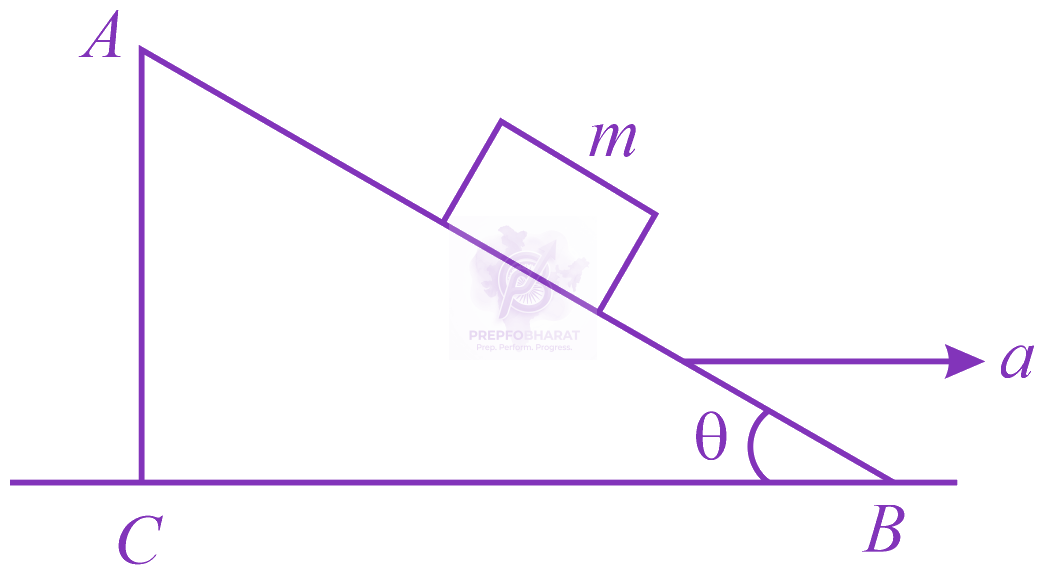
Which one of the following statements is incorrect?