NEET UG 2025 — Mechanics
Physics Mechanics questions from NEET UG 2025.
Other Years
17 Mechanics Questions from 2025
In some appropriate units, time $(t)$ and position ( x ) relation of a moving particle is given by $t=x^2+x$. The acceleration of the particle is
There are two inclined surface of equal length (L) and same angle of inclination $45^{\circ}$ with the horizontal. One of them is rough and the other is perfectly smooth. A given body takes 2 times as much time to slide down on rough surface than on the smooth surface. The coefficient of kinetic friction $\left(\mu_k\right)$ between the object and the rough surface is close to :
Two cities X and Y are connected by a regular bus service with a bus leaving in either direction every T min. A girl is driving scooty with a speed of 60 $\mathrm{km} / \mathrm{h}$ in the direction X to Y notices that a bus goes past her every 30 minutes in the direction of her motion, and every 10 minutes in the opposite direction. Choose the correct option for the period T of the bus service and the speed (assumed constant) of the buses.
A body weighs 48 N on the surface of the earth. The gravitational force experienced by the body due to the earth at a height equal to one-third the radius of the earth from its surface is :
The kinetic energies of two similar cars $A$ and $B$ are 100 J and 225 J respectively. On applying breaks, car A stops after 1000 m and car B stops after 1500 m . If $\mathrm{F}_{\mathrm{A}}$ and $\mathrm{F}_{\mathrm{B}}$ are the forces applied by the breaks on cars A and B , respectively, then the ratio $\mathrm{F}_{\mathrm{A}} / \mathrm{F}_{\mathrm{B}}$ is :
A sphere of radius $R$ is cut from a larger solid sphere of radius $2 R$ as shown in the figure. The ratio of the moment of inertia of the smaller sphere to that of the rest part of the sphere about the Y-axis is: 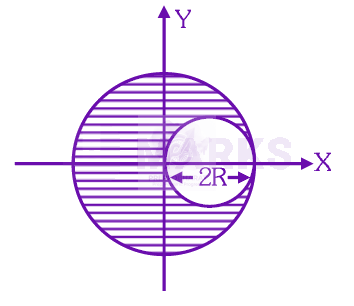
According to Newton's second law, the net force acting on a body is:
A bob of heavy mass $m$ is suspended by a light string of length $l$. The bob is given a horizontal velocity $\mathrm{v}_0$ as shown in figure. If the string gets slack at some point P making an angle $\theta$ from the horizontal, the ratio of the speed v of the bob at point $P$ to its initial speed $v_0$ is : 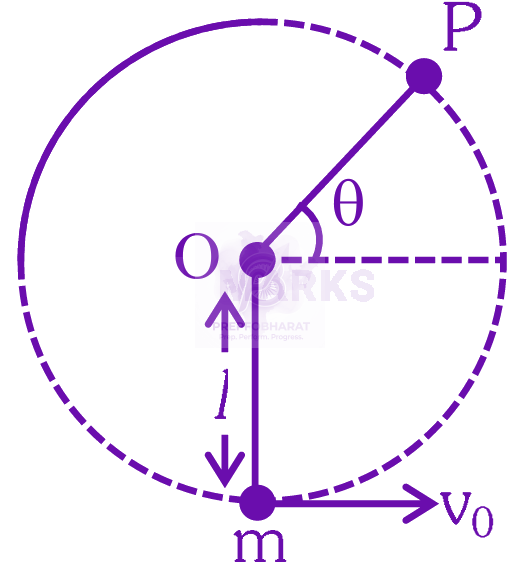
A ball of mass 0.5 kg is dropped from a height of 40 m . The ball hits the ground and rises to a height of 10 m . The impulse imparted to the ball during its collision with the ground is (Take $\mathrm{g}=9.8 \mathrm{~m} / \mathrm{s}^2$ )
Consider the diameter of a spherical object being measured with the help of a Vernier callipers. Suppose its 10 Vernier Scale Divisions (V.S.D.) are equal to its 9 Main Scale Divisions (M.S.D.) The least division in the M.S. is 0.1 cm and the zero of V.S. is at $\mathrm{x}=0.1 \mathrm{~cm}$ when the jaws of Vernier callipers are closed. If the main scale reading for the diameter is $\mathrm{M}=5 \mathrm{~cm}$ and the number of coinciding vernier division is 8 , the measured diameter after zero error correction, is
A balloon is made of a material of surface tension $S$ and its inflation outlet (from where gas is filled in it) has small area $A$. It is filled with a gas of density $\rho$ and takes a spherical shape of radius $R$. When the gas is allowed to flow freely out of it, its radius changes from $R$ to 0 (zero) in time $T$. If the speed $\eta(r)$ of gas coming out of the balloon depends on $r$ as $r^\alpha$ and $T \propto S^\alpha A^\beta \rho^\gamma R^\delta$ then
A body of mass 5 kg is moving with a velocity of 10 m/s. The kinetic energy of the body is:
The Sun rotates around its centre once in 27 days. What will be the period of revolution if the Sun were to expand to twice its present radius without any external influence? Assume the Sun to be a sphere of uniform density.
Consider a water tank shown in the figure. It has one wall at $x=L$ and can be taken to be very wide in the $z$ direction. When filled with a liquid of surface tension $S$ and density $\rho$, the liquid surface makes angle $\theta_0\left(\theta_0 \ll 1\right)$ with the $x$-axis at $x=L$. If $y(x)$ is the height of the surface then the equation for $y(x)$ is: 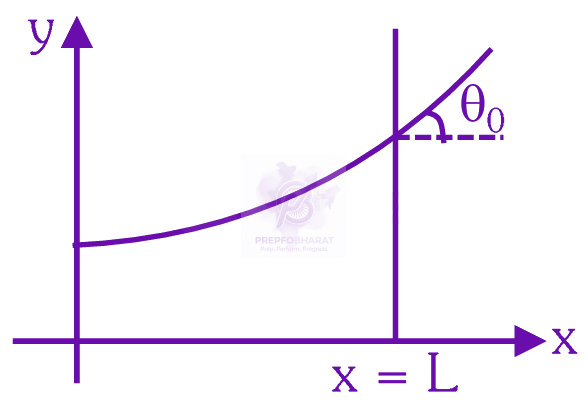 $\left(\operatorname{take} \theta(x)=\sin \theta(x)=\tan \theta(x)=\frac{d y}{d x}, g\right.$ is the acceleration due to gravity)
The radius of Martian orbit around the Sun is about 4 times the radius of the orbit of Mercury. The Martian year is 687 Earth days. Then which of the following is the length of 1 year on Mercury?
A uniform rod of mass 20 kg and length 5 m leans against a smooth vertical wall making an angle of $60^{\circ}$ with it. The other end rests on a rough horizontal floor. The friction force that the floor exerts on the rod is (take $\mathrm{g}=10 \mathrm{~m} / \mathrm{s}^2$ )
A physical quantity $P$ is related to four observations $a, b, c$ and $d$ as follows : $P=a^3 b^2 / c \sqrt{d}$ The percentage errors of measurement in $a, b, c$ and $d$ are $1 \%, 3 \%, 2 \%$ and $4 \%$ respectively. The percentage error in the quantity $P$ is