NEET UG 2016 — Mechanics
Physics Mechanics questions from NEET UG 2016.
Other Years
27 Mechanics Questions from 2016
A satellite of mass $m$ is orbiting the earth (of radius $R$) at a height $h$ from its surface. The total energy of the satellite in terms of ${g}_{o}$ , the value of acceleration due to gravity at the earth's surface, is
Planck's constant $(h)$, speed of light in a vacuum $( c )$ and Newton's gravitational constant $( G )$ are three fundamental constants. Which of the following combinations of these has the dimension of length?
At what height from the surface of earth the gravitation potential and the value of g are $-5.4\times {10}^{7 }J k{g}^{-2}$ and $6.0 m {s}^{-2}$ respectively? Take the radius of earth as $6400 km$:
A particle of mass $10g$ moves along a circle of radius $6.4\mathrm{cm}$with a constant tangential acceleration. What is the magnitude of this acceleration if the kinetic energy of the particle becomes equal to $8\times {10}^{-4} J$ by the end of the second revolution after the beginning of the motion?
A disk and a sphere of same radius but different masses roll off on two inclined planes of the same altitude and length. Which one of the two objects gets to the bottom of the plane first?
Two non-mixing liquids of densities $\rho$ and $n\rho (n>1)$ are put in a container. The height of each liquid is $h.$ A solid cylinder of length $\text{L}$ and density $d$ is put in this container. The cylinder floats with its axis vertical and length $pL(p<1)$ in the denser liquid. The density $d$ is equal to:
A solid sphere of mass, $m$ and radius, $R$ is rotating about its diameter. A solid cylinder of the same mass and same radius is also rotating about its geometrical axis with an angular speed twice that of the sphere. The ratio of their kinetic energies of rotation $(\frac{{E}_{\mathrm{sphere}}}{{E}_{\mathrm{cylinder}}})$ will be
Three liquids of densities, ${\rho }_{1}, {\rho }_{2}$ and ${\rho }_{3}$ (with, ${\rho }_{1}>{\rho }_{2}>{\rho }_{3})$, having the same value of surface tension,$T$ , rise to the same height in three identical capillaries. The angles of contact, ${\theta }_{1}, {\theta }_{2}$ and ${\theta }_{3}$ obey
A particle moves from a point $(- 2\hat{i}+5\hat{j})$ to $(4\hat{j}+3\hat{k})$ when a force of $(4\hat{i}+3\hat{j})N$ is applied. How much work has been done by the force?
A bullet of mass $10 g$ moving horizontally with a velocity of $400 m {s}^{-1}$ strikes a wooden block of mass $2 kg$ which is suspended by a light inextensible string of length $5 m.$ As a result, the centre of gravity of the block is found to rise a vertical distance of $10 cm.$ The speed of the bullet after it emerges out horizontally from the block will be
Two rotating bodies, $A$ and $B$ of masses, $m$ and $2m$ with moments of inertia. ${I}_{A}$ and ${I}_{B}({I}_{B}>{I}_{A})$ have equal kinetic energy of rotation. If, ${L}_{A}$ and ${L}_{B}$ be their angular momenta, respectively, then,
If the magnitude of sum of two vectors is equal to the magnitude of difference of the two vectors, the angle between these vectors is:
A particle moves so that its position vector is given by $\vec{r}=cos\omega t \hat{x} +sin\omega t \hat{y}$, where $\omega$ is a constant. Which of the following is true?
In the given figure, $a=15m{s}^{-2}$ represents the total acceleration of a particle moving in the clockwise direction in a circle of the radius $R=2.5m$at a given instant of time. The speed of the particle is 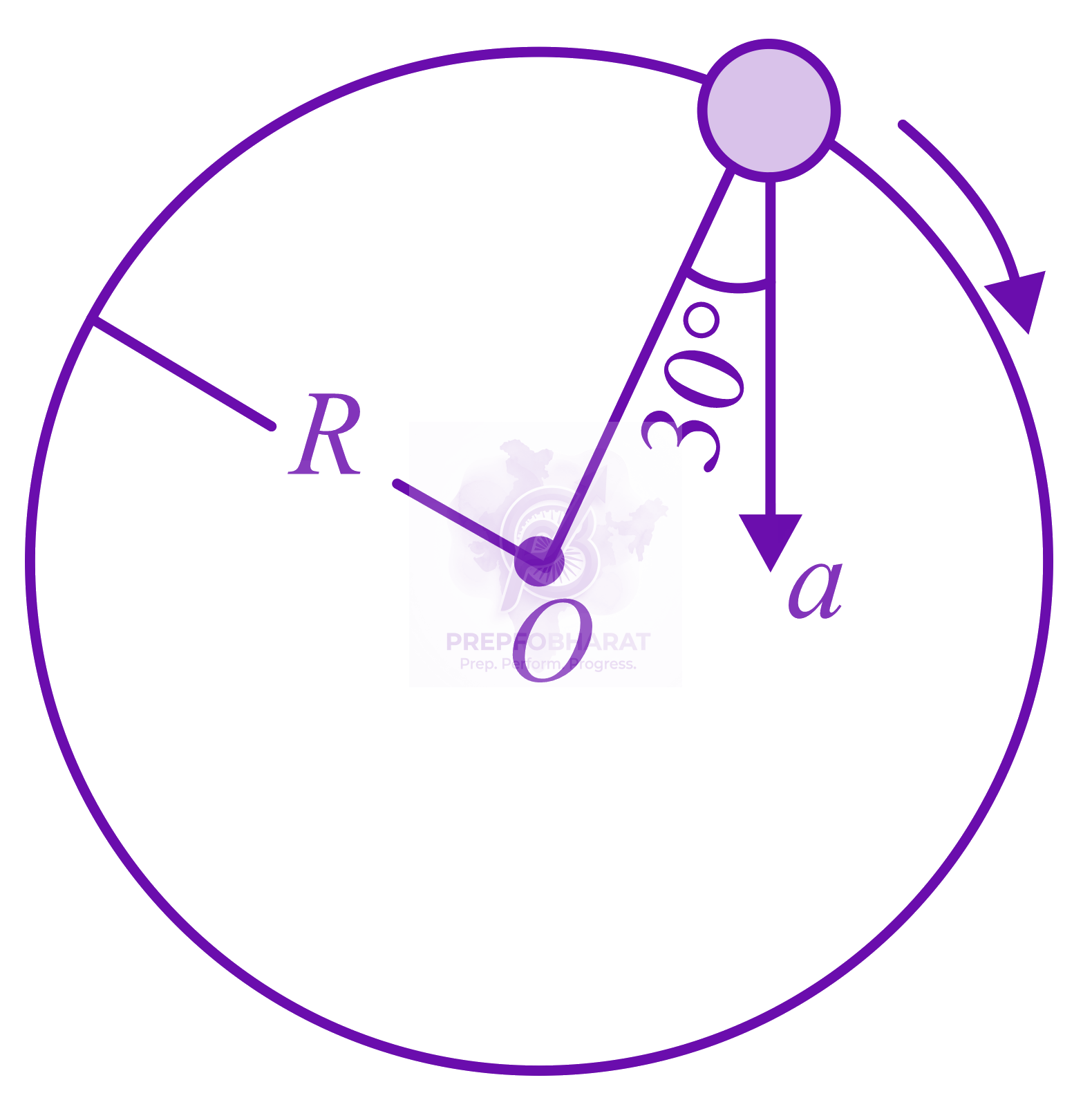
A rectangular film of liquid is extended from $(4 \mathrm{cm}\times 2 \mathrm{cm})$ to $(5 \mathrm{cm}\times 4 \mathrm{cm})$. If the work done is $3\times {10}^{-4} J$, the value of the surface tension of the liquid is
The ratio of escape velocity at earth $({\upsilon }_{e})$ to the escape velocity at a planet $({\upsilon }_{p})$ whose radius and mean density are twice as that of earth is:
Starting from the center of the earth having radius, $R$, the variation of $g$ (acceleration due to gravity) is shown by
From a disc of radius $R$ and mass $M$, a circular hole of diameter $R$, whose rim passes through the centre is cut. What is the moment of inertia of the remaining part of the disc about a perpendicular axis, passing through the centre?
Two cars $P$ and $Q$ start from a point at the same time in a straight line and their positions are represented by ${X}_{P}(t)=at+b{t}^{2}$ and ${X}_{Q}(t)=ft-{t}^{2}$. At what time do the cars have the same velocity?
A light rod of length, $l$ has two masses, ${m}_{1}$ and ${m}_{2}$ attached to its two ends. The moment of inertia of the system about an axis perpendicular to the rod and passing through the centre of mass is
A rigid ball of mass, $m$ strikes a rigid wall at ${60}^{o}$ and gets reflected without any loss of speed as shown in the figure below. The value of impulse imparted by the wall on the ball will be 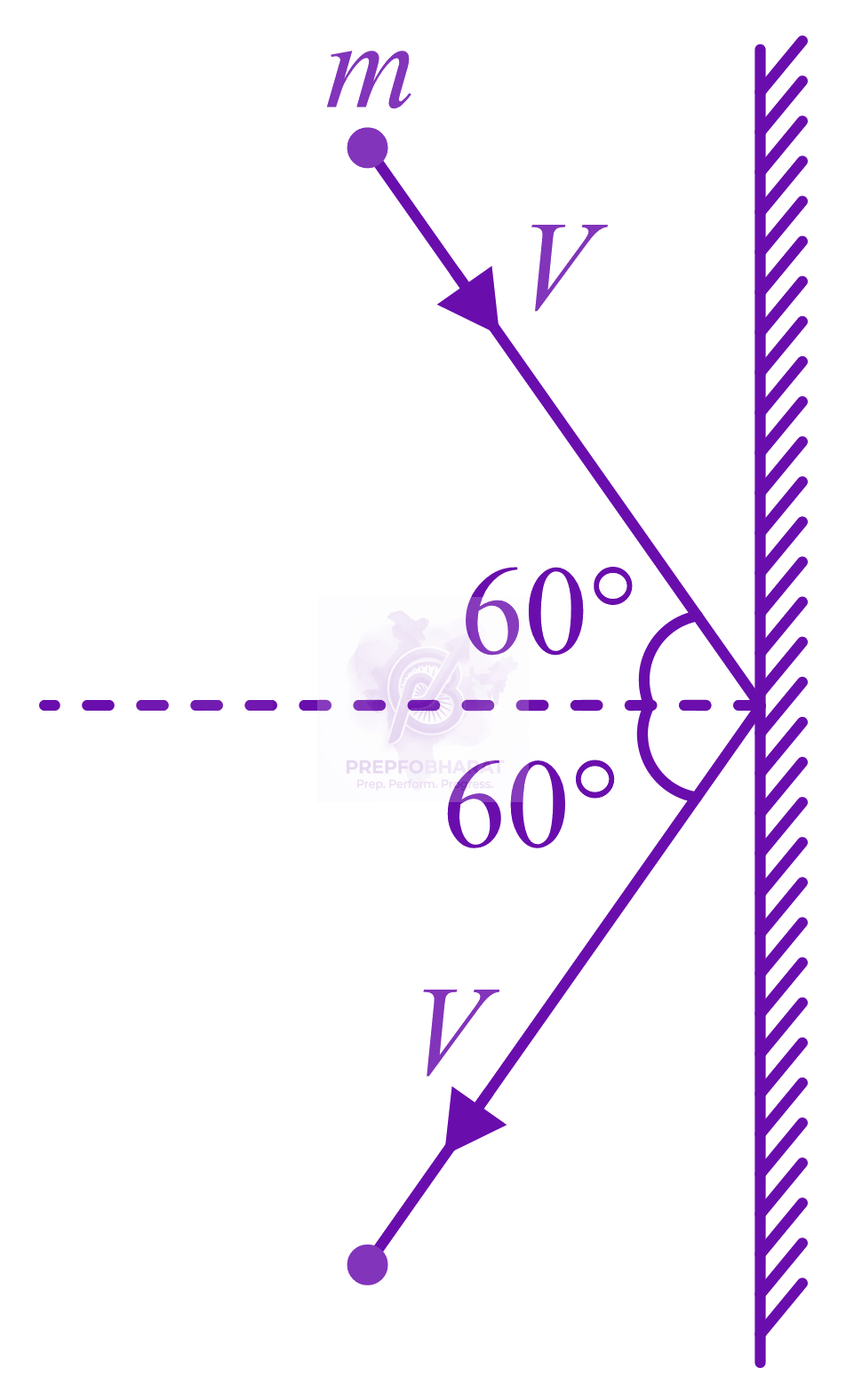
What is the minimum velocity with which a body of mass m must enter a vertical loop of radius $\text{R}$ so that it can complete the loop?
If the velocity of a particle is $\upsilon =At+B{t}^{2}$, where $\text{A}$ and $\text{B}$ are constants, then the distance travelled by it between $\text{1} \text{s}$ and $\text{2} \text{s}$ is:
A car is negotiating a curved road of radius $\text{R}$. The road is banked at an angle $\theta$. The coefficient of friction between the tyres of the car and the road is ${\mu }_{s}$. The maximum safe velocity on this road is:
A body of mass $1\mathrm{kg}$ begins to move from rest under the action of a time dependent force $\vec{F}=(2t \hat{i}+3{t}^{2} \hat{j})N$, where $\hat{i}$and $\hat{j}$ are unit vectors along x and y axis. What power will be developed by the force at the time t?
Two identical balls $A$ and $B$ having velocities of $0.5m{s}^{-1}$ and $-0.3m{s}^{-1}$, respectively, collide elastically in one dimension. The velocities of $B$ and $A$ after the collision, respectively, will be
A uniform circular disc of radius $\text{50}\text{ cm}$ at rest is free to rotate about an axis which is perpendicular to its plane and passes through its centre. It is subjected to a torque which produces a constant angular acceleration of $2.0 rad {s}^{-2}$. Its net acceleration in $m {s}^{-2}$ at the end of $\text{2.0 s}$ is approximately: