NEET UG 2024 — Mechanics
Physics Mechanics questions from NEET UG 2024.
Other Years
28 Mechanics Questions from 2024
In a vernier callipers, $(N+1)$ divisions of vernier scale coincide with $N$ divisions of main scale. If 1 MSD represents 0.1 mm , the vernier constant (in cm ) is:
A box of mass 5 kg is pulled by a cord, up along a frictionless plane inclined at $30^{\circ}$ with the horizontal. The tension in the cord is 30 N . The acceleration of the box is (Take $g=10 \mathrm{~m} \mathrm{~s}^{-2}$ )
A metallic bar of Young's modulus, $0.5 \times 10^{11} \mathrm{~N} \mathrm{~m}^{-2}$ and coefficient of linear thermal expansion $10^{-5}{ }^{\circ} \mathrm{C}^{-1}$, length 1 m and area of cross-section $10^{-3} \mathrm{~m}^2$ is heated from $0^{\circ} \mathrm{C}$ to $100^{\circ} \mathrm{C}$ without expansion or bending. The compressive force developed in it is :
An ideal fluid is flowing in a non-uniform cross-sectional tube $X Y$ (as shown in the figure) from end $X$ to end $Y$. If $K_1$ and $K_2$ are the kinetic energy per unit volume of the fluid at $X$ and $Y$ respectively, then the correct option is : 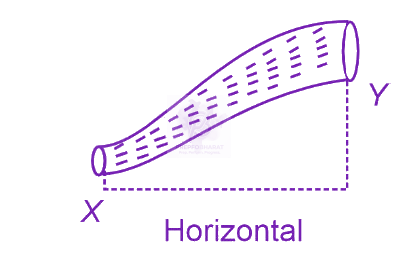
A particle moving with uniform speed in a circular path maintains:
An object moving along horizontal $x$-direction with kinetic energy 10 J is displaced through $x=(3 \hat{i}) \mathrm{m}$ by the force $\vec{F}=(-2 \hat{i}+3 \hat{j}) \mathrm{N}$. The kinetic energy of the object at the end of the displacement $x$ is
Two heaters A and B have power rating of 1 kW and 2 kW , respectively. Those two are first connected in series and then in parallel to a fixed power source. The ratio of power outputs for these two cases is:
A force defined by $F=\alpha t^2+\beta t$ acts on a particle at a given time $t$. The factor which is dimensionless, if $\alpha$ and $\beta$ are constants, is:
The quantities which have the same dimensions as those of solid angle are:
The potential energy of a particle moving along $x$-direction varies as $V=\frac{A x^2}{\sqrt{x}+B}$. The dimensions of $\frac{A^2}{B}$ are:
A wheel of a bullock cart is rolling on a level road as shown in the figure below. If its linear speed is $v$ in the direction shown, which one of the following options is correct ( $P$ and $Q$ are any highest and lowest points on the wheel, respectively)? 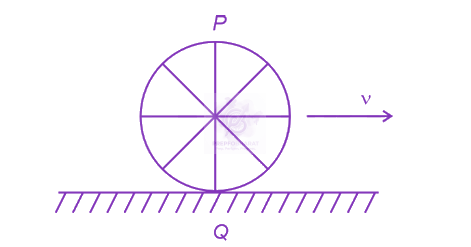
A bob is whirled in a horizontal circle by means of a string at an initial speed of 10 rpm. If the tension in the string is quadrupled while keeping the radius constant, the new speed is:
A bob is whirled in a horizontal plane by means of a string with an initial speed of $\omega$ rpm. The tension in the string is $T$. If speed becomes $2 \omega$ while keeping the same radius, the tension in the string becomes:
The mass of a planet is $\frac{1}{10}$ th that of the earth and its diameter is half that of the earth. The acceleration due to gravity on that planet is:
A horizontal force 10 N is applied to a block $A$ as shown in figure. The mass of blocks $A$ and $B$ are 2 kg and 3 kg respectively. The blocks slide over a frictionless surface. The force exerted by block $A$ on block $B$ is : 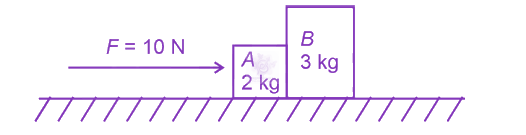
The velocity $(v)$ - time $(t)$ plot of the motion of a body is shown below: 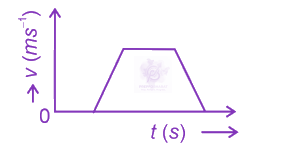 The acceleration (a) - time $(t)$ graph that best suits this motion is :
The escape velocity for earth is $v$. A planet having 9 times mass that of earth and radius, 16 times that of earth, has the escape velocity of:
An object falls from a height of 10 m above the ground. After striking the ground it loses $50 \%$ of its kinetic energy. The height upto which the object can rebounce from the ground is:
A thin flat circular disc of radius 4.5 cm is placed gently over the surface of water. If surface tension of water is $0.07 \mathrm{~N} \mathrm{~m}^{-1}$, then the excess force required to take it away from the surface is
A particle is moving along $x$-axis with its position (x) varying with time $(t)$ as $x=\alpha t^4+\beta t^2+\gamma t+\delta$. The ratio of its initial velocity to its initial acceleration, respectively, is:
The moment of inertia of a thin rod about an axis passing through its mid point and perpendicular to the rod is $2400 \mathrm{~g} \mathrm{~cm}^2$. The length of the 400 g rod is nearly:
At any instant of time $t$, the displacement of any particle is given by $2 t-1$ (SI unit) under the influence of force of 5 N . The value of instantaneous power is (in SI unit):
The minimum energy required to launch a satellite of mass $m$ from the surface of earth of mass $M$ and radius $R$ in a circular orbit at an altitude of $2 R$ from the surface of the earth is:
The radius of gyration of a solid sphere of mass 5 kg about $X Y$ is 5 m as shown in figure. The radius of the sphere is $\frac{5 x}{\sqrt{7}} \mathrm{~m}$, then the value of $x$ is: 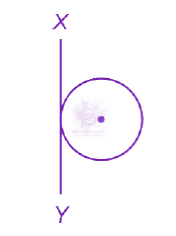
The pitch of an error free screw gauge is 1 mm and there are 100 divisions on the circular scale. While measuring the diameter of a thick wire, the pitch scale reads 1 mm and $63^{\text {rd }}$ division on the circular scale coincides with the reference line. The diameter of the wire is:
Two bodies $A$ and $B$ of same mass undergo completely inelastic one dimensional collision. The body $A$ moves with velocity $v_1$ while body $B$ is at rest before collision. The velocity of the system after collision is $v_2$. The ratio $v_1: v_2$ is
An object of mass 100 kg falls from point $A$ to $B$ as shown in figure. The change in its weight, corrected to the nearest integer is ( $R_E$ is the radius of the earth) 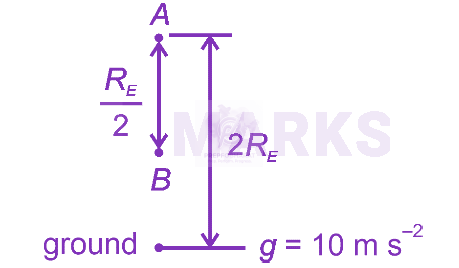
The maximum elongation of a steel wire of 1 m length if the elastic limit of steel and its Young's modulus, respectively, are $8 \times 10^8 \mathrm{~N} \mathrm{~m}^{-2}$ and $2 \times 10^{11} \mathrm{~N} \mathrm{~m}^{-2}$, is: