NEET UG 2007 — Mechanics
Physics Mechanics questions from NEET UG 2007.
Other Years
12 Mechanics Questions from 2007
A wheel has angular acceleration of 3.0 $\mathrm{rad} / \mathrm{sec}^2$ and an initial angular speed of $2~ \mathrm{rad}/ \mathrm{sec}$. In a time of $2 \mathrm{sec}$ it has rotated through an angle (in radian) of:
A uniform rod $\mathrm{AB}$ of length $I$ and mass $m$ is free to rotate about point $A$. The rod is released from rest in the horizontal position. Given that the moment of inertia of the rod about $\mathrm{A}$ is $m l^2 / 3$, the initial angular acceleration of the rod will be 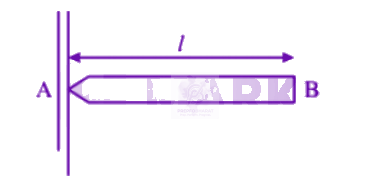
A particle starting from the origin $(0,0)$ moves in a straight line in the $(x, y)$ plane. Its coordinates at a later time are $(\sqrt{3}, 3)$. The path of the particle makes with the $x$-axis an angle of:
A block $B$ is pushed momentarily along a horizontal surface with an initial velocity $V$. If $\mu$ is the coefficient of sliding friction between B and the surface, block B will come to rest after a time. 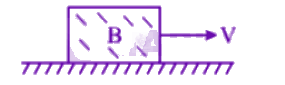
Dimensions of resistance in an electrical circuit, in terms of dimension of mass $M$, of length $L$, of time $T$ and of current $I$, would be
A particle moving along $x$-axis has acceleration $f$, at time $t$, given by $f=$ $f_0\left(1-\frac{t}{T}\right)$, where $f_0$ and $T$ are constants. The particle at $t=0$ has zero velocity. In the time interval between $t=0$ and the instant when $f=0$, the particle's velocity $\left(v_x\right)$ is:
A vertical spring with force constant $k$ is fixed on a table. A ball of mass $m$ at a height $h$ above the free upper end of the spring falls vertically on the spring so that the spring is compressed by a distance $d$. The net work done in the process is
A particle of mass $m$ moves in the $X Y$ plane with a velocity $v$ along the straight line $\mathrm{AB}$. If the angular momentum of the particle with respect to origin $\mathrm{O}$ is $L_A$ when it is at A and $L_B$ when it is at B, then: 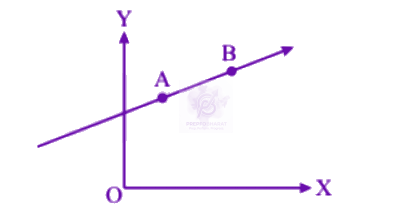
A car moves from $\mathrm{X}$ to $\mathrm{Y}$ with a uniform speed $v_u$. The average speed for this round trip is :
$\vec{A}$ and $\overline{\mathrm{B}}$ are two vectors and $\theta$ is the angle between them, if $|\overrightarrow{\mathrm{A}} \times \overline{\mathrm{B}}|=$ $\sqrt{3}(\overrightarrow{\mathrm{A}} \cdot \overline{\mathrm{B}})$, the value of $\theta$ is.
The position $x$ of a particle with respect to time $t$ along $x$-axis is given by $x=9 t^2$ $-t^3$ where $x$ is in metres and $t$ in second. What will be the position of this particle when it achieves maximum speed along the $+x$ direction?
Two satellites of earth, $\mathrm{S}_1$ and $\mathrm{S}_2$ are moving in the same orbit. The mass of $S_1$ of four times the mass of $S_2$. Which one of the following statements is true?