Thermodynamics PYQ — Page 2
JEE Main Physics — Thermodynamics previous year questions with solutions.
All Thermodynamics Questions (487)
A vessel contains $0.15$ m$^3$ of a gas at pressure $8$ bar and temperature $140°$C with $c_p = 3R$ and $c_v = 2R$. It is expanded adiabatically till pressure falls to $1$ bar. The work done during this process is _______ kJ. ($R$ is gas constant)
The internal energy of a monoatomic gas is 3 nRT. One mole of helium is kept in a cylinder having internal cross section area of $17 \mathrm{~cm}^{2}$ and fitted with a light movable frictionless piston. The gas is heated slowly by suppling 126 J heat. If the temperature rises by $4^{\circ} \mathrm{C}$, then the piston will move $\_\_\_\_$ cm. (atmospheric pressure $=10^{5} \mathrm{~Pa}$)
If $2$ mole of an ideal monoatomic gas at temperature $T$, is mixed with $6$ mole of another ideal monoatomic gas at temperature $2T$ then the temperature of mixture is :
Initial pressure and volume of a monoatomic ideal gas are $P$ and $V$. The change in internal energy of this gas in adiabatic expansion to volume $V_{final}=27V$ is ________ J.
One mole of diatomic gas having rotational modes only is kept in a cylinder with a piston system. The cross-section area of the cylinder is $4$ cm$^2$. The gas is heated slowly to raise the temperature by $1.2\,^\circ$C during which the piston moves by $25$ mm. The amount of heat supplied to the gas is ________ J. (Atmospheric pressure $=100$ kPa, $R=8.3$ J/mol·K) (Neglect mass of the piston)
An aluminium and steel rods having same lengths and cross-sections are joined to make total length of 120 cm at $30^{\circ} \mathrm{C}$. The coefficient of linear expansion of aluminium and steel are $24 \times 10^{-6} /{ }^{\circ} \mathrm{C}$ and $1.2 \times 10^{-5} /{ }^{\circ} \mathrm{C}$, respectively. The length of this composite rod when its temperature is raised to $100^{\circ} \mathrm{C}$, is $\_\_\_\_$ cm.
Given below are two statements: one is labelled as Assertion A and the other is labelled as Reason R Statement I: Change in internal energy of a system containing $n$ mole of ideal gas can be written as $\Delta U = n C_v (T_f - T_i) = \dfrac{nR}{\gamma - 1}(T_f - T_i)$, where $\gamma = \dfrac{C_p}{C_v}$, $T_i =$ initial temperature, $T_f =$ final temperature. Statement II: Relation between degree of freedom $f$ and $\gamma (= C_p/C_v)$ is $\left(\gamma = 1 + \dfrac{2}{f}\right)$ Choose the correct answer from the options given below
10 mole of an ideal gas is undergoing the process shown in the figure. The heat involved in the process from $P_{1}$ to $P_{2}$ is $\alpha$ Joule ($P_{1}=21.7 \mathrm{~Pa}$ and $\left.P_{2}=30 \mathrm{~Pa}, \mathrm{C}_{v}=21 \mathrm{~J} / \mathrm{K}. \mathrm{mol}, R=8.3 \mathrm{~J} / \mathrm{mol}. \mathrm{K}\right)$. The value of $\alpha$ is $\_\_\_\_$. 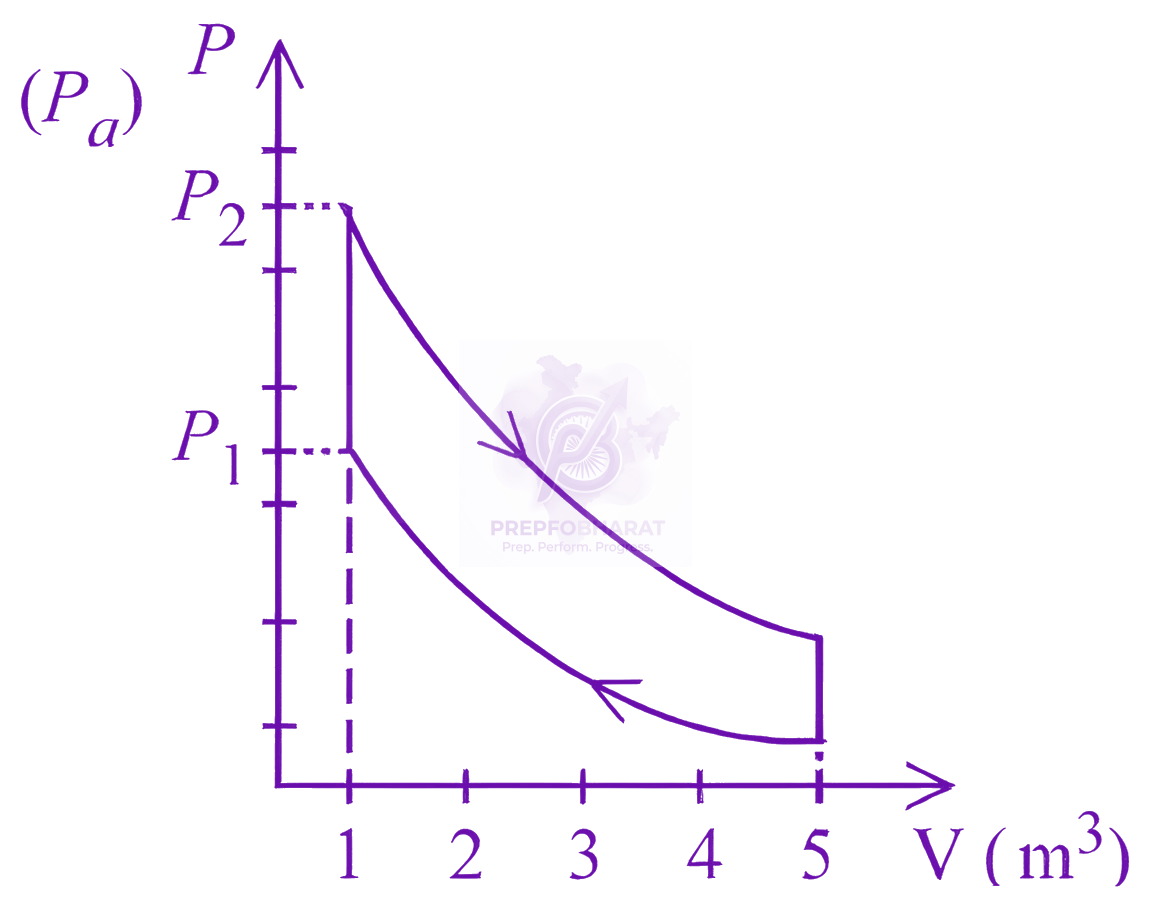
When 300 J of heat given to an ideal gas with $C_{p}=\frac{7}{2} R$ its temperature raises from $20^{\circ} \mathrm{C}$ to $50^{\circ} \mathrm{C}$ keeping its volume constant. If n is the number of moles of the gas, then what is the value of $100n$? $(\mathrm{R}=8.314 \mathrm{~J} / \mathrm{mol}. \mathrm{K})$
An ideal gas undergoes a process maintaining relation between pressure $(P)$ and volume $(V)$ as $P = P_o\left(1 + \left(\dfrac{V_o}{V}\right)^2\right)^{-1}$, where $P_o$ and $V_o$ are constants. If two samples $A$ and $B$ (two moles each) with initial volumes $V_o$ and $3V_o$ respectively undergo above mentioned process and attain same pressure, then the difference at the temperatures of these samples, $T_B - T_A$ is _____. ($R = $ gas constant)
A mixture of carbon dioxide and oxygen has volume $8310$ cm$^3$, temperature $300$ K, pressure $100$ kPa and mass $13.2$ g. The number of moles of carbon dioxide and oxygen gases in the mixture respectively are _______. (Assume both carbon dioxide and oxygen gases behave like ideal gases) $[R = 8.31$ J/mol.K$]$
An insulated cylinder of volume $60 \mathrm{~cm}^{3}$ is filled with a gas at $27^{\circ} \mathrm{C}$ and 2 atmospheric pressure. Then the gas is compressed making the final volume as $20 \mathrm{~cm}^{3}$ while allowing the temperature to rise to $77^{\circ} \mathrm{C}$. The final pressure is $\_\_\_\_$ atmospheric pressure.
Consider two boxes containing ideal gases $A$ and $B$ such that their temperatures, pressures and number densities are same. The molecular size of $A$ is half of that of $B$ and mass of molecule $A$ is four times that of $B$. If the collision frequency in gas $B$ is $32 \times 10^{18} / \mathrm{s}$ then collision frequency in gas $A$ is $\_\_\_\_$ $/ \mathrm{s}$.
One mole of an ideal diatomic gas expands from volume $V$ to 2 V isothermally at a temperature $27^{\circ} \mathrm{C}$ and does $W$ joule of work. If the gas undergoes same magnitude of expansion adiabatically from $27^{\circ} \mathrm{C}$ doing the same amount of work $W$, then its final temperature will be (close to) $\_\_\_\_$ ${ }^{\circ} \mathrm{C}$. $\left(\log _{\mathrm{e}} 2=0.693\right)$
The temperature of a metal strip having coefficient of linear expansion $\alpha$ is increased from $T_1$ to $T_2$ resulting in increase of its length by $\Delta L_1$. The temperature is further increased from $T_2$ to $T_3$ such that the increase in its length is $\Delta L_2$. Given $T_3+T_1=2T_2$ and $T_2-T_1=\Delta T$, the value of $\Delta L_2$ is ______.
The mean free path of a molecule of diameter $5 \times 10^{-10} \mathrm{~m}$ at the temperature $41^{\circ} \mathrm{C}$ and pressure $1.38 \times 10^{5} \mathrm{~Pa}$, is given as $\_\_\_\_$ m. (Given $k_{B}=1.38 \times 10^{-23} \mathrm{~J} / \mathrm{K}$).
Two closed vessels of same volume are joined through a narrow tube and both vessels are filled with air of pressure $90$ kPa and temperature $400$ K. Keeping the temperature of one vessel constant at $400$ K the second vessel temperature is raised to $500$ K. The final pressure in the vessels is _______ kPa.
Identify the characteristics of an adiabatic process in a monoatomic gas. (A) Internal energy is constant. (B) Work done in the process is equal to the charge in internal energy. (C) The product of temperature and volume is a constant. (D) The product of pressure and volume is a constant. (E) The work done to change the temperature from $\mathrm{T}_1$ to $\mathrm{T}_2$ is proportional to $\left(\mathrm{T}_2-\mathrm{T}_1\right)$ Choose the correct answer from the options given below :
Given are statements for certain thermodynamic variables, (A) Internal energy, volume (V) and mass (M) are extensive variables. (B) Pressure (P), temperature (T) and density ( $\rho$ ) are intensive variables. (C) Volume (V), temperature (T) and density ( $\rho$ ) are intensive variables. (D) Mass (M), temperature (T) and internal energy are extensive variables. Choose the correct answer from the options given below :
$\gamma_{\mathrm{A}}$ is the specific heat ratio of monoatomic gas A having 3 translational degrees of freedom. $\gamma_B$ is the specific heat ratio of polyatomic gas B having 3 translational, 3 rotational degrees of freedom and 1 vibrational mode. If $\frac{\gamma_{\mathrm{A}}}{\gamma_{\mathrm{B}}}=\left(1+\frac{1}{\mathrm{n}}\right)$, then the value of $n$ is _______.
$$ \text{Match the LIST-I with LIST-II} $$ \[ \begin{array}{|l|p{6cm}|l|p{4cm}|} \hline \textbf{LIST-I} & & \textbf{LIST-II} & \\ \hline A. & \text{Pressure varies inversely with volume of an ideal gas.} & I. & \text{Adiabatic process} \\ \hline B. & \text{Heat absorbed goes partly to increase internal energy and partly to do work.} & II. & \text{Isochoric process} \\ \hline C. & \text{Heat is neither absorbed nor released by a system.} & III. & \text{Isothermal process} \\ \hline D. & \text{No work is done on or by a gas.} & IV. & \text{Isobaric process} \\ \hline \end{array} \] $$ \text{Choose the correct answer from the options given below:} $$
A Carnot engine $(\mathrm{E})$ is working between two temperatures 473 K and 273 K . In a new system two engines - engine $E_1$ works between 473 K to 373 K and engine $E_2$ works between 373 K to 273 K . If $\eta_{12}, \eta_1$ and $\eta_2$ are the efficiencies of the engines $E, E_1$ and $E_2$, respectively, then
Pressure of an ideal gas, contained in a closed vessel, is increased by $0.4 \%$ when heated by $1^{\circ} \mathrm{C}$. Its initial temperature must be :
A gun fires a lead bullet of temperature 300 K into a wooden block. The bullet having melting temperature of 600 K penetrates into the block and melts down. If the total heat required for the process is 625 J , then the mass of the bullet is $\qquad$ grams. (Latent heat of fusion of lead $=2.5 \times 10^4 \mathrm{JKg}^{-1}$ and specific heat capacity of lead $=125 \mathrm{JKg}^{-1}$ $\left.\mathrm{K}^{-1}\right)$