JEE Main Physics — Thermodynamics previous year questions with solutions.
Pressure of an ideal gas, contained in a closed vessel, is increased by $0.4 \%$ when heated by $1^{\circ} \mathrm{C}$. Its initial temperature must be :
The internal energy of air in $4 \mathrm{~m} \times 4 \mathrm{~m} \times 3 \mathrm{~m}$ sized room at 1 atmospheric pressure will be _______ $\times 10^6 \mathrm{~J}$. (Consider air as diatomic molecule)
A gun fires a lead bullet of temperature 300 K into a wooden block. The bullet having melting temperature of 600 K penetrates into the block and melts down. If the total heat required for the process is 625 J , then the mass of the bullet is $\qquad$ grams. (Latent heat of fusion of lead $=2.5 \times 10^4 \mathrm{JKg}^{-1}$ and specific heat capacity of lead $=125 \mathrm{JKg}^{-1}$ $\left.\mathrm{K}^{-1}\right)$
A gas is kept in a container having walls which are thermally non-conducting. Initially the gas has a volume of $800 \mathrm{~cm}^3$ and temperature $27^{\circ} \mathrm{C}$. The change in temperature when the gas is adiabatically compressed to $200 \mathrm{~cm}^3$ is : (Take $\gamma=1.5: \gamma$ is the ratio of specific heats at constant pressure and at constant volume)
An amount of ice of mass $10^{-3} \mathrm{~kg}$ and temperature $-10^{\circ} \mathrm{C}$ is transformed to vapour of temperature $110^{\circ} \mathrm{C}$ by applying heat. The total amount of work required for this conversion is, (Take, specific heat of ice $=2100 \mathrm{Jkg}^{-1} \mathrm{~K}^{-1}$, specific heat of water $=4180 \mathrm{Jkg}^{-1} \mathrm{~K}^{-1}$, specific heat of steam $=1920 \mathrm{Jkg}^{-1} \mathrm{~K}^{-1}$, Latent heat of ice $=3.35 \times 10^5 \mathrm{Jkg}^{-1}$ and Latent heat of steam $=2.25 \times 10^6$ $\mathrm{Jkg}^{-1}$ )
$$ \text{Match the LIST-I with LIST-II} $$ \[ \begin{array}{|l|p{6cm}|l|p{4cm}|} \hline \textbf{LIST-I} & & \textbf{LIST-II} & \\ \hline A. & \text{Pressure varies inversely with volume of an ideal gas.} & I. & \text{Adiabatic process} \\ \hline B. & \text{Heat absorbed goes partly to increase internal energy and partly to do work.} & II. & \text{Isochoric process} \\ \hline C. & \text{Heat is neither absorbed nor released by a system.} & III. & \text{Isothermal process} \\ \hline D. & \text{No work is done on or by a gas.} & IV. & \text{Isobaric process} \\ \hline \end{array} \] $$ \text{Choose the correct answer from the options given below:} $$
An ideal gas initially at $0^{\circ} \mathrm{C}$ temperature, is compressed suddenly to one fourth of its volume. If the ratio of specific heat at constant pressure to that at constant volume is $3 / 2$, the change in temperature due to the thermodynamic process is _____ K.
Given below are two statements. One is labelled as Assertion (A) and the other is labelled as Reason (R). Assertion (A) : With the increase in the pressure of an ideal gas, the volume falls off more rapidly in an isothermal process in comparison to the adiabatic process. Reason (R) : In isothermal process, $\mathrm{PV}=$ constant, while in adiabatic process $\mathrm{PV}^\gamma=$ constant. Here $\gamma$ is the ratio of specific heats, P is the pressure and V is the volume of the ideal gas. In the light of the above statements, choose the correct answer from the options given below :
Which of the following figure represents the relation between Celsius and Fahrenheit temperatures ?
Two spherical bodies of same materials having radii 0.2 m and 0.8 m are placed in same atmosphere. The temperature of the smaller body is 800 K and temperature of the bigger body is 400 K . If the energy radiated from the smaller body is E, the energy radiated from the bigger body is (assume, effect of the surrounding temperature to be negligible),
The magnitude of heat exchanged by a system for the given cyclic process ABCA (as shown in figure) is (in SI unit) : 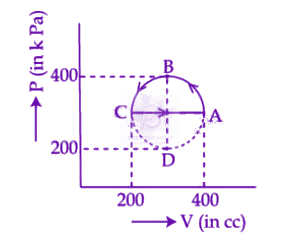
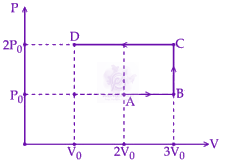 Using the given $\mathrm{P}-\mathrm{V}$ diagram, the work done by an ideal gas along the path ABCD is :
A monoatomic gas having $\gamma=\frac{5}{3}$ is stored in a thermally insulated container and the gas is suddenly compressed to $\left(\frac{1}{8}\right)^{\text {th }}$ of its initial volume. The ratio of final pressure and initial pressure is: ( $\gamma$ is the ratio of specific heats of the gas at constant pressure and at constant volume)
A wire of length 10 cm and diameter 0.5 mm is used in a bulb. The temperature of the wire is $1727^{\circ} \mathrm{C}$ and power radiated by the wire is 94.2 W. Its emissivity is $\frac{x}{8}$ where $x=$_______ (Given $\sigma=6.0 \times 10^{-8} \mathrm{~W} \mathrm{~m}^{-2} \mathrm{~K}^{-4}, \pi=3.14$ and assume that the emissivity of wire material is same at all wavelength.)
Given below are two statements. One is labelled as Assertion (A) and the other is labelled as Reason (R). Assertion (A) : In an insulated container, a gas is adiabatically shrunk to half of its initial volume. The temperature of the gas decreases. Reason (R): Free expansion of an ideal gas is an irreversible and an adiabatic process. In the light of the above statements, choose the correct answer from the options given below :
Identify the characteristics of an adiabatic process in a monoatomic gas. (A) Internal energy is constant. (B) Work done in the process is equal to the charge in internal energy. (C) The product of temperature and volume is a constant. (D) The product of pressure and volume is a constant. (E) The work done to change the temperature from $\mathrm{T}_1$ to $\mathrm{T}_2$ is proportional to $\left(\mathrm{T}_2-\mathrm{T}_1\right)$ Choose the correct answer from the options given below :
Match List-I with List-II. \(\begin{array}{|l|l|l|l|} \hline & \text{List - I} & & \text{List - II} \\ \hline \text { (A) } & \text { Isobaric } & \text { (I) } & \Delta Q=\Delta W \\ \hline \text { (B) } & \text { Isochoric } & \text { (II) } & \Delta Q=\Delta U \\ \hline \text { (C) } & \text { Adiabatic } & \text { (III) } & \Delta Q=\text { zero } \\ \hline \text { (D) } & \text { Isothermal } & \text { (IV) } & \Delta Q=\Delta U+P \Delta V \\ \hline \end{array}\) $\Delta \mathrm{Q}=$ Heat supplied $\Delta \mathrm{W}=$ Work done by the system $\Delta \mathrm{U}=$ Change in internal energy $\mathrm{P}=$ Pressure of the system $\Delta \mathrm{V}=$ Change in volume of the system Choose the correct answer from the options given below:
During the melting of a slab of ice at 273 K at atmospheric pressure :
A Carnot engine $(\mathrm{E})$ is working between two temperatures 473 K and 273 K . In a new system two engines - engine $E_1$ works between 473 K to 373 K and engine $E_2$ works between 373 K to 273 K . If $\eta_{12}, \eta_1$ and $\eta_2$ are the efficiencies of the engines $E, E_1$ and $E_2$, respectively, then
The temperature of 1 mole of an ideal monoatomic gas is increased by $50^{\circ} \mathrm{C}$ at constant pressure. The total heat added and change in internal energy are $E_1$ and $E_2$, respectively. If $\frac{E_1}{E_2}=\frac{x}{9}$ then the value of $x$ is _____
For a diatomic gas, if $\gamma_1=\left(\frac{C p}{C v}\right)$ for rigid molecules and $\gamma_2=\left(\frac{C p}{C v}\right)$ for another diatomic molecules, but also having vibrational modes. Then, which one of the following options is correct ? (Cp and Cv are specific heats of the gas at constant pressure and volume)
An ideal gas has undergone through the cyclic process as shown in the figure. Work done by the gas in the entire cycle is ______ $\times 10^{-1} \mathrm{~J}$. (Take $\pi=3.14$) 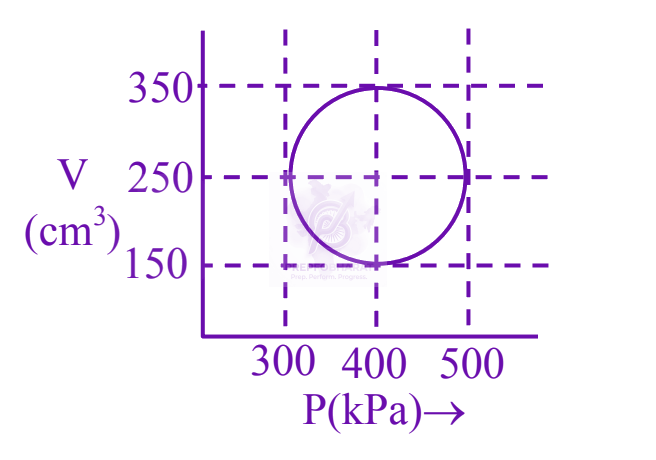
Match the $\mathrm {List-I}$ with $\mathrm {List-II}$ $\begin{array}{|l|l|l|l|}\hline & \text{List-I} & & \text{List-II} \\ \hline \text{A.} & \text{Triatomic rigid gas} & \text{I.} & \frac{\mathrm{C}_{\mathrm{P}}}{\mathrm{C}_{\mathrm{V}}}=\frac{5}{3} \\ \hline \text{B.} & \begin{array}{l} \text{Diatomic non-rigid} \\ \text{gas} \end{array} & \text{II.} & \frac{\mathrm{C}_{\mathrm{P}}}{\mathrm{C}_{\mathrm{V}}}=\frac{7}{5} \\ \hline \text{C.} & \text{Monoatomic gas} & \text{III.} & \frac{\mathrm{C}_{\mathrm{P}}}{\mathrm{C}_{\mathrm{V}}}=\frac{4}{3} \\ \hline \text{D.} & \text{Diatomic rigid gas} & \text{IV }& \frac{\mathrm{C}_{\mathrm{P}}}{\mathrm{C}_{\mathrm{V}}}=\frac{9}{7} \\ \hline\end{array}$ Choose the $\mathrm {correct}$ answer from the options given below :
Consider a rectangular sheet of solid material of length $\ell=9 \mathrm{~cm}$ and width $\mathrm{d}=4 \mathrm{~cm}$. The coefficient of linear expansion is $\alpha=3.1 \times 10^{-5} \mathrm{~K}^{-1}$ at room temperature and one atmospheric pressure. The mass of sheet $\mathrm{m}=0.1 \mathrm{~kg}$ and the specific heat capacity $\mathrm{C}_{\mathrm{v}}=900 \mathrm{~J} \mathrm{~kg}^{-1} \mathrm{~K}^{-1}$. If the amount of heat supplied to the material is $8.1 \times 10^2 \mathrm{~J}$ then change in area of the rectangular sheet is :-