JEE Main Physics — Thermodynamics previous year questions with solutions.
The temperature of a body in air falls from $40^{\circ} \mathrm{C}$ to $24^{\circ} \mathrm{C}$ in 4 minutes. The temperature of the air is $16^{\circ} \mathrm{C}$. The temperature of the body in the next 4 minutes will be:
For a particular ideal gas which of the following graphs represents the variation of mean squared velocity of the gas molecules with temperature?
The workdone in an adiabatic change in an ideal gas depends upon only :
Given are statements for certain thermodynamic variables, (A) Internal energy, volume (V) and mass (M) are extensive variables. (B) Pressure (P), temperature (T) and density ( $\rho$ ) are intensive variables. (C) Volume (V), temperature (T) and density ( $\rho$ ) are intensive variables. (D) Mass (M), temperature (T) and internal energy are extensive variables. Choose the correct answer from the options given below :
The helium and argon are put in the flask at the same room temperature ( 300 K). The ratio of average kinetic energies (per molecule) of helium and argon is : (Give : Molar mass of helium $=4 \mathrm{~g} / \mathrm{mol}$, Molar mass of argon $=40 \mathrm{~g} / \mathrm{mol}$)
$\gamma_{\mathrm{A}}$ is the specific heat ratio of monoatomic gas A having 3 translational degrees of freedom. $\gamma_B$ is the specific heat ratio of polyatomic gas B having 3 translational, 3 rotational degrees of freedom and 1 vibrational mode. If $\frac{\gamma_{\mathrm{A}}}{\gamma_{\mathrm{B}}}=\left(1+\frac{1}{\mathrm{n}}\right)$, then the value of $n$ is _______.
An ideal gas exists in a state with pressure $P_0$ volume $\mathrm{V}_0$.It is isothermally expanded to 4 times of its initial volume $\left(\mathrm{V}_0\right)$, then isobarically compressed to its original volume. Finally the system is heated isochorically to bring it to its initial state. The amount of heat exchanged in this process is :
Match List-I with List-II. $\begin{array}{|l|l|l|l|} \hline & \text{List-I} & & \text{List-II} \\ \hline \text{(A)} & \text{Isothermal} & \text{(I)} & \Delta \mathrm{W} \text{(work done)} =0 \\ \hline \text{(B)} & \text{Adiabatic} & \text{(II)} & \Delta \mathrm{Q} \text{(supplied heat)} =0 \\ \hline \text{(C)} & \text{Isobaric} & \text{(III)} & \begin{array}{l}\Delta \mathrm{U} \text{(change in internal} \\ \text{energy} \neq 0\end{array} \\ \hline \text{(D)} & \text{Isochoric} & \text{(IV)} & \Delta \mathrm{U}=0 \\ \hline\end{array}$ Choose the correct answer from the options given below :
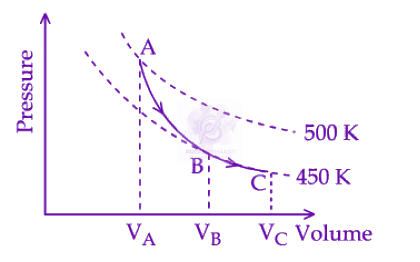 A poly-atomic molecule ( $C_V=3 R, C_P=4 R$, where $R$ is gas constant) goes from phase space point $\mathrm{A}\left(\mathrm{P}_{\mathrm{A}}=10^5 \mathrm{~Pa}, \mathrm{~V}_{\mathrm{A}}=4 \times 10^{-6} \mathrm{~m}^3\right)$ to point $\mathrm{B}\left(\mathrm{P}_{\mathrm{B}}=5 \times 10^4 \mathrm{~Pa}, \mathrm{~V}_{\mathrm{B}}=6 \times 10^{-6} \mathrm{~m}^3\right)$ to point $\mathrm{C}\left(\mathrm{P}_{\mathrm{C}}=10^4\right.$ $\left.\mathrm{Pa}, \mathrm{V}_{\mathrm{C}}=8 \times 10^{-6} \mathrm{~m}^3\right)$. A to B is an adiabatic path and $B$ to $C$ is an isothermal path. The net heat absorbed per unit mole by the system is :
Three conductors of same length having thermal conductivity $\mathrm{k}_1, \mathrm{k}_2$ and $\mathrm{k}_3$ are connected as shown in figure. 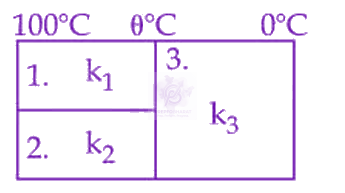 Area of cross sections of $1^{\text {st }}$ and $2^{\text {nd }}$ conductor are same and for $3^{\text {rd }}$ conductor it is double of the $1^{\text {st }}$ conductor. The temperatures are given in the figure. In steady state condition, the value of $\theta$ is _______ ${ }^{\circ} \mathrm{C}$. (Given : $\mathrm{k}_1=60 \mathrm{Js}^{-1} \mathrm{~m}^{-1} \mathrm{~K}^{-1}, \mathrm{k}_2=120 \mathrm{Js}^{-1} \mathrm{~m}^{-1} \mathrm{~K}^{-1}, \mathrm{k}_3=135 \mathrm{Js}^{-1} \mathrm{~m}^{-1} \mathrm{~K}^{-1}$ )
An ideal gas goes from an initial state to final state. During the process, the pressure of gas increases linearly with temperature. A. The work done by gas during the process is zero. B. The heat added to gas is different from change in its internal energy. C. The volume of the gas is increased. D. The internal energy of the gas is increased. E. The process is isochoric (constant volume process) Choose the correct answer from the options given below:
There are two vessels filled with an ideal gas where volume of one is double the volume of other. The large vessel contains the gas at 8 kPa at 1000 K while the smaller vessel contains the gas at 7 kPa at 500 K. If the vessels are connected to each other by a thin tube allowing the gas to flow and the temperature of both vessels is maintained at 600 K , at steady state the pressure in the vessels will be (in kPa).
Water of mass $m$ gram is slowly heated to increase the temperature from $T_1$ to $T_z$ The change in entropy of the water, given specific heat of water is $1 \mathrm{Jkg}^{-1} \mathrm{~K}^{-1}$, is :
A container of fixed volume contains a gas at \(27^{\circ} \mathrm{C}\). To double the pressure of the gas, the temperature of gas should be raised to ______ \({ }^{\circ} \mathrm{C}\).
The efficiency of a Carnot engine operating between temperatures T₁ (source) and T₂ (sink) is:
A diatomic gas $(\gamma =1.4)$ does $200J$ of work when it is expanded isobarically. The heat given to the gas in the process is :
The parameter that remains the same for molecules of all gases at a given temperature is :
A block of ice at $-10^{\circ}C$ is slowly heated and converted to steam at $100^{\circ}C$. Which of the following curves represent the phenomenon qualitatively:
The average kinetic energy of a monatomic molecule is $0.414\mathrm{eV}$ at temperature: (Use ${K}_{B}=1.38\times {10}^{-23}J{\mathrm{mol}}^{-1}{K}^{-1}$)
The given figure represents two isobaric processes for the same mass of an ideal gas, then 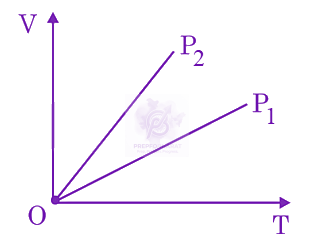
A gas mixture consists of $8$ moles of argon and $6$ moles of oxygen at temperature $T$. Neglecting all vibrational modes, the total internal energy of the system is
The volume of an ideal gas $(\gamma=1.5)$ is changed adiabatically from 5 litres to 4 litres. The ratio of initial pressure to final pressure is:
Two vessels $A$ and $B$ are of the same size and are at same temperature. $A$ contains $1g$ of hydrogen and $B$ contains $1g$ of oxygen. ${P}_{A}$ and ${P}_{B}$ are the pressures of the gases in $A$ and $B$ respectively, then $\frac{{P}_{A}}{{P}_{B}}$ is :
The temperature of a gas is $-78^{\circ} \mathrm{C}$ and the average translational kinetic energy of its molecules is $\mathrm{K}$. The temperature at which the average translational kinetic energy of the molecules of the same gas becomes $2 \mathrm{~K}$ is :