JEE Main Physics — Thermodynamics previous year questions with solutions.
At which temperature the r.m.s. velocity of a hydrogen molecule equal to that of an oxygen molecule at $47^{\circ}C$ ?
If $\mathrm{n}$ is the number density and $\mathrm{d}$ is the diameter of the molecule, then the average distance covered by a molecule between two successive collisions (i.e. mean free path) is represented by :
A mixture of one mole of monoatomic gas and one mole of a diatomic gas (rigid) are kept at room temperature $\left(27^{\circ} \mathrm{C}\right)$. The ratio of specific heat of gases at constant volume respectively is:
A total of $48 \mathrm{~J}$ heat is given to one mole of helium kept in a cylinder. The temperature of helium increases by $2^{\circ} \mathrm{C}$. The work done by the gas is: Given, $\mathrm{R}=8.3 \mathrm{~J} \mathrm{~K}^{-1} \mathrm{~mol}^{-1}$.
Choose the correct statement for processes $A$ & $B$ shown in figure. 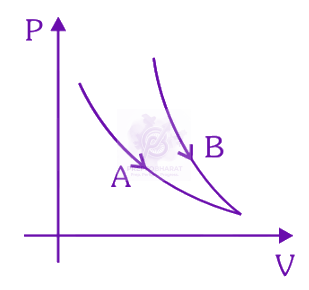
Energy of 10 non rigid diatomic molecules at temperature $T$ is :
If the root mean square velocity of hydrogen molecule at a given temperature and pressure is $2\mathrm{km}{s}^{-1},$ the root mean square velocity of oxygen at the same condition in $\mathrm{km}{s}^{-1}$ is:
Two conductors have the same resistances at $0^{\circ}C$ but their temperature coefficients of resistance are ${\alpha }_{1}$ and ${\alpha }_{2}$. The respective temperature coefficients for their series and parallel combinations are :
The resistances of the platinum wire of a platinum resistance thermometer at the ice point and steam point are $8 \Omega$ and $10 \Omega$ respectively. After inserting in a hot bath of temperature $400^{\circ} \mathrm{C}$, the resistance of platinum wire is :
The translational degrees of freedom $\left(f_t\right)$ and rotational degrees of freedom $\left(f_r\right)$ of $\mathrm{CH}_4$ molecule are:
A real gas within a closed chamber at $27^{\circ} \mathrm{C}$ undergoes the cyclic process as shown in figure. The gas obeys $P V^3=R T$ equation for the path $A$ to $B$. The net work done in the complete cycle is (assuming $R=8 \mathrm{~J} / \mathrm{mol} \mathrm{K}$ ): 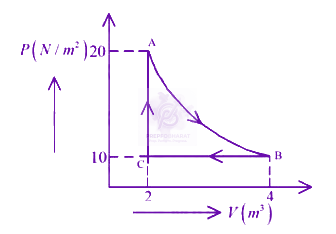
P-T diagram of an ideal gas having three different densities $\rho_1, \rho_2, \rho_3$ (in three different cases) is shown in the figure. Which of the following is correct : 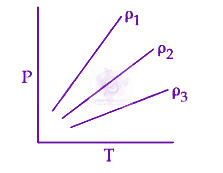
$0.08\mathrm{kg}$ air is heated at constant volume through $5^{\circ}C$. The specific heat of air at constant volume is $0.17\mathrm{kcal}{\mathrm{kg}}^{-1}^{\circ}{C}^{-1}$ and $1J=4.18\mathrm{joule}{\mathrm{cal}}^{-1}$. The change in its internal energy is approximately.
Given below are two statements : Statement (I) : The mean free path of gas molecules is inversely proportional to square of molecular diameter. Statement (II) : Average kinetic energy of gas molecules is directly proportional to absolute temperature of gas. In the light of the above statements, choose the correct answer from the options given below :
A sample contains mixture of helium and oxygen gas. The ratio of root mean square speed of helium and oxygen in the sample, is:
Two thermodynamical process are shown in the figure. The molar heat capacity for process $A$ and $B$ are ${C}_{A}$ and ${C}_{B}$. The molar heat capacity at constant pressure and constant volume are represented by ${C}_{P}$ and ${C}_{V}$, respectively. Choose the correct statement. 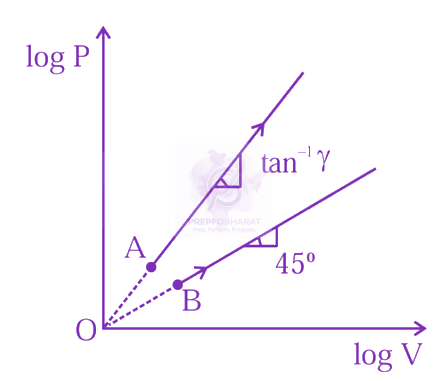
On celcius scale the temperature of body increases by $40^{\circ} \mathrm{C}$. The increase in temperature on Fahrenheit scale is :
An ideal gas undergoes isothermal expansion at temperature T. If the volume doubles, by what factor does the pressure change?
$N$ moles of a polyatomic gas$(f=6)$ must be mixed with two moles of a monoatomic gas so that the mixture behaves as a diatomic gas. The value of $N$ is:
A sample of 1 mole gas at temperature $\mathrm{T}$ is adiabatically expanded to double its volume. If adiabatic constant for the gas is $\gamma=\frac{3}{2}$, then the work done by the gas in the process is:
During an adiabatic process, the pressure of a gas is found to be proportional to the cube of its absolute temperature. The ratio of $\frac{{C}_{p}}{{C}_{v}}$ for the gas is :
At room temperature $\left(27^{\circ} \mathrm{C}\right)$, the resistance of a heating element is $50 \Omega$. The temperature coefficient of the material is $2.4 \times 10^{-4}{ }^{\circ} \mathrm{C}^{-1}$. The temperature of the element, when its resistance is $62 \Omega$, is _____ ${ }^{\circ} \mathrm{C}$.
The temperature of a gas having $2.0\times {10}^{25}$ molecules per cubic meter at $1.38\mathrm{atm}$ (Given, $k=1.38\times {10}^{-23}J{K}^{-1})$ is :
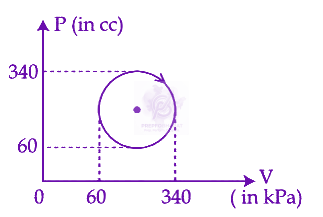
The heat absorbed by a system in going through the given cyclic process is :