JEE Main Physics — Thermodynamics previous year questions with solutions.
The pressure and volume of an ideal gas are related as $P{V}^{\frac{3}{2}}=K$ (Constant). The work done when the gas is taken from state $A({P}_{1},{V}_{1},{T}_{1})$ to state $B({P}_{2},{V}_{2},{T}_{2})$ is :
Two moles of a monoatomic gas is mixed with six moles of a diatomic gas. The molar specific heat of the mixture at constant volume is :
The specific heat at constant pressure of a real gas obeying $P V^2=R T$ equation is:
If three moles of monoatomic gas $(\gamma =\frac{5}{3})$ is mixed with two moles of a diatomic gas $(\gamma =\frac{7}{5})$, the value of adiabatic exponent $\gamma$ for the mixture is:
If the collision frequency of hydrogen molecules in a closed chamber at $27^{\circ} \mathrm{C}$ is $\mathrm{Z}$, then the collision frequency of the same system at $127^{\circ} \mathrm{C}$ is :
A diatomic gas $(\gamma=1.4)$ does $100 \mathrm{~J}$ of work in an isobaric expansion. The heat given to the gas is :
During an adiabatic process, if the pressure of a gas is found to be proportional to the cube of its absolute temperature, then the ratio of $\frac{C_{\mathrm{P}}}{\mathrm{C}_{\mathrm{V}}}$ for the gas is :
Two different adiabatic paths for the same gas intersect two isothermal curves as shown in P-V diagram. The relation between the ratio $\frac{V_a}{V_d}$ and the ratio $\frac{V_b}{V_c}$ is: 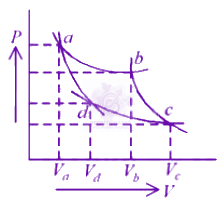
A thermodynamic system is taken from an original state $A$ to an intermediate state $B$ by a linear process as shown in the figure. Its volume is then reduced to the original value from $B$ to $C$ by an isobaric process. The total work done by the gas from $A$ to $B$ and $B$ to $C$ would be : 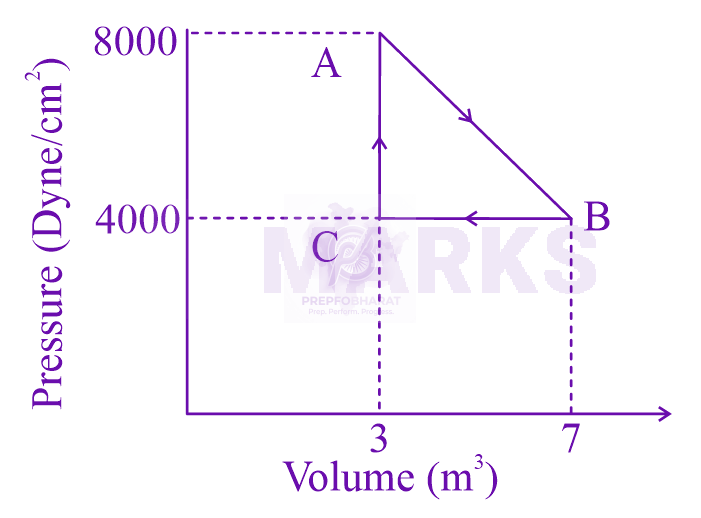
The total kinetic energy of $1$ mole of oxygen at $27^{\circ}C$ is : [Use universal gas constant $(R)=8.31J{\mathrm{mol}}^{-1}{K}^{-1}$ ]
A sample of gas at temperature $T$ is adiabatically expanded to double its volume. Adiabatic constant for the gas is $\gamma=3 / 2$. The work done by the gas in the process is: $(\mu=1 \mathrm{~mole})$
For an ideal gas undergoing isothermal process
A water heater of power $2000W$ is used to heat water. The specific heat capacity of water is $4200J{\mathrm{kg}}^{-1}{K}^{-1}$. The efficiency of heater is $70%$. Time required to heat $2\mathrm{kg}$ of water from $10^{\circ}C$ to $60^{\circ}C$ is _____ $s$. (Assume that the specific heat capacity of water remains constant over the temperature range of the water).
For an ideal gas, Cp - Cv is equal to:
A sample of gas at temperature $T$ is adiabatically expanded to double its volume. The work done by the gas in the process is given, (given $\gamma =\frac{3}{2}$) :
Heat is given to an ideal gas in an isothermal process. A. Internal energy of the gas will decrease. B. Internal energy of the gas will increase. C. Internal energy of the gas will not change. D. The gas will do positive work. E. The gas will do negative work. Choose the correct answer from the options given below :
For three low density gases $A,B,C$ pressure versus temperature graphs are plotted while keeping them at constant volume, as shown in the figure 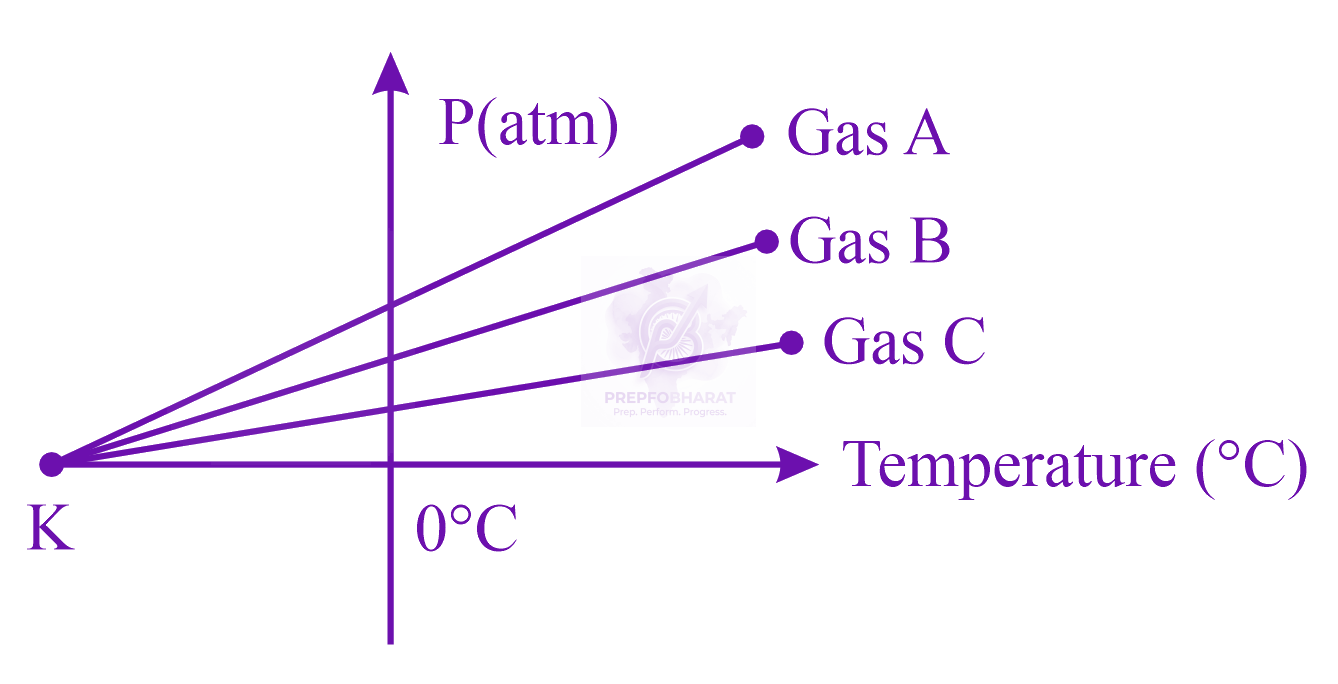 The temperature corresponding to the point $'K'$ is:
Match List I with List II: <table class="pyq-table"><tbody><tr><td></td><td>List I</td><td></td><td>List II</td></tr><tr><td>(A)</td><td>$3$ Translational degrees of freedom</td><td>(I)</td><td>Monoatomic gases</td></tr><tr><td>(B)</td><td>$3$ Translational, $2$ rotational degrees of freedoms</td><td>(II)</td><td>Polyatomic gases</td></tr><tr><td>(C)</td><td>$3$ Translational, $2$ rotational and $1$ vibrational degrees of freedom</td><td>(III)</td><td>Rigid diatomic gases</td></tr><tr><td>(D)</td><td>$3$ Translational, $3$ rotational and more than one vibrational degrees of freedom</td><td>(IV)</td><td>Nonrigid diatomic gases</td></tr></tbody></table>Choose the correct answer from the options given below:
The temperature of an ideal gas is increased from $200K$ to $800K$. If r.m.s. speed of gas at $200K$ is ${v}_{0}$. Then, r.m.s. speed of the gas at $800K$ will be:
Given below are two statements: Statement I: The temperature of a gas is $-73^{\circ}C$. When the gas is heated to $527^{\circ}C$, the root mean square speed of the molecules is doubled. Statement II : The product of pressure and volume of an ideal gas will be equal to translational kinetic energy of the molecules. In the light of the above statements, choose the correct answer from the options given below:
The graph between two temperature scales $P$ and $Q$ is shown in the figure. Between upper fixed point and lower fixed point there are $150$ equal divisions of scale $P$ and $100$ divisions on scale $Q$. The relationship for conversion between the two scales is given by : 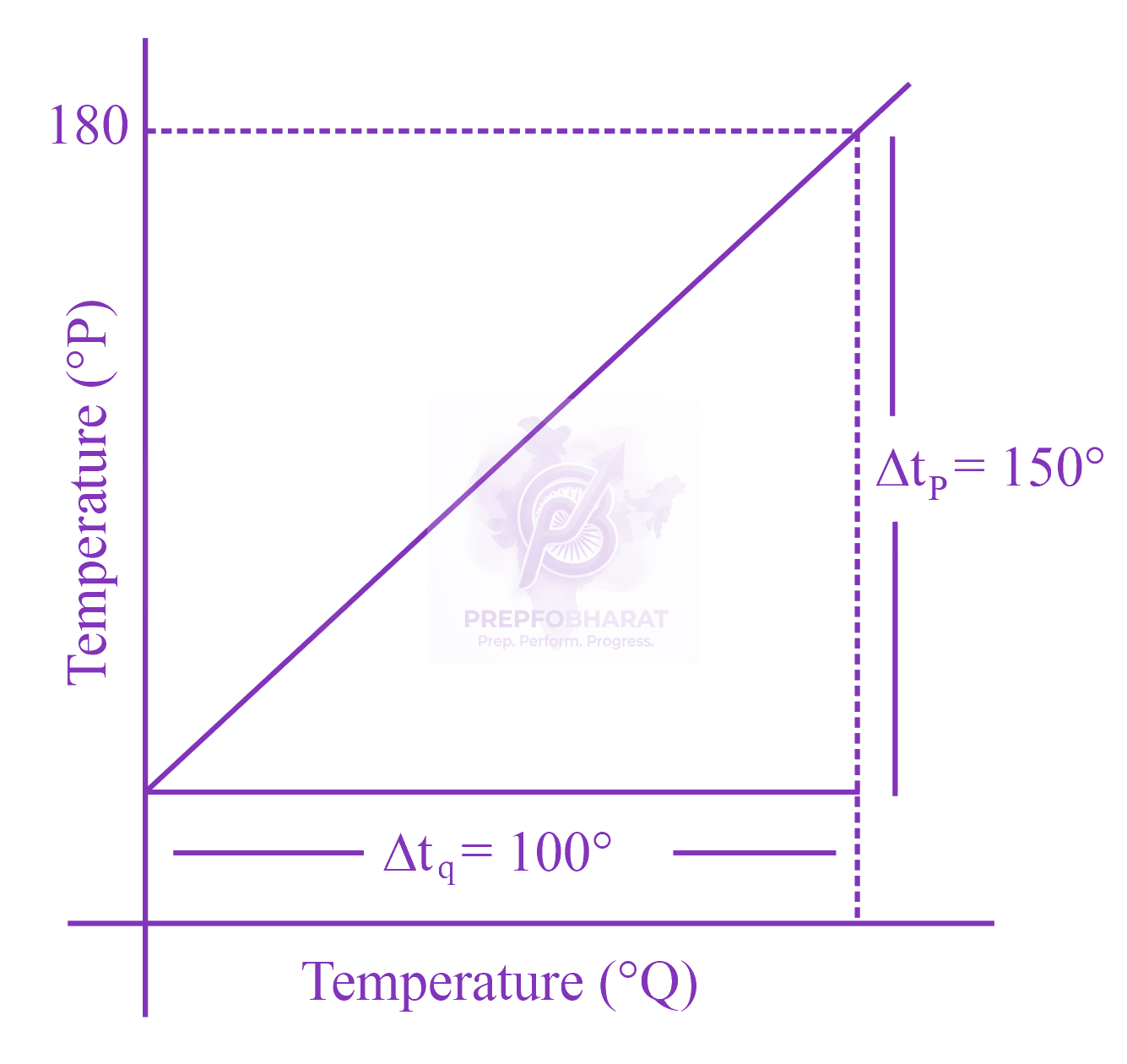.
A faulty thermometer reads $5^{\circ}C$ in melting ice and $95^{\circ}C$ in steam. The correct temperature on absolute scale will be ______ $K$ when the faulty thermometer reads $41^{\circ}C$.
A flask contains hydrogen and oxygen in the ratio of $2:1$ by mass at temperature $27^{\circ}C$. The ratio of average kinetic energy per molecule of hydrogen and oxygen respectively is :
$1\mathrm{kg}$ of water at $100^{\circ}C$ is converted into steam at $100^{\circ}C$ by boiling at atmospheric pressure. The volume of water changes from $1.00\times {10}^{-3}{m}^{3}$ as a liquid to $1.671{m}^{3}$ as steam. The change in internal energy of the system during the process will be (Given latent heat of vaporisation $=2257\mathrm{kJ}/\mathrm{kg}$, Atmospheric pressure $=1\times {10}^{5}\mathrm{Pa})$