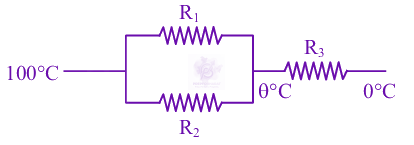
R1= K1 A2 LR2= K2 A2 LR3=K3 ALR1+R2R1R2θ−100+R3θ−0=0θ=40
JEE Main 2025 — Physics Thermodynamics
Three conductors of same length having thermal conductivity k1,k2 and k3 are connected as shown in figure. 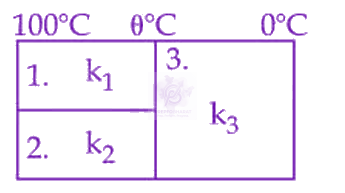
Area of cross sections of 1st and 2nd conductor are same and for 3rd conductor it is double of the 1st conductor. The temperatures are given in the figure. In steady state condition, the value of θ is _______ ∘C. (Given : k1=60Js−1 m−1 K−1,k2=120Js−1 m−1 K−1,k3=135Js−1 m−1 K−1 )
Held on 22 Jan 2025 · Verified 6 Jul 2026.
Sign in to track your attempts and accuracy.
Sign in to keep a private note on this question. Nothing you write is ever public.
The temperature of a metal strip having coefficient of linear expansion $\alpha$ is increased from $T_1$ to $T_2$ resulting in increase of its length by $\Delta L_1$. The temperature is further increased from $T_2$ to $T_3$ such that the increase in its length is $\Delta L_2$. Given $T_3+T_1=2T_2$ and $T_2-T_1=\Delta T$, the value of $\Delta L_2$ is ______.
The mean free path of a molecule of diameter $5 \times 10^{-10} \mathrm{~m}$ at the temperature $41^{\circ} \mathrm{C}$ and pressure $1.38 \times 10^{5} \mathrm{~Pa}$, is given as $\_\_\_\_$ m. (Given $k_{B}=1.38 \times 10^{-23} \mathrm{~J} / \mathrm{K}$).
Two closed vessels of same volume are joined through a narrow tube and both vessels are filled with air of pressure $90$ kPa and temperature $400$ K. Keeping the temperature of one vessel constant at $400$ K the second vessel temperature is raised to $500$ K. The final pressure in the vessels is _______ kPa.
Heat is supplied to a diatomic gas at constant pressure. Then the ratio of $\Delta Q : \Delta U : \Delta W$ is _______.
An ideal gas undergoes a process maintaining relation between pressure $(P)$ and volume $(V)$ as $P = P_o\left(1 + \left(\dfrac{V_o}{V}\right)^2\right)^{-1}$, where $P_o$ and $V_o$ are constants. If two samples $A$ and $B$ (two moles each) with initial volumes $V_o$ and $3V_o$ respectively undergo above mentioned process and attain same pressure, then the difference at the temperatures of these samples, $T_B - T_A$ is _____. ($R = $ gas constant)
Work through every JEE Main Thermodynamics PYQ, year by year.