Mechanics PYQ — Page 5
JEE Main Physics — Mechanics previous year questions with solutions.
All Mechanics Questions (2069)
A river of width 200 m is flowing from west to east with a speed of $18 \mathrm{~km} / \mathrm{h}$. A boat, moving with speed of $36 \mathrm{~km} / \mathrm{h}$ in still water, is made to travel one-round trip (bank to bank of the river). Minimum time taken by the boat for this journey and also the displacement along the river bank are $\_\_\_\_$ and $\_\_\_\_$ respectively.
A projectile is thrown upward at an angle $60^{\circ}$ with the horizontal. The speed of the projectile is $20 \mathrm{~m} / \mathrm{s}$ when its direction of motion is $45^{\circ}$ with the horizontal. The initial speed of the projectile is $\_\_\_\_$ $\mathrm{m} / \mathrm{s}$.
In a screw gauge when the circular scale is given five complete rotations it moves linearly by $2.5$ mm. If the circular scale has $100$ divisions, the least count of screw gauge is _____ mm.
Given below are two statements: Statement I: Pressure of a fluid is exerted only on a solid surface in contact as the fluid-pressure does not exist everywhere in a still fluid. Statement II: Excess potential energy of the molecules on the surface of a liquid, when compared to interior, results in surface tension. In the light of the above statements, choose the correct answer from the options given below
The diameter of a wire measured by a screw gauge of least count $0.001$ cm is $0.08$ cm. The length measured by a scale of least count $0.1$ cm is $150$ cm. When a weight of $100$ N is applied to the wire, the extension in length is $0.5$ cm, measured by a micrometer of least count $0.001$ cm. The error in the measured Young's modulus is $\alpha \times 10^9$ N/m$^2$. The value of $\alpha$ is _______. (Ignore the contribution of the load to Young's modulus error calculation)
A tub is filled with water and a wooden cube $10$ cm $\times$ $10$ cm $\times$ $10$ cm is placed in the water. The wooden cube is found to float on the water with a part of it submerged in water. When a metal coin is placed on the wooden cube, the submerged part is increased by $3.87$ cm. The mass of the metal coin is _______ gram. (Take water density as $1$ g/cm$^3$ and density of wood as $0.4$ g/cm$^3$)
When both jaws of vernier callipers touch each other, zero mark of the vernier scale is right to zero mark of main scale, $4^{\text {th }}$ mark on vernier scale coincides with certain mark on the main scale. While measuring the length of a cylinder, observer observes 15 divisions on main scale and $5^{\text {th }}$ division of vernier scale coincides with a main scale division. Measured length of cylinder is $\_\_\_\_$ mm. (Least count of Vernier calliper $=0.1 \mathrm{~mm}$)
A ball of radius $r$ and density $\rho$ dropped through a viscous liquid of density $\sigma$ and viscosity $\eta$ attains its terminal velocity at time $t$, given by $t=A \rho^{a} r^{b} \eta^{\mathrm{c}} \sigma^{d}$, where $A$ is a constant and $a, b, c$ and $d$ are integers. The value of $\frac{b+c}{a+d}$ is $\_\_\_\_$.
A thin uniform rod $(X)$ of mass $M$ and length $L$ is pivoted at a height $\left(\frac{L}{3}\right)$ as shown in the figure. The rod is allowed to fall from a vertical position and lie horizontally on the table. The angular velocity of this rod when it hits the table top, is $\_\_\_\_$. ($\mathrm{g}=$ gravitational acceleration) 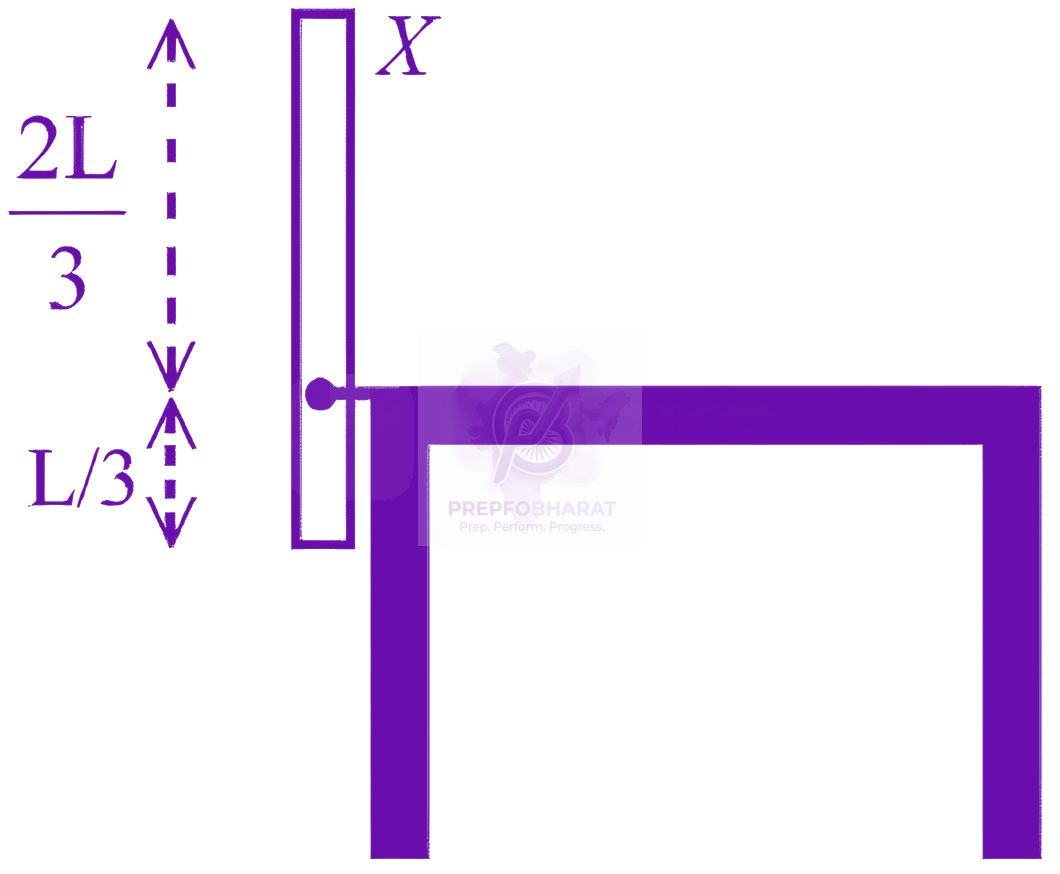
Match List - I with List - II.<table class="pyq-table"><tbody><tr><th>List - I</th><th>List - II</th></tr><tr><td>A. Boltzmann constant</td><td>I. $[M^{-1}L^3T^{-2}]$</td></tr><tr><td>B. Stefan's constant</td><td>II. $[ML^2T^{-1}]$</td></tr><tr><td>C. Planck's constant</td><td>III. $[ML^2T^{-2}K^{-1}]$</td></tr><tr><td>D. Gravitational constant</td><td>IV. $[ML^0T^{-3}K^{-4}]$</td></tr></tbody></table>Choose the correct answer from the options given below :
A solid sphere of radius $4$ cm and mass $5$ kg is rotating (rotation axis is passing through the centre of the sphere) with an angular velocity of $1200$ rpm. It is brought to rest in $10$ s by applying a constant torque. The torque applied and the number of rotations it made before it comes to rest are _______ and _______ respectively.
A liquid of density $600$ kg/m$^3$ flowing steadily in a tube of varying cross-section. The cross-section at a point $A$ is $1.0$ cm$^2$ and that at $B$ is $20$ mm$^2$. Both the points $A$ and $B$ are in same horizontal plane, the speed of the liquid at $A$ is $10$ cm/s. The difference in pressures at $A$ and $B$ points is ________ Pa.
A cube has side length $5$ cm and modulus of rigidity $10^5$ N/m$^2$. The displacement produced by a force of $10$ N in the upper face of cube is _____ mm.
A small metallic sphere of diameter 2 mm and density $10.5 \mathrm{~g} / \mathrm{cm}^{3}$ is dropped in glycerine having viscosity 10 Poise and density $1.5 \mathrm{~g} / \mathrm{cm}^{3}$ respectively. The terminal velocity attained by the sphere is $\_\_\_\_$ $\mathrm{cm} / \mathrm{s}$. ($\pi=\frac{22}{7}$ and $g=10 \mathrm{~m} / \mathrm{s}^{2}$)
In a perfectly inelastic collision, two spheres made of the same material with masses 15 kg and 25 kg, moving in opposite directions with speeds of $10 \mathrm{~m} / \mathrm{s}$ and $30 \mathrm{~m} / \mathrm{s}$, respectively, strike each other and stick together. The rise in temperature (in ${ }^{\circ} \mathrm{C}$), if all the heat produced during the collision is retained by these spheres, is : (specific heat of sphere material $31 \mathrm{cal} / \mathrm{kg}.{ }^{\circ} \mathrm{C}$ and $1 \mathrm{cal}=4.2 \mathrm{~J}$)
A flexible chain of mass $m$ hangs between two fixed points at the same level. The inclination of the chain with the horizontal at the two points of support is $30^{\circ}$. Considering the equilibrium of each half of the chain, the tension of the chain at the lowest point is $\_\_\_\_$.
The time taken by a block of mass $m$ to slide down from the highest point to the lowest point on a rough inclined plane is $50\%$ more compared to the time taken by the same block on identical inclined smooth plane. Both inclined planes are at $45^\circ$ with the horizontal. The coefficient of kinetic friction between the rough inclined surface and block is _____.
Eight mercury drops, each of radius $r$, coalesce to form a bigger drop. The surface energy released in this process is _______. ($S$ is the surface tension of mercury).
Two identical bodies, projected with the same speed at two different angles cover the same horizontal range $R$. If the time of flight of these bodies are $5$ s and $10$ s, respectively, then the value of $R$ is ________ m. (Take $g=10$ m/s$^2$)
In a vernier callipers, 50 vernier scale divisions are equal to 48 main scale divisions. If one main scale division $=0.05 \mathrm{~mm}$, then the least count of the vernier callipers is $\_\_\_\_$ mm.
A body of mass $1$ kg moves along a straight line with a velocity $v = 2x^2$. The work done by the body during displacement from $x = 0$ to $5$ m is __________ J.
A circular disc has radius $R_{1}$ and thickness $T_{1}$. Another circular disc made of the same material has radius $R_{2}$ and thickness $T_{2}$. If the moment of inertia of both discs are same and $\frac{R_{1}}{R_{2}}=2$ then $\frac{T_{1}}{T_{2}}=\frac{1}{\alpha}$. The value of $\alpha$ is $\_\_\_\_$.
The position of center of mass of three masses $2$ kg, $3$ kg and $15$ kg placed with respect to mid point ($p$) of normal bisector, as shown in the figure is _______. 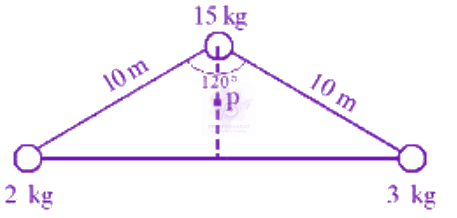
A $1$ kg block subjected to two simultaneous forces $(2\hat{i} + 3\hat{j} + 4\hat{k})$ N and $(3\hat{i} - \hat{j} - 2\hat{k})$ N is moved a distance of $25$ m along $(3\hat{i} - 4\hat{j})$ direction. The work done in this process is _____ J.