Mechanics PYQ — Page 4
JEE Main Physics — Mechanics previous year questions with solutions.
All Mechanics Questions (2069)
A new unit $(\alpha)$ of length is chosen such that it is equal to the speed of light in vacuum. What is the distance between Venus and Earth in terms of $\alpha$ units if light takes $6$ min. $40$ s to cover this distance?
In an experiment, a set of reading are obtained as follows - $1.24 \mathrm{~mm}, 1.25 \mathrm{~mm}, 1.23 \mathrm{~mm}$, 1.21 mm. The expected least count of the instrument used in recording these readings is $\_\_\_\_$ mm.
A uniform solid cylinder of length $L$ and radius $R$ has moment of inertia about its axis equal to $I_{1}$. A small co-centric cylinder of length $L / 2$ and radius $R / 3$ carved from this cylinder has moment of inertia about its axis equals to $I_{2}$. The ratio $I_{1} / I_{2}$ is $\_\_\_\_$.
A liquid drop of diameter $2$ mm breaks into $512$ droplets. The change in surface energy is $\alpha \times 10^{-6}$ J. The value of $\alpha$ is _______. (Take surface tension of liquid $= 0.08$ N/m)
Moment of inertia about an axis $AB$ for a rod of mass $40$ kg and length $3$ m is same as that of a solid sphere of mass of $10$ kg and radius $R$ about an axis parallel to $AB$ axis with separation of $3$ m as shown in figure below. The value of $R$ is given as $\sqrt{\dfrac{\alpha}{2}}$. The value of $\alpha$ is _______. 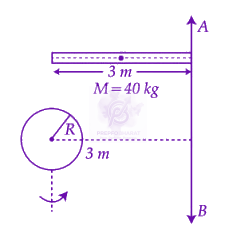
A solid sphere of mass 5 kg and radius 10 cm is kept in contact with another solid sphere of mass 10 kg and radius 20 cm. The moment of inertia of this pair of spheres about the tangent passing through the point of contact is $\_\_\_\_$ $\mathrm{kg}. \mathrm{m}^{2}$.
A solid sphere of radius 10 cm is rotating about an axis which is at a distance 15 cm from its centre. The radius of gyration about this axis is $\sqrt{n} \mathrm{~cm}$. The value of $n$ is
Two cars $A$ and $B$ are moving in the same direction along a straight line with speeds $100$ km/h and $80$ km/h, respectively such that car $A$ is moving ahead of car $B$. A person in car $B$ throws a stone with a speed $v$ so that it hits the car $A$ with a speed of $5$ m/s. The value of $v$ is ______ km/h.
In an experiment the values of two spring constants were measured as $k_{1}=(10 \pm 0.2) \mathrm{N} / \mathrm{m}$ and $k_{2}=(20 \pm 0.3) \mathrm{N} / \mathrm{m}$. If these springs are connected in parallel, then the percentage error in equivalent spring constant is :
The potential energy of a particle changes with distance $x$ from a fixed origin as $V = \dfrac{A\sqrt{x}}{x + B}$, where $A$ and $B$ are constant with appropriate dimensions. The dimensions of $AB$ are _______.
A particle is rotating in a circular path and at any instant its motion can be described as $\theta = \dfrac{5t^4}{40} - \dfrac{t^3}{3}$. The angular acceleration of the particle after $10$ seconds is _______ rad/s$^2$.
A block takes $t$ time to slide down a plane inclined at $45°$ to the horizontal. If the surface is made smooth (frictionless), the block takes time $\dfrac{t}{2}$ to slide down the plane. The coefficient of friction between the block and the inclined plane is $\left(\dfrac{\alpha}{100}\right)$. The value of $\alpha$ is __________.
The increase in the pressure required to decrease the volume $(\Delta V)$ of water is $6.3 \times 10^7$ N/m$^2$. The percentage decrease in the volume is _____. (Bulk modulus of water $= 2.1 \times 10^9$ N/m$^2$.)
Two blocks ($P$ and $Q$) with respectively masses $2$ kg and $1.5$ kg are joined by a massless thread. These blocks are mounted on a frictionless pulley which is fixed on the edge of a cube ($S$), as shown in the figure below. Block $P$ is positioned on the top surface which has no friction and block $Q$ is in contact with side-surface, having coefficient friction $\mu$. The cube ($S$) moves towards the right with acceleration of $\dfrac{g}{2}$, where $g$ is gravitational acceleration. During this movement the block $P$ and $Q$ remain stationary. The value of $\mu$ is _______. (take $g = 10$ m/s$^2$) 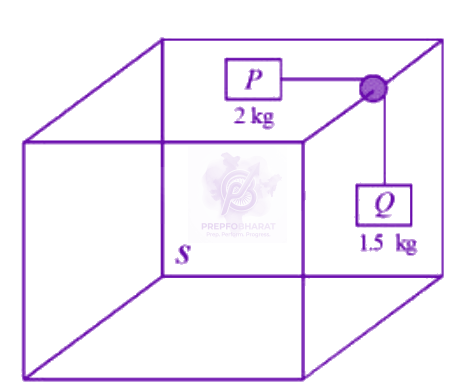
The position of an object having mass $0.1$ kg as a function of time $t$ is given as $\vec{r} = \left(10t^2\hat{i} + 5t^3\hat{j}\right)$ m. At $t = 1$ s, which of the following statements are correct? A. The linear momentum $\vec{p} = \left(2\hat{i} + 1.5\hat{j}\right)$ kg·m/s. B. The force acting on the object $\vec{F} = \left(2\hat{i} + 3\hat{j}\right)$ N. C. The angular momentum of the object about its origin $\vec{L} = 15\hat{k}$ J·s. D. The torque acting on the object about its origin $\vec{\tau} = 20\hat{k}$ N·m. Choose the correct answer from the options given below :
A particle of mass $m$ falls from rest through a resistive medium having resistive force, $F=-k v$, where $v$ is the velocity of the particle and $k$ is a constant. Which of the following graphs represents velocity ($v$) versus time ($t$)?
A string $A$ of length $0.314$ m and Young's modulus $2 \times 10^{10}$ N/m$^2$ is connected to another string $B$ of length and Young's modulus both twice of those of $A$. This series combination of strings is then suspended from a rigid support and its free end is fixed to a load of mass $0.8$ kg. The net change in length of the combination is _____ mm. (radius of both the strings is $0.2$ mm and acceleration due to gravity $= 10$ m/s$^2$) (Mass of both strings is to be neglected as compared to the mass of load)
$L$, $C$ and $R$ represents physical quantities inductance, capacitance and resistance respectively. The dimensional formula $ML^2 T^{-4} A^{-2}$ corresponds to __________.
The surface tension of a soap bubble is $0.03$ N/m. The work done in increasing the diameter of bubble from $2$ cm to $6$ cm is $\alpha \pi \times 10^{-4}$ J. The value of $\alpha$ is _______. (Take $\pi = 3.14$)
Consider a modified Bernoulli equation. $\left(\mathrm{P}+\frac{A}{B t^{2}}\right)+\rho g(h+B t)+\frac{1}{2} \rho V^{2}=$ constant If $t$ has the dimension of time then the dimensions of $A$ and $B$ are $\_\_\_\_$, $\_\_\_\_$ respectively.
In case of vertical circular motion of a particle by a thread of length $r$ if the tension in the thread is zero at an angle $30^{\circ}$ shown in figure, the velocity at the bottom point $(A)$ of the circular path is ($g=$ gravitational acceleration) 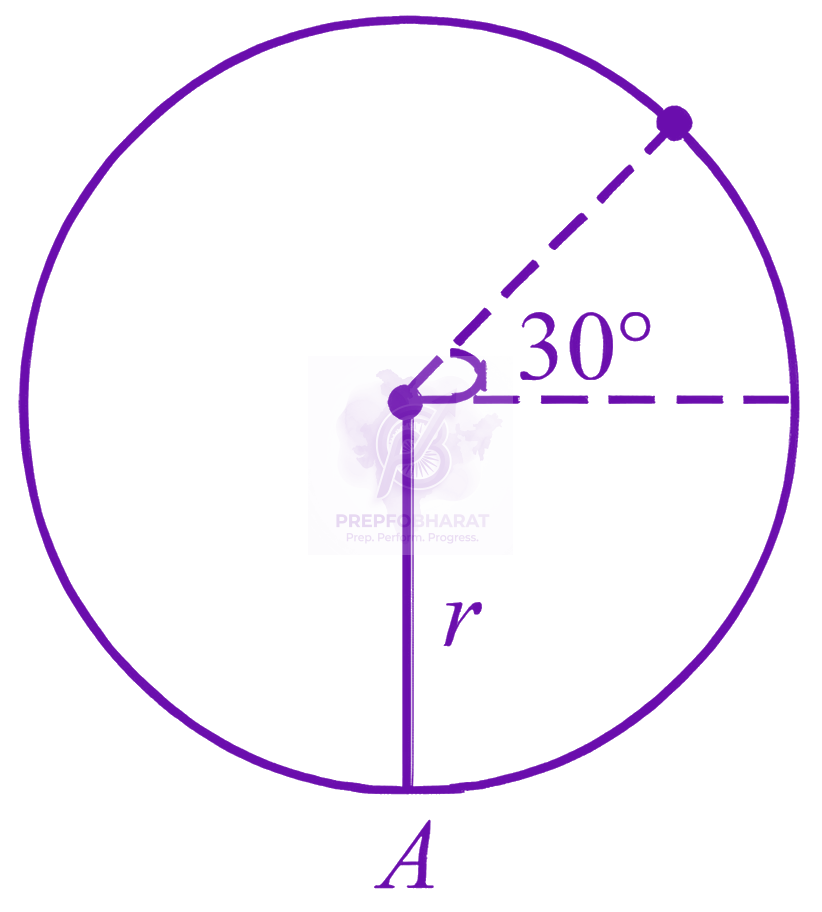
In the given figure the blocks $A, B$ and $C$ weigh $4 \mathrm{~kg}, 6 \mathrm{~kg}$ and 8 kg respectively. The co-efficient of sliding friction between any two surfaces is 0.5. The force $\vec{F}$ required to slide the block $C$ with constant speed is $\_\_\_\_$ N. (Use $g=10 \mathrm{~m} / \mathrm{s}^{2}$) 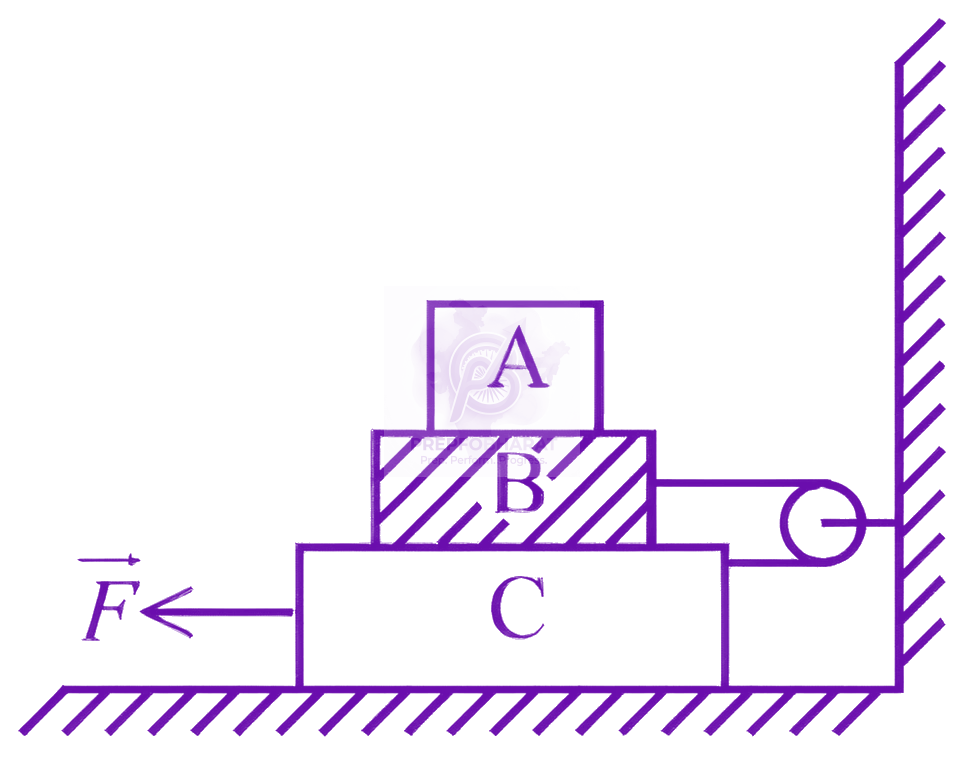
A mass of $1\text{ kg}$ is kept on an inclined plane with $30°$ inclination with respect to horizontal plane and it is at rest initially. Then the whole assembly is moved up with constant velocity of $4\text{ m/s}$. The work done by the frictional force in time $2\text{ s}$ is _______ J. (Take $g = 10\text{ m/s}^2$)
A spring of force constant $15 \mathrm{~N} / \mathrm{m}$ is cut into two pieces. If the ratio of their length is $1: 3$, then the force constant of smaller piece is $\_\_\_\_$ $\mathrm{N} / \mathrm{m}$.