Mechanics PYQ — Page 3
JEE Main Physics — Mechanics previous year questions with solutions.
All Mechanics Questions (2069)
The percentage error in the calculated volume of a sphere, if there is $2\%$ error in its diameter measurement, is __________.
Three masses $200 \mathrm{~kg}, 300 \mathrm{~kg}$ and 400 kg are placed at the vertices of an equilateral triangle with sides 20 m. They are rearranged on the vertices of a bigger triangle of side 25 m and with the same centre. The work done in this process $\_\_\_\_$ J. (Gravitational constant $\mathrm{G}=6.7 \times 10^{-11} \mathrm{~N} \mathrm{~m}^{2} / \mathrm{kg}^{2}$)
Match the LIST-I with LIST-II \(\begin{array}{||c|l||c|l||} \hline & \text{List-I} & & \text{List-II} \\ \hline \text{A.} & \text{Magnetic induction} & \text{I.} & \mathrm{M\,L\,T^{-2}\,A^{-2}} \\ \hline \text{B.} & \text{Magnetic flux} & \text{II.} & \mathrm{M\,L^{2}\,T^{-2}\,A^{-2}} \\ \hline \text{C.} & \text{Magnetic permeability} & \text{III.} & \mathrm{M\,L^{0}\,T^{-2}\,A^{-1}} \\ \hline \text{D.} & \text{Self inductance} & \text{IV.} & \mathrm{M\,L^{2}\,T^{-2}\,A^{-1}} \\ \hline \end{array}\) Choose the correct answer from the options given below:
A uniform bar of length 12 cm and mass $20 m$ lies on a smooth horizontal table. Two point masses $m$ and $2 m$ are moving in opposite directions with same speed of $v$ and in the same plane as the bar, as shown in figure. These masses strike the bar simultaneously and get stuck to it. After collision the entire system is rotating with angular frequency $\omega$. The ratio of $v$ and $\omega$ is : 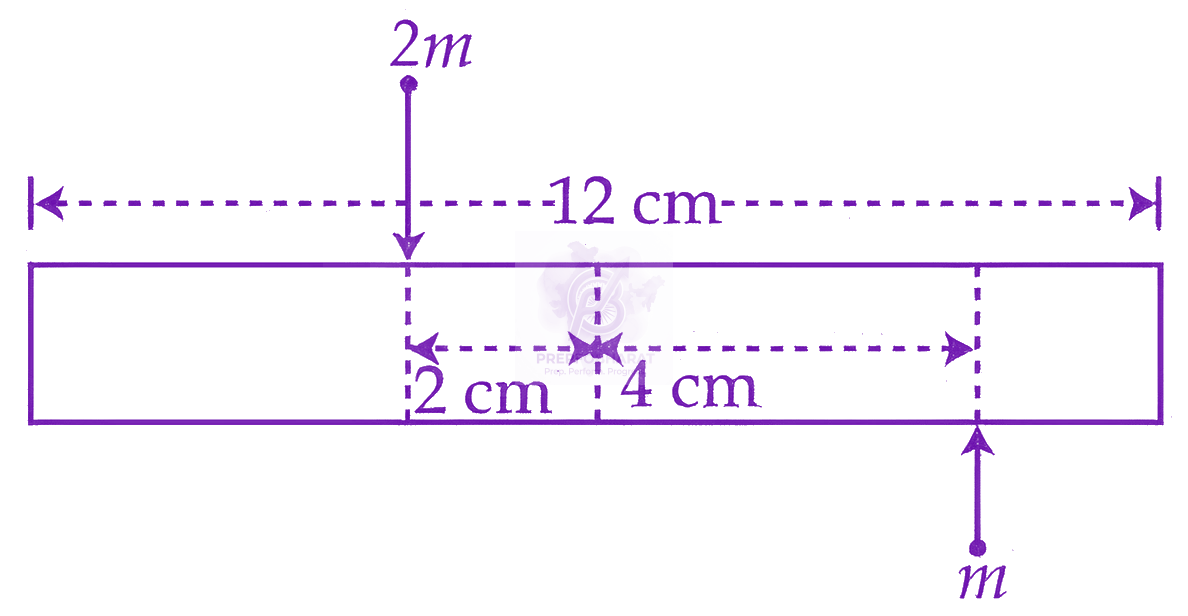
The velocity at which $6$ kg mass (shown in figure) strikes the ground when it is released from a height of $6$ m above the ground is __________ m/s. Assume pulley is massless and string is light and inextensible. (Take g $= 10$ m/s$^2$) 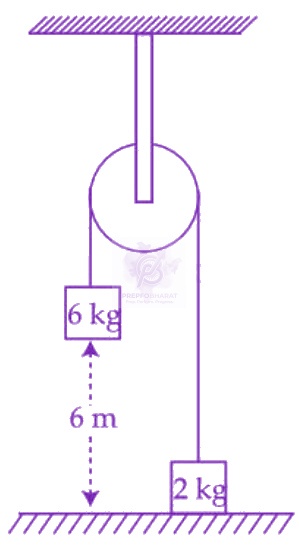
Two cars $A$ and $B$ each of mass $10^{3} \mathrm{~kg}$ are moving on parallel tracks separated by a distance of 10 m, in same direction with speeds $72 \mathrm{~km} / \mathrm{h}$ and $36 \mathrm{~km} / \mathrm{h}$. The magnitude of angular momentum of $\operatorname{car} A$ with respect to $\operatorname{car} B$ is $\_\_\_\_$ J.s.
If a body of mass $1$ kg falls on the earth from infinity, it attains velocity $(v)$ and kinetic energy $(k)$ on reaching the surface of earth. The values of $v$ and $k$ respectively are _______. (Take radius of earth to be $6400$ km and $g = 9.8$ m/s$^2$)
The velocity $(v)$ - Distance $(x)$ graph is shown in figure. Which graph represents acceleration $(a)$ versus distance $(x)$ variation of this system? 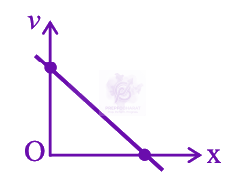
The escape velocity from a spherical planet $A$ is $10 \mathrm{~km} / \mathrm{s}$. The escape velocity from another planet $B$ whose density and radius are $10 \%$ of those of planet $A$, is $\_\_\_\_$ $\mathrm{m} / \mathrm{s}$.
Dimensions of universal gravitational constant $(G)$ in terms of Planck's constant $(h)$, distance $(L)$, mass $(M)$ and time $(T)$ are _______.
The rain drop of mass $1$ g, starts with zero velocity from a height of $1$ km. It hits the ground with a speed of $5$ m/s. The work done by the unknown resistive force is _______ J. (take $g = 10$ m/s$^2$)
Given below are two statements : Statement I: An object moves from position $r_{1}$ to position $r_{2}$ under a conservative force field $\vec{F}$. The work done by the force is $W=-\int_{r_{1}}^{r_{2}} \vec{F} \cdot \overrightarrow{d r}$. Statement II: Any object moving from one location to another location can follow infinite number of paths. Therefore, the amount of work done by the object changes with the path it follows for a conservative force. In the light of the above statements, choose the correct answer from the options given below :
An air bubble of volume $2.9 \mathrm{~cm}^{3}$ rises from the bottom of a swimming pool of 5 m deep. At the bottom of the pool water temperature is $17^{\circ} \mathrm{C}$. The volume of the bubble when it reaches the surface, where the water temperature is $27^{\circ} \mathrm{C}$, is $\_\_\_\_$ $\mathrm{cm}^{3}$. $\left(\mathrm{g}=10 \mathrm{~m} / \mathrm{s}^{2}\right.$, density of water $=10^{3} \mathrm{~kg} / \mathrm{m}^{3}$, and 1 atm pressure is $\left.10^{5} \mathrm{~Pa}\right)$
A solid cylinder having radius $R$ and length $L$ is slipping on a rough horizontal plane. At time $t=0$ the cylinder has a translational velocity $v_0=49$ m/s, perpendicular to its axis and a rotational velocity $v_0/4R$ about the centre. The time taken by the cylinder to start rolling is ________ seconds. (coefficient of kinetic friction $\mu_K=0.25$ and $g=9.8$ m/s$^2$)
A body of mass $m$ is taken from the surface of earth to a height equal to twice the radius of earth ($R_e$). The increase in potential energy will be _______. ($g$ is acceleration due to gravity at the surface of earth)
An object is projected with kinetic energy $K$ from a point $A$ at an angle $60^{\circ}$ with the horizontal. The ratio of the difference in kinetic energies at points $B$ and $C$ to that at point $A$ (see figure), in the absence of air friction is : 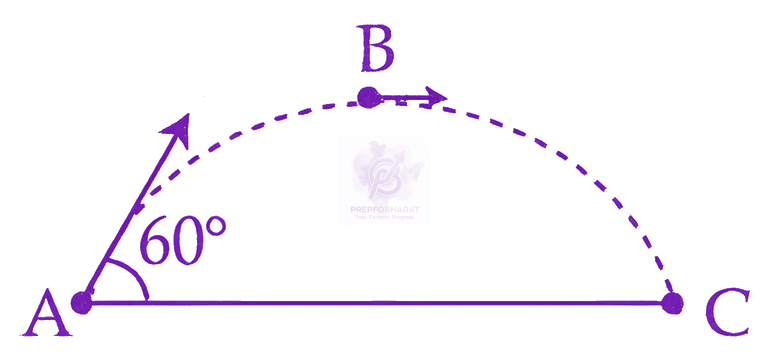
Two identical thin rods of mass $M \mathrm{~kg}$ and length $L \mathrm{~m}$ are connected as shown in figure. Moment of inertia of the combined rod system about an axis passing through point $P$ and perpendicular to the plane of the rods is $\frac{x}{12} \mathrm{ML}^{2} \mathrm{~kg} \mathrm{~m}^{2}$. The value of $x$ is $\_\_\_\_$. 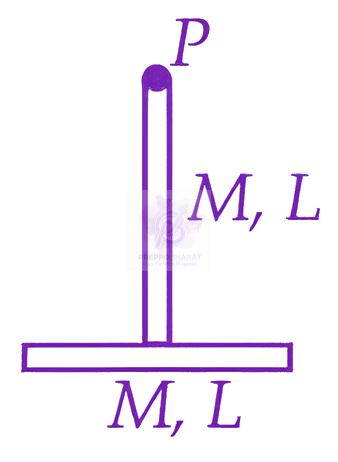
A planet $(P_1)$ is moving around the star of mass $2M$ in the orbit of radius $R$. Another planet $(P_2)$ is moving around another star of mass $4M$ in a orbit of radius $2R$. Ratio of time periods of revolution of $P_2$ and $P_1$ is _______.
A spherical body of radius $r$ and density $\sigma$ falls freely through a viscous liquid having density $\rho$ and viscosity $\eta$ and attains a terminal velocity $v_{0}$. Estimated maximum error in the quantity $\eta$ is : (Ignore errors associated with $\sigma, \rho$ and $g$, gravitational acceleration)
A smooth inclined plane ends in a vertical circular loop, as shown in the figure. A small body is released from height $h$ as shown. If the body exerts a force of three times its weight on the plane at the highest point of circle then the height $h = \alpha R$. The value of $\alpha$ is _______. 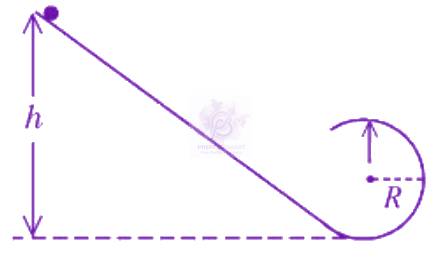
A copper wire of length $3\text{ m}$ is stretched by $3\text{ mm}$ by applying an external force. The volume of the wire is $600 \times 10^{-6}\text{ m}^3$. The elastic potential energy stored in the wire in stretched condition would be _______ J. (Given Young modulus of copper $= 1.1 \times 10^{11}\text{ N/m}^2$)
Two wires $A$ and $B$ made of different materials of lengths 6.0 cm and 5.4 cm, respectively and area of cross sections $3.0 \times 10^{-5} \mathrm{~m}^{2}$ and $4.5 \times 10^{-5} \mathrm{~m}^{2}$, respectively are stretched by the same magnitude under a given load. The ratio of the Young's modulus of $A$ to that of $B$ is $x: 3$. The value of $x$ is $\_\_\_\_$.
Match the LIST-I with LIST-II \(\begin{array}{||c|l||c||l||} \hline & \textbf{List-I} & & \textbf{List-II} \\ \hline A. & \text{Spring constant} & I. & \mathrm{M L^{2} T^{-2} K^{-1}} \\ \hline B. & \text{Thermal conductivity} & II. & \mathrm{M L^{0} T^{-2}} \\ \hline C. & \text{Boltzmann constant} & III. & \mathrm{M L^{2} T^{-3} A^{-2}} \\ \hline D. & \text{Inductive reactance} & IV. & \mathrm{M L T^{-3} K^{-1}} \\ \hline \end{array}\) Choose the correct answer from the options given below:
Match List - I with List - II. \(\begin{array}{llll} & \text{List - I} & & \text{List - II} \\ A. & \text{Coefficient of viscosity} & I. & [M L^{-1} T^{-1}] \\ B. & \text{Surface tension} & II. & [M L^{0} T^{-2}] \\ C. & \text{Pressure} & III. & [M L^{-1} T^{-2}] \\ D. & \text{Surface energy} & IV. & [M L^{2} T^{-2}] \end{array}\) Choose the correct answer from the options given below :