Mechanics PYQ — Page 6
JEE Main Physics — Mechanics previous year questions with solutions.
All Mechanics Questions (2069)
A large drum having radius $R$ is spinning around its axis with angular velocity $\omega$, as shown in figure. The minimum value of $\omega$ so that a body of mass $M$ remains stuck to the inner wall of the drum, taking the coefficient of friction between the drum surface and mass $M$ as $\mu$, is : 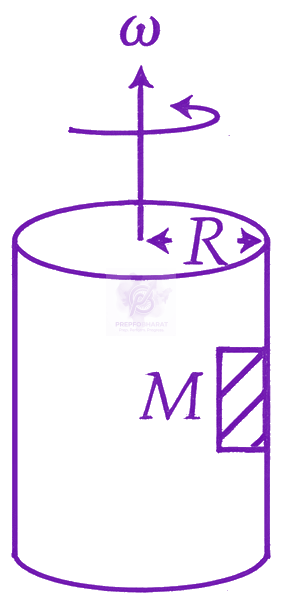
The terminal velocity of a metallic ball of radius 6 mm in a viscous fluid is $20 \mathrm{~cm} / \mathrm{s}$. The terminal velocity of another ball of same material and having radius 3 mm in the same fluid will be $\_\_\_\_$ $\mathrm{cm} / \mathrm{s}$.
A bead $P$ sliding on a frictionless semi-circular string $(A C B)$ and it is at point $S$ at $t =0$ and at this instant the horizontal component of its velocity is $v$. Another bead $Q$ of the same mass as $P$ is ejected from point $A$ at $t=0$ along the horizontal string $A B$, with the speed $v$, friction between the beads and the respective strings may be neglected in both cases. Let $t_{P}$ and $t_{Q}$ be the respective times taken by beads $P$ and $Q$ to reach the point $B$, then the relation between $t_{P}$ and $t_{Q}$ is 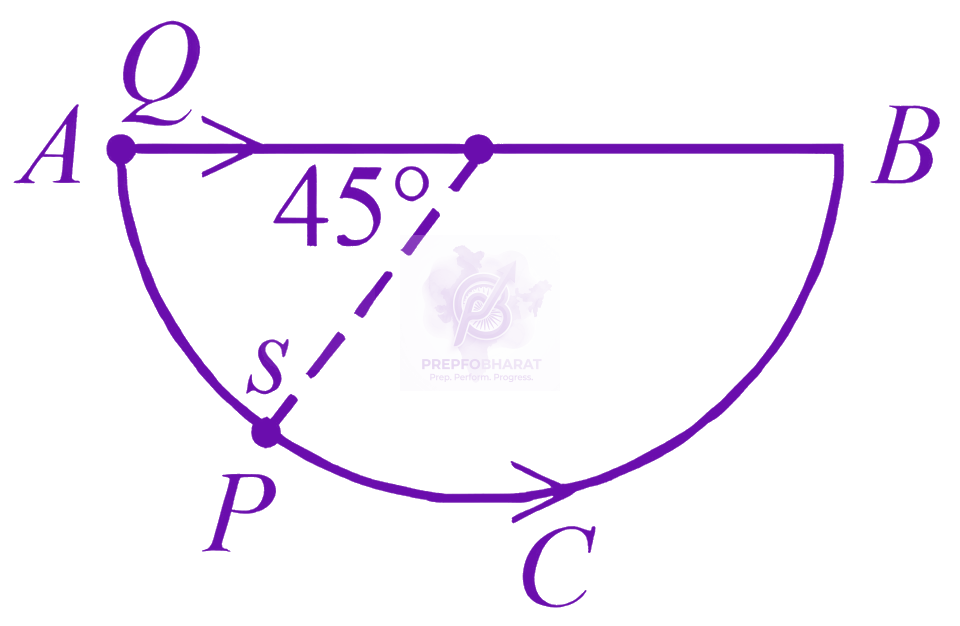
The Young's modulus of steel wire of radius $r$ and length $L$ is $Y$. If the radius $r$ and length $L$ of the wire are doubled then the value of $Y$
Two projectiles are projected with the same initial velocities at the $15^\circ$ and $30^\circ$ with respect to the horizontal. The ratio of their ranges is $1:x$. The value of $x$ is:
Potential energy ($V$) versus distance ($x$) is given by the graph. Rank various regions as per the magnitudes of the force (F) acting on a particle from high to low. 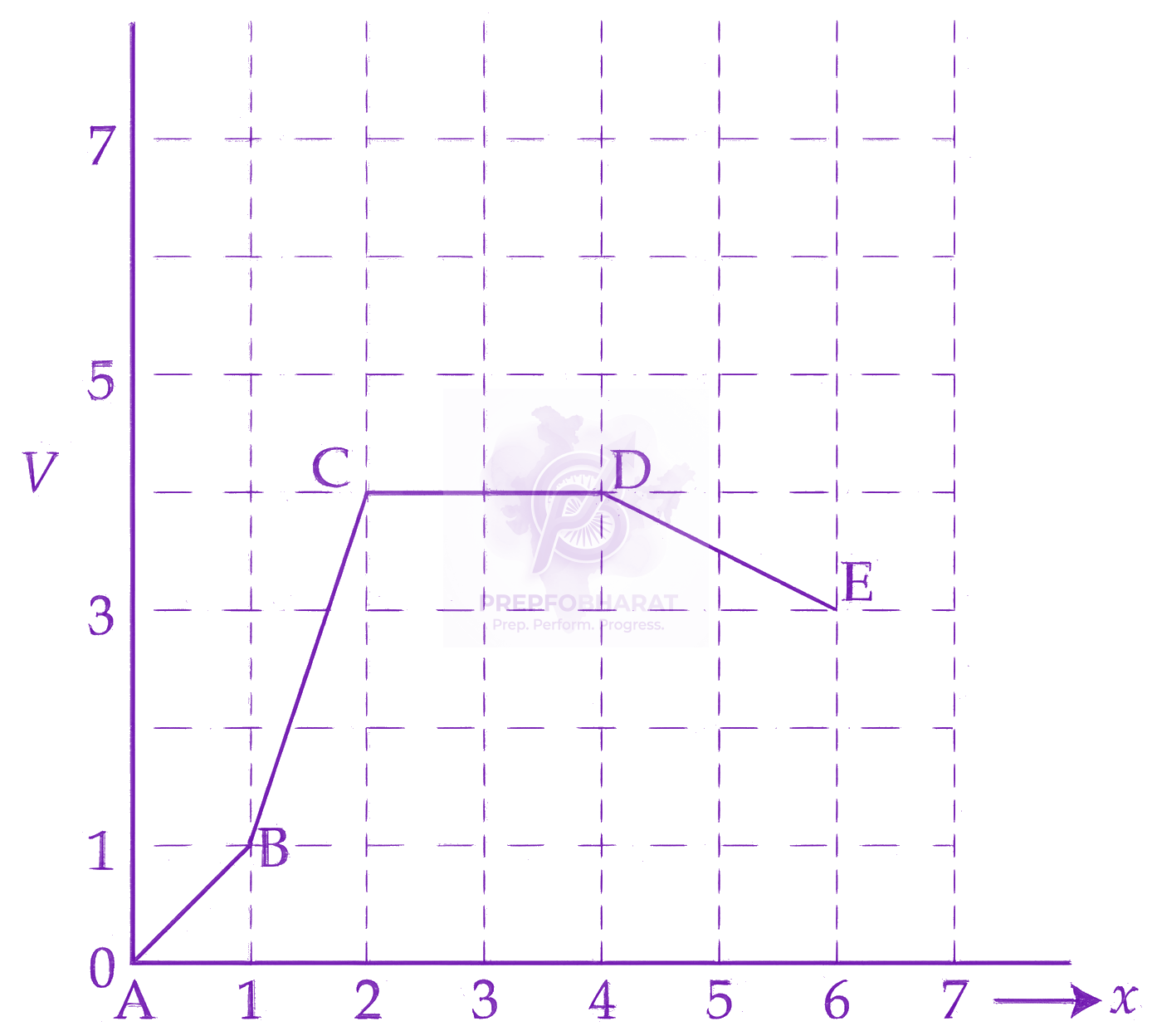
If an air bubble of diameter $2$ mm rises steadily through a liquid of density $2000$ kg/m$^3$ at a rate of $0.5$ cm/s, then the coefficient of viscosity of liquid is _______ Poise. (Take $g = 10$ m/s$^2$)
Net gravitational force at the center of a square is found to be $F_{1}$ when four particles having mass $M, 2 M, 3 M$ and $4 M$ are placed at the four corners of the square as shown in figure and it is $F_{2}$ when the positions of $3 M$ and $4 M$ are interchanged. The ratio $\frac{F_{1}}{F_{2}}$ is $\frac{\alpha}{\sqrt{5}}$. The value of $\alpha$ is $\_\_\_\_$. 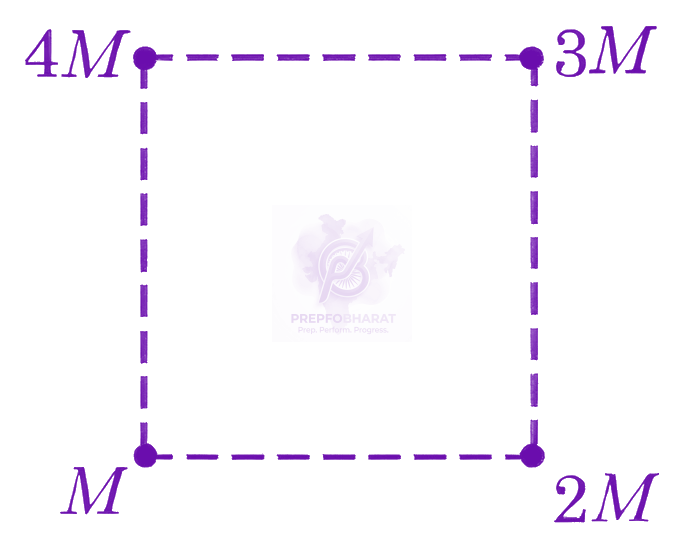
Two wires as shown in the figure below, made of steel and have breaking stress of $12 \times 10^8$ N/m$^2$. Area of cross-section of upper wire is $0.008$ cm$^2$ and of lower wire is $0.004$ cm$^2$. The maximum mass that can be added to pan without breaking any wire is _____ kg. (take $g = 10$ m/s$^2$) 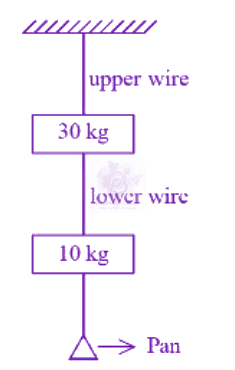
A block of mass 5 kg is moving on an inclined plane which makes an angle of $30^{\circ}$ with the horizontal. Friction coefficient between the block and inclined plane surface is $\frac{\sqrt{3}}{2}$. The force to be applied on the block so that the block will move down without acceleration is $\_\_\_\_$ N. $\left(g=10 \mathrm{~m} / \mathrm{s}^{2}\right)$.
In a screw gauge, the zero of the circular scale lies 3 divisions above the horizontal pitch line when their metallic studs are brought in contact. Using this instrument thickness of a sheet is measured. If pitch scale reading is 1 mm and the circular scale reading is 51 then the correct thickness of the sheet is $\_\_\_\_$ mm. [Assume least count is 0.01 mm ]
A wheel initially at rest is subjected to a uniform angular acceleration about its axis. In the first $2\text{ s}$ it rotates through an angle $\theta_1$ and in the next $2\text{ s}$ it rotates through an angle $\theta_2$. The ratio $\dfrac{\theta_2}{\theta_1}$ is _______.
A boy throws a ball into air at $45^{\circ}$ from the horizontal to land it on a roof of a building of height $H$. If the ball attains maximum height in 2 s and lands on the building in 3 s after launch, then value of $H$ is $\_\_\_\_$ m. $\left(\mathrm{g}=10 \mathrm{~m} / \mathrm{s}^{2}\right)$
Sixty four rain drops of radius 1 mm each falling down with a terminal velocity of $10 \mathrm{~cm} / \mathrm{s}$ coalesce to form a bigger drop. The terminal velocity of bigger drop is $\_\_\_\_$ $\mathrm{cm} / \mathrm{s}$.
A 4 kg mass moves under the influence of a force $\vec{F}=\left(4 t^{3} \hat{i}-3 t \hat{j}\right) \mathrm{N}$ where $t$ is the time in second. If mass starts from origin at $t=0$, the velocity and position after $t=2 \mathrm{~s}$ will be:
A solid sphere of mass $M$ and radius $R$ is divided into two unequal parts. The smaller part having mass $M/8$ is converted into a sphere of radius $r$ and the larger part is converted into a circular disc of thickness $t$ and radius $2R$. If $I_1$ is moment of inertia of a sphere having radius $r$ about an axis through its centre and $I_2$ is the moment of inertia of a disc about its diameter, the ratio of their moment of inertia $I_2/I_1 = $ _____.
The density $\rho$ of a uniform cylinder is determined by measuring its mass $m$, length $l$ and diameter $d$. The measured values of $m$, $l$ and $d$ are $97.42 \pm 0.02$ g, $8.35 \pm 0.05$ mm and $20.20 \pm 0.02$ mm, respectively. Calculated percentage fractional error in $\rho$ is _______.
The two wires $A$ and $B$ of equal cross-section but of different materials are joined together. The ratio of Young's modulus of wire $A$ and wire $B$ is $20/11$. When the joined wire is kept under certain tension the elongations in the wires $A$ and $B$ are equal. If the length of wire $A$ is $2.2$ m, then the length of wire $B$ is _______ m.
Two identical bodies $A$ and $B$ of equal masses have initial velocities $\vec{v_1} = 4\hat{i}$ m/s and $\vec{v_2} = 4\hat{j}$ m/s respectively. The body $A$ has acceleration $\vec{a_1} = 6\hat{i} + 6\hat{j}$ m/s$^2$ while the acceleration of the other body $B$ is zero. The centre of mass of the two bodies moves in __________ path.
The moment of inertia of a square loop made of four uniform solid cylinders, each having radius $R$ and length $L(\mathrm{R}<\mathrm{L})$ about an axis passing through the mid points of opposite sides, is (Take the mass of the entire loop as $M$) :
A uniform rod of mass $m$ and length $l$ suspended by means of two identical inextensible light strings as shown in figure. Tension in one string immediately after the other string is cut, is $\_\_\_\_$. $(g$ acceleration due to gravity) 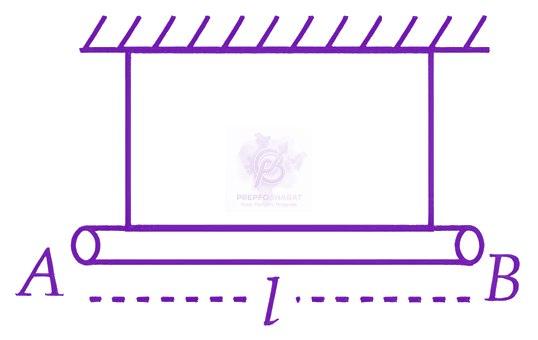
Two masses 400 g and 350 g are suspended from the ends of a light string passing over a heavy pulley of radius 2 cm. When released from rest the heavier mass is observed to fall 81 cm in 9 s. The rotational inertia of the pulley is $\_\_\_\_$ $\mathrm{kg} \cdot \mathrm{m}^{2}$. $\left(\mathrm{g}=9.8 \mathrm{~m} / \mathrm{s}^{2}\right)$
The strain-stress plot for materials $A, B, C$ and $D$ is shown in the figure. Which material has the largest Young's modulus ? 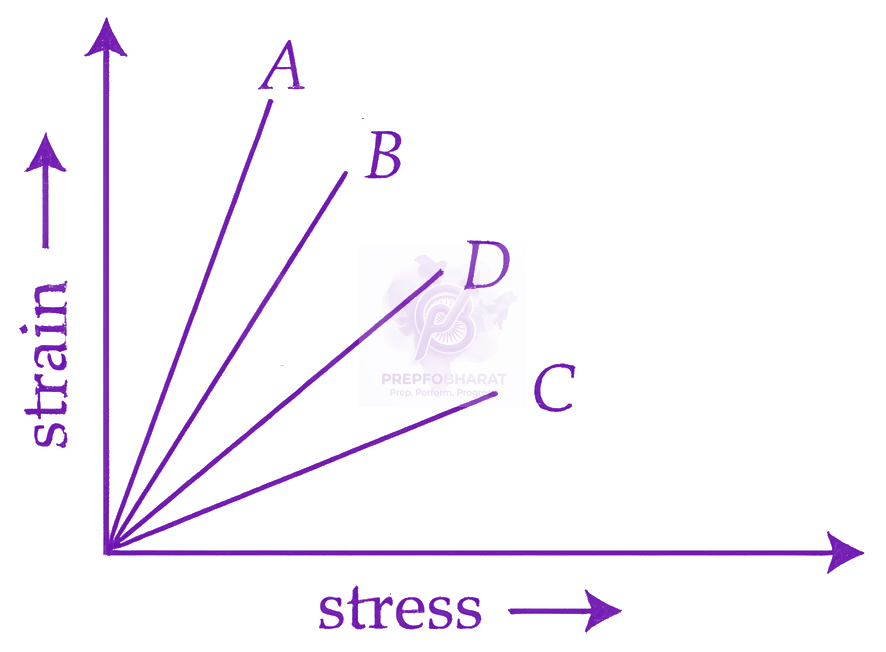
A body of mass 14 kg initially at rest explodes and breaks into three fragments of masses in the ratio $2: 2: 3$. The two pieces of equal masses fly off perpendicular to each other with a speed of $18 \mathrm{~m} / \mathrm{s}$ each. The velocity of the heavier fragment is $\_\_\_\_$ $\mathrm{m} / \mathrm{s}$.