∵ the molecular weight of C2H5OH&CH3OCH3 are same so in its vapour phase at same temperature & pressure the densities will be same
For which of the following parameters the structural isomers C_2 H_5 OH and CH_3 OCH_3 would be expected to have the same values? (Assume ideal…
JEE Main 2004 — Chemistry Organic Chemistry
2004mcqeasy
For which of the following parameters the structural isomers C2H5OH and CH3OCH3 would be expected to have the same values? (Assume ideal behaviour)
Official previous-year question
Held on 30 Apr 2004 · Verified 6 Jul 2026.
Options
- A
Heat of vaporization
- B
Gaseous densities at the same temperature and pressure
- C
Boiling points
- D
Vapour pressure at the same temperature
Did you get this right?
Sign in to track your attempts and accuracy.
Your note
Sign in to keep a private note on this question. Nothing you write is ever public.
JEE Main Organic Chemistry in other years
More JEE Main Organic Chemistry questions
A hydroxy compound $(\mathrm{X})$ with molar mass $122 \mathrm{~g} \mathrm{~mol}^{-1}$ is acetylated with acetic anhydride, using a large excess of the reagent ensuring complete acetylation of all hydroxyl groups. The product obtained has a molar mass of $290 \mathrm{~g} \mathrm{~mol}^{-1}$. The number of hydroxyl groups present in compound (X) is:
2026medium
Given below are two statements: Statement I: Benzene is nitrated to give nitrobenzene, which on further treatment with $\mathrm{CH}_{3} \mathrm{COCl} / \mathrm{AlCl}_{3}$ will give 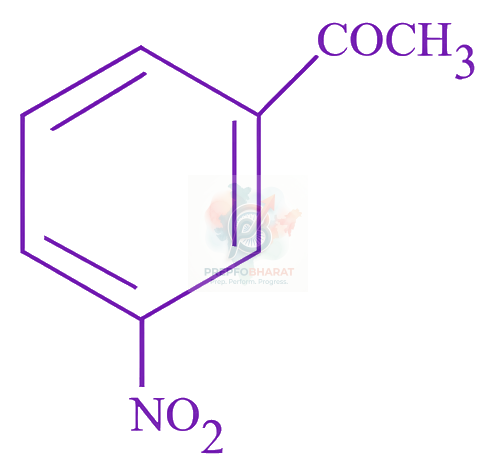 Statement II: $-\mathrm{NO}_{2}$ group is a $m$-directing, and deactivating group. In the light of the above statements, choose the most appropriate answer from the options given below
2026medium
Given below are two statements: Statement I: $\left(\mathrm{CH}_{3}\right)_{3} \stackrel{\oplus}{\mathrm{C}}$ is more stable than $\stackrel{\oplus}{\mathrm{C}} \mathrm{H}_{3}$ as nine hyperconjugation interactions are possible in $\left(\mathrm{CH}_{3}\right)_{3} \stackrel{\oplus}{\mathrm{C}}$. Statement II: $\stackrel{\oplus}{\mathrm{C}} \mathrm{H}_{3}$ is less stable than $\left(\mathrm{CH}_{3}\right)_{3} \stackrel{\oplus}{\mathrm{C}}$ as only three hyperconjugation interactions are possible in $\stackrel{\oplus}{\mathrm{C}} \mathrm{H}_{3}$. In the light of the above statements, choose the correct answer from the options given below
2026medium
Sucrose hydrolyses in acidic medium into glucose and fructose by first order rate law with $t_{1/2} = 3$ hour. The percentage of sucrose remaining after $6$ hours is _______. (Nearest integer) (Given: $\log 2 = 0.3010$ and $\log 3 = 0.4771$)
2026medium
Consider the following reaction sequence 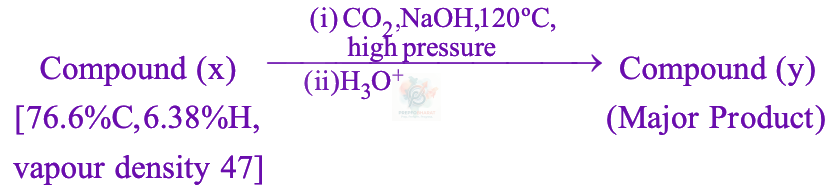 Compound $(\mathrm{y})$ develops characteristic colour with neutral $\mathrm{FeCl}_{3}$ solution. Identify the INCORRECT statement from the following for the above sequence.
2026medium
Other Chemistry topics for JEE Main
Keep practicing Organic Chemistry
Work through every JEE Main Organic Chemistry PYQ, year by year.