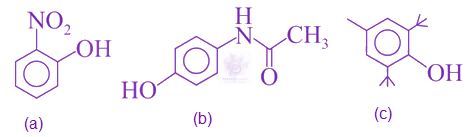
(a) Shows intra molecular H-bonding.
(b) Shows significant intermolecular H-bonding.
(c) It does not show intermolecular H-bonding due to steric hindrance.
JEE Main 2021 — Chemistry Inorganic Chemistry
The compound/s which will show significant intermolecular H-bonding is/are :
Held on 27 Aug 2021 · Verified 6 Jul 2026.
(a), (b) and (c)
(b) only
(c) only
(a) and (b) only
Sign in to track your attempts and accuracy.
Sign in to keep a private note on this question. Nothing you write is ever public.
$SF_4$ is isostructural with: A. $BrF_4^{\ominus}$ B. $CH_4$ C. $IF_4^{\oplus}$ D. $XeF_4$ E. $XeO_2 F_2$ Choose the correct answer from the options given below:
Correct statements from the following are: A. Nitrogen in oxidation states from $+1$ to $+4$ disproportionates in acid medium. B. Nitrogen has the ability to form $d\pi - p\pi$ multiple bonds with itself and other elements with small size and high electronegativity. C. N-N single bond is stronger than P-P single bond. D. Nitrogen has highest density in its group due to small size. E. The maximum covalency of nitrogen is four since it has only four valence orbitals for bonding. Choose the correct answer from the options given below:
The correct statements about metal carbonyls are A. The metal-carbon bonds in metal carbonyls possess both $\sigma$ and $\pi$-character. B. Due to synergic bonding interactions between metal and CO ligand, the metal-carbon bond becomes weak. C. The metal-carbon $\sigma$ bond is formed by the donation of lone pair of electrons on the carbonyl carbon into a vacant orbital of metal. D. The metal-carbon $\pi$ bond is formed by the donation of electrons from filled d-orbital of metal into vacant $\pi^*$ orbital of CO. Choose the correct answer from the options given below:
The electronegativity of a group 13 element 'E' is same as that of Ge (on Pauling scale and upto one decimal point). The CORRECT statements about $E^{3+}$ are A. It can act as a reducing agent. B. It can act as an oxidizing agent. C. $E^{3+}$ is more stable than $E^+$. D. The standard electrode potential value for $E^{3+}/E$ is positive. Choose the correct answer from the options given below:
Among $Fe^{3+}$, $Pb^{2+}$, $Cu^{2+}$ and $Mn^{2+}$, identify the one that gets precipitated out while passing $H_2S$ in presence of $NH_4OH$ as group reagent. The highest possible oxidation state of the corresponding metal is
Work through every JEE Main Inorganic Chemistry PYQ, year by year.