By Work-Energy Theorem
Wg+Wa=Kf−Ki
mgh+Wa=21mv2−0
10−3×10×103+wa=21×10−3×(50)2
Wa=−8.75J
work done due to gravity =mgh
=10−3×10×103
=10J
NEET UG 2017 — Physics Mechanics
Consider a drop of rain water having mass 1g falling from a height of 1km. It hits the ground with a speed of 50ms−1. Take g constant with a value 10ms−2. The work done by the (i) gravitational force and the (ii) resistive force of air is
Held on 30 Apr 2017 · Verified 9 Jul 2026.
(i)−10J(ii)−8.25J
(i)1.25J(ii)−8.25J
(i)100J(ii)8.75J
(i)10J(ii)−8.75J
Sign in to track your attempts and accuracy.
Sign in to keep a private note on this question. Nothing you write is ever public.
A bullet of mass 10 g moving with 400 m/s penetrates a wall and comes to rest. The loss in kinetic energy is:
A physical quantity $P$ is related to four observations $a, b, c$ and $d$ as follows : $P=a^3 b^2 / c \sqrt{d}$ The percentage errors of measurement in $a, b, c$ and $d$ are $1 \%, 3 \%, 2 \%$ and $4 \%$ respectively. The percentage error in the quantity $P$ is
A uniform rod of mass 20 kg and length 5 m leans against a smooth vertical wall making an angle of $60^{\circ}$ with it. The other end rests on a rough horizontal floor. The friction force that the floor exerts on the rod is (take $\mathrm{g}=10 \mathrm{~m} / \mathrm{s}^2$ )
The radius of Martian orbit around the Sun is about 4 times the radius of the orbit of Mercury. The Martian year is 687 Earth days. Then which of the following is the length of 1 year on Mercury?
Consider a water tank shown in the figure. It has one wall at $x=L$ and can be taken to be very wide in the $z$ direction. When filled with a liquid of surface tension $S$ and density $\rho$, the liquid surface makes angle $\theta_0\left(\theta_0 \ll 1\right)$ with the $x$-axis at $x=L$. If $y(x)$ is the height of the surface then the equation for $y(x)$ is: 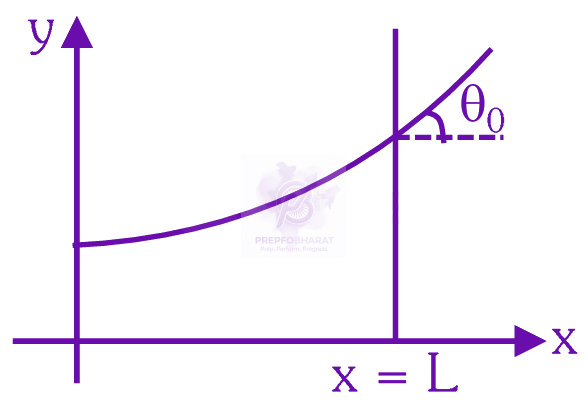 $\left(\operatorname{take} \theta(x)=\sin \theta(x)=\tan \theta(x)=\frac{d y}{d x}, g\right.$ is the acceleration due to gravity)
Work through every NEET UG Mechanics PYQ, year by year.