NEET UG 2014 — Mechanics
Physics Mechanics questions from NEET UG 2014.
Other Years
13 Mechanics Questions from 2014
A particle is moving such that its position coordinates $(x, y)$ are $(2m, 3m)$ at time $t=0,$ $(6m, 7m)$ at time $t=2s$ and $(13m, 14m)$ at time $t=5s$. The average velocity vector $({\vec{V}}_{av})$ from $t=0$ to $t=5 s$ is:
A solid cylinder of mass $50 kg$ and radius $0.5 m$ is free to rotate about horizontal axis. A massless string is wound round the cylinder with one end attached to it and other hanging freely. Tension in the string required to produce an angular acceleration of $2$ revolutions ${s}^{-2}$
Copper of fixed volume $V$ is drawn into wire of length $l$. When this wire is subjected to a constant force $F,$ the extension produced in the wire is $\Delta l.$ Which of the following graph is a straight line?
If force $(F),$velocity $(V)$ and time $(T)$ are taken as fundamental units, the dimensions of mass are
Dependence of intensity of gravitational field $(E)$ of earth with distance $(r)$ from centre of earth is correctly represented by:
The ratio of the acceleration for a solid sphere (mass $‘m'$ and radius $R)$ rolling down an incline of angle $‘\theta '$ without slipping and slipping down the incline without rolling is:
A black hole is an object whose gravitational field is so strong that even light cannot escape from it. To what approximate radius would earth $(mass=5.98\times {10}^{24}kg)$ have to be compressed to be a black hole?
A certain number of spherical drops of a liquid of radius $r$ coalesce to form a single drop of radius $R$ and volume $V.$ If $T$ is the surface tension of the liquid then:
A system consists of three masses ${m}_{1},{m}_{2}$ and ${m}_{3}$ connected by a string passing over a pulley $P.$ The mass ${m}_{3}$ hangs freely and ${m}_{2}$ and ${m}_{1}$ are on a rough horizontal table (the coefficient of friction $=\mu ).$ The pulley is frictionless and of negligible mass. The downward acceleration of mass ${m}_{3}$ is: (Assume ${m}_{1}={m}_{2}={m}_{3}=m)$ 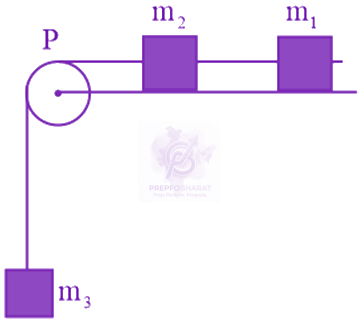
The force $‘F'$ acting on a particle of mass $‘m'$ is indicated by the force-time graph shown below. The change in momentum of the particle over the time interval from zero to $8 s$ is: 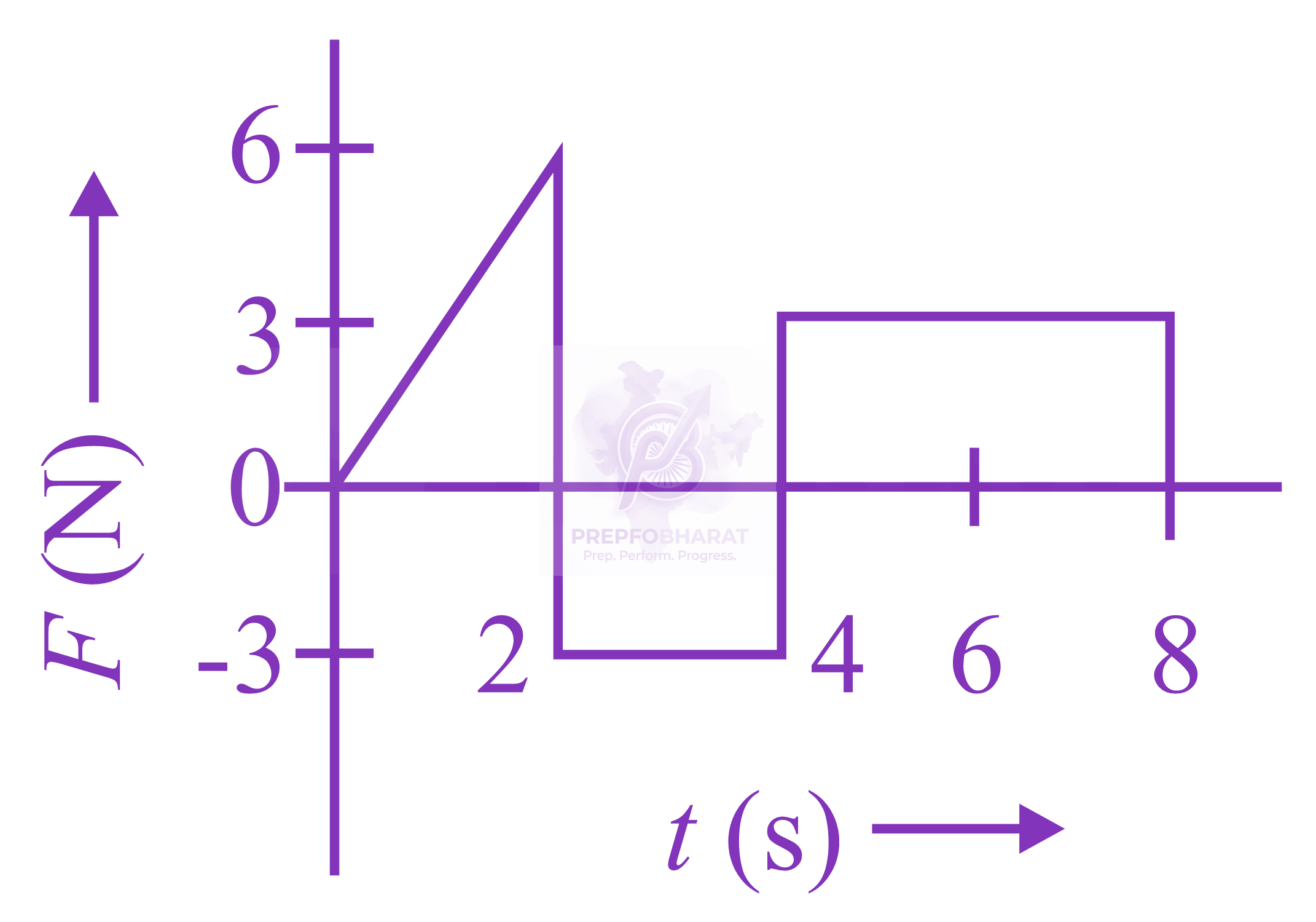
A projectile is fired from the surface of the earth with a velocity of $5 m{s}^{-1}$ and angle $\theta$ with the horizontal. Another projectile fired from another planet with a velocity of $3 {ms}^{-1}$ at the same angle follows a trajectory which is identical with the trajectory of the projectile fired from the earth. The value of the acceleration due to gravity on the planet is: (given $=9.8 m{s}^{-2}$)
A balloon with mass $m$ is descending down with an acceleration $a$ (where $a<g).$ How much mass should be removed from it so that it starts moving up with an acceleration $a$?
A body of mass $(4m)$ is lying in $x$ - $y$ plane at rest. It suddenly explodes into three pieces. Two pieces, each of mass $(m)$ move perpendicular to each other with equal speeds $(\upsilon ).$ The total kinetic energy generated due to explosion is: