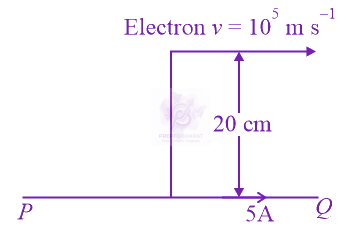
Magnetic Field due to a current carrying wire at 20cm in terms of current I is given by,
B=2πdμ0I
B=20×10−22×10−7×5
B=0.5×10⁻⁵T
Now,
Force on charge particle =qvB
Fm=eVB
Fm=1.6×10−19×105×0.5×10−5
=8×10⁻²⁰N
NEET UG 2021 — Physics Electromagnetism
An infinitely long straight conductor carries a current of 5A as shown. An electron is moving with a speed of 105ms−1 parallel to the conductor. The perpendicular distance between the electron and the conductor is 20cm at an instant. Calculate the magnitude of the force experienced by the electron at that instant.
Held on 30 Apr 2021 · Verified 9 Jul 2026.
4×10⁻²⁰N
8π×10−20N
4π×10−20N
8×10⁻²⁰N
Sign in to track your attempts and accuracy.
Sign in to keep a private note on this question. Nothing you write is ever public.
Two point charges +2μC and -2μC are placed 10 cm apart. The electric field at the midpoint is:
A model for quantized motion of an electron in a uniform magnetic field $B$ states that the flux passing through the orbit of the electron is $n(h / e)$ where $n$ is an integer, $h$ is Planck's constant and $e$ is the magnitude of electron's charge. According to the model, the magnetic moment of an electron in its lowest energy state will be ( $m$ is the mass of the electron)
A 2 amp current is flowing through two different small circular copper coils having radii ratio $1: 2$. The ratio of their respective magnetic moments will be
Two identical charged conducting spheres $A$ and $B$ have their centres separated by a certain distance. Charge on each sphere is q and the force of repulsion between them is $F$. A third identical uncharged conducting sphere is brought in contact with sphere A first and then with B and finally removed from both. New force of repulsion between spheres $A$ and $B$ (Radii of $A$ and $B$ are negligible compared to the distance of separation so that for calculating force between them they can be considered as point charges) is best given as :
An electron (mass $9 \times 10^{-31} \mathrm{~kg}$ and charge $1.6 \times 10^{-19} \mathrm{C}$ ) moving with speed $\mathrm{c} / 100(\mathrm{c}=$ speed of light) is injected into a magnetic field $\vec{B}$ of magnitude $9 \times 10^{-4} \mathrm{~T}$ perpendicular to its direction of motion. We wish to apply an uniform electric field $\vec{E}$ together with the magnetic field so that the electron does not deflect from its path. Then (speed of light $\mathrm{c}=3 \times 10^8 \mathrm{~ms}^{-1}$ )
Work through every NEET UG Electromagnetism PYQ, year by year.