In the first case, it is given that 'n' resistances are arranged in series, each having a resistance R.
In that case, the nett reistance of the external circuit is 'nR'. The internal resistance itself is R. Hence, the resultant resistance of the circuit is nR+R=(n+1)R.
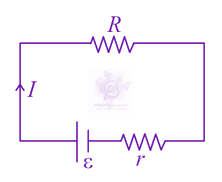
∵I=nR+Rϵ
⇒ I=(n+1)RE .... (i)
In the case of parallel combination, these external n resistances are arranged in parallel,thereby their nett external resistance is nR. This is in series with the internal resistance R.
Hence,
10I=nR+RE=R+nRnE .... (ii)
From (i) and (ii);
nR+nRE=10(nR+RE)
n=10