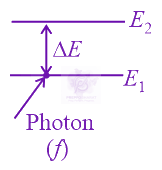
According to Bohr's model, when electron makes the transition from lower orbit to higher orbit, its energy can be given as
ΔE=Efinal−Einitial=hf, here, h is Planck's constant.
Then, f=hE2−E1.
Bohr's frequency condition is the law that state that the frequency of the radiation emitted or absorbed during the transition of an atomic system between two stationary states equals the difference in the energies of the states divided by Planck's constant.
Hence, Statement I is incorrect but statement II is true.