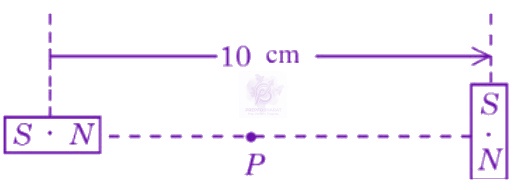
Let the magnetic moment of each magnet be M=35 J/T.
The distance of point P from the center of each magnet is r=5 cm =0.05 m.
For the first magnet (horizontal), point P lies on its axial line. The magnetic field at P due to the first magnet is:
B1=4πμ0r32M
The direction of B1 is along the axis of the first magnet.
For the second magnet (vertical), point P lies on its equatorial line. The magnetic field at P due to the second magnet is:
B2=4πμ0r3M
The direction of B2 is parallel to the axis of the second magnet, which is perpendicular to the axis of the first magnet.
Since B1 and B2 are perpendicular to each other, the net magnetic field at P is:
B=B12+B22
Substituting the expressions for B1 and B2:
B=(4πμ0r32M)2+(4πμ0r3M)2
B=4πμ0r3M22+12=4πμ0r35M
Substituting the given values 4πμ0=10−7 T m/A, M=35 J/T, and r=0.05 m:
B=10−7×(0.05)35×35
B=10−7×125×10−615
B=12515×10−1
B=0.1×0.12 T
B=0.012 T
B=12×10−3 T
Comparing this with the given value α×10−3 T, we get α=12.
Answer: 12