JEE Main 2014 — Electromagnetism
Physics Electromagnetism questions from JEE Main 2014.
Other Years
37 Electromagnetism Questions from 2014
An electromagnetic wave of frequency $1 \times 10^{14}$ hertz is propagating along $\mathrm{z}$-axis. The amplitude of electric field is $4 \mathrm{~V} / \mathrm{m}$. If $\varepsilon_0=8.8 \times 10^{-12} \mathrm{C}^2 / \mathrm{N}-$ $\mathrm{m}^2$, then average energy density of electric field will be:
A positive charge ' $\mathrm{q}$ ' of mass ' $\mathrm{m}$ ' is moving along the $+x$ axis. We wish to apply a uniform magnetic field B for time $\Delta t$ so that the charge reverses its direction crossing the $\mathrm{y}$ axis at a distance $\mathrm{d}$. Then:
In the circuit shown, current (in A) through $50 \mathrm{~V}$ and $30 \mathrm{~V}$ batteries are, respectively: 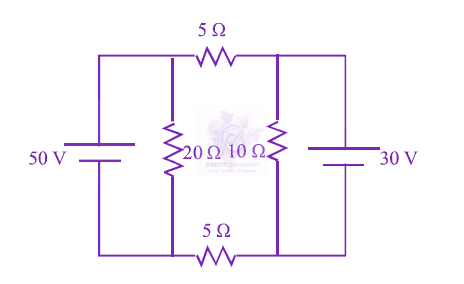
A parallel plate capacitor is made of two plates of length 1 , width $w$ and separated by distance $d$. A dielectric slab (dielectric constant $\mathrm{K}$ ) that fits exactly between the plates is held near the edge of the plates. It is pulled into the capacitor by a force $\mathrm{F}=-\frac{\partial \mathrm{U}}{\partial \mathrm{x}}$ where $\mathrm{U}$ is the energy of the capacitor when dielectric is inside the capacitor up to distance $x$ (See figure). If the charge on the capacitor is Q then the force on the dielectric when it is near the edge is: 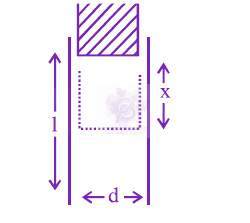
When the rms voltages ${V}_{L} , {V}_{C}$ and ${V}_{R}$ are measured respectively across the inductor $L,$ the capacitor $C$ and the resistor $R$ in a series $LCR$ circuit connected to an $AC$ source, it is found that the ratio ${V}_{L} :{V}_{C} :{V}_{R} =1:2:3.$ If the rms voltage of the $AC$ source is $100 V,$ then ${V}_{R}$ is close to :
Match List I (Wavelength range of electromagnetic spectrum) with List II (Method of production of these waves) and select the correct option from the options given below the lists.<table class="pyq-table"><tbody><tr><th></th><th>List I</th><th></th><th>List II</th></tr><tr><td>(a)</td><td>$700\mathrm{nm}$ to $1\mathrm{mm}$</td><td>(i)</td><td>Vibration of atoms and molecules.</td></tr><tr><td>(b)</td><td>$1\mathrm{nm}$ to $400\mathrm{nm}$</td><td>(ii)</td><td>Inner shell electrons in atoms moving from one energy level to a lower level.</td></tr><tr><td>(c)</td><td>$<{10}^{-3}\mathrm{nm}$</td><td>(iii)</td><td>Radioactive decay of the nucleus.</td></tr><tr><td>(d)</td><td>$1\mathrm{mm}$ to $0.1m$</td><td>(iv)</td><td>Magnetron valve.</td></tr></tbody></table>
The magnitude of the average electric field normally present in the atmosphere just above the surface of the Earth is about $150N/C$, directed inward towards the center of the Earth. This gives the total net surface charge carried by the Earth to be : [Given : ${\in }_{\text{O}} = \text{8.85} \times 1 {0}^{ - 1 2 } {\text{ C}}^{2} / {\text{N-m}}^{2} \text{, } {\text{R}}_{\text{E}} = \text{6.37} \times 1 {0}^{6} \text{m}$]
The electric field in a region of space is given by, $\vec{E}={E}_{0}\hat{i}+2{E}_{0}\hat{j}$ where ${E}_{0}=100N{C}^{-1}$. The flux of this field through a circular surface of radius $0.02m$ parallel to the $Y‐Z$ plane is nearly
The coercivity of a small magnet, where the ferromagnet gets demagnetised is $3\times {10}^{3}A/m$. The current required to be passed in a solenoid of length $10\mathrm{cm}$ and number of turns $100$, so that the magnet gets demagnetised when inside the solenoid is
A spherically symmetric charge distribution is characterised by a charge density having the following variations: $\rho(r)=\rho_o\left(1-\frac{r}{R}\right)$ for $r < R$ $\rho(\mathrm{r})=0$ for $r \geq \mathrm{R}$ Where $r$ is the distance from the centre of the charge distribution $\rho_{\mathrm{o}}$ is a constant. The electric field at an internal point $(r < R)$ is:
The circuit shown here has two batteries of $8.0 \mathrm{~V}$ and $16.0 \mathrm{~V}$ and three resistors $3 \Omega, 9 \Omega$ and $9 \Omega$ and a capacitor of $5.0 \mu \mathrm{F}$. 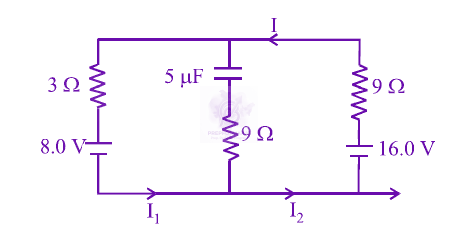 How much is the current $\mathrm{I}$ in the circuit in steady state?
In the experiment of calibration of voltmeter, a standard cell of e.m.f. $1.1$ volt is balanced against $440 \mathrm{~cm}$ of potential wire. The potential difference across the ends of resistance is found to balance against $220 \mathrm{~cm}$ of the wire. The corresponding reading of voltmeter is $0.5$ volt. The error in the reading of volmeter will be:
An example of a perfect diamagnet is a superconductor. This implies that when a superconductor is put in a magnetic field of intensity $B$, the magnetic field ${B}_{s}$ inside the superconductor will be such that
Three straight parallel current carrying conductors are shown in the figure. The force experienced by the middle conductor of length $25 \mathrm{~cm}$ is: 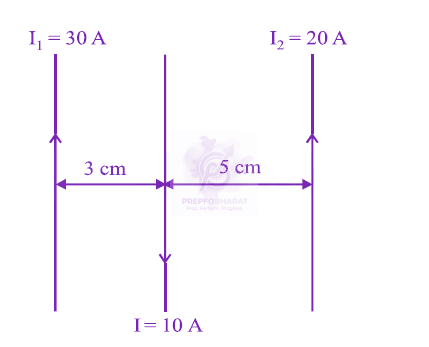
In a large building, there are 15 bulbs of 40 W, 5 bulbs of 100 W, 5 fans of 80 W and 1 heater of 1 kW. The voltage of the electric mains is 220 V. The minimum capacity of the main fuse of the building will be:
The gap between the plates of a parallel plate capacitor of area $A$ and distance between plates $d$, is filled with a dielectric whose relative permittivity varies linearly from ${\epsilon }_{1}$ at one plate to ${\epsilon }_{2}$ at the other. The capacitance of the capacitor is
A cone of base radius $R$ and height $h$ is located in a uniform electric field $\overrightarrow{\mathrm{E}}$ parallel to its base. The electric flux entering the cone is:
Match List - I (Electromagnetic wave type) with List - II (Its association/application) and select the correct option from the choices given below the lists : <table class="pyq-table"><tbody><tr><th></th><th>List - I</th><th></th><th>List - II</th></tr><tr><td>(a)</td><td>Infrared waves</td><td>(i)</td><td>To treat muscular strain</td></tr><tr><td>(b)</td><td>Radio waves</td><td>(ii)</td><td>For broadcasting</td></tr><tr><td>(c)</td><td>X - rays</td><td>(iii)</td><td>To detect fracture of bones</td></tr><tr><td>(d)</td><td>Ultraviolet rays</td><td>(iv)</td><td>Absorbed by the ozone layer of the atmosphere</td></tr></tbody></table>
A parallel plate capacitor is made of two circular plates separated by a distance of 5 mm and with a dielectric of dielectric constant 2.2 between them. When the electric field in the dielectric is $3 \times 1 {0}^{4} \text{ V/m}$, the charge density of the positive plate will be close to :
The space between the plates of a parallel plate capacitor is filled with a 'dielectric' whose 'dielectric constant' varies with distance as per the relation: $$ \mathrm{K}(\mathrm{x})=\mathrm{K}_{\mathrm{o}}+\lambda \mathrm{x}(\lambda=\mathrm{a} \text { constant }) $$ The capacitance $\mathrm{C}$, of the capacitor, would be related to its vacuum capacitance $\mathrm{C}_{\mathrm{o}}$ for the relation :
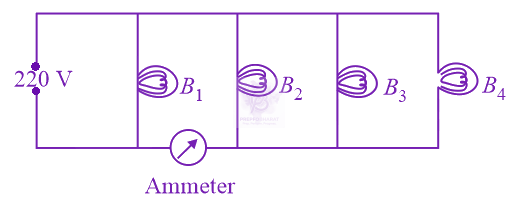 Four bulbs ${B}_{1}$, ${B}_{2}$, ${B}_{3}$ and ${B}_{4}$ of $100W$ each are connected to $220V$ main as shown in the figure. The reading in an ideal ammeter will be
In the circuit diagrams (A, B, C and D) shown below, $\mathrm{R}$ is a high resistance and $\mathrm{S}$ is a resistance of the order of galvanometer resistance G. The correct circuit, corresponding to the half deflection method for finding the resistance and figure of merit of the galvanometer, is the circuit labelled as: (a) 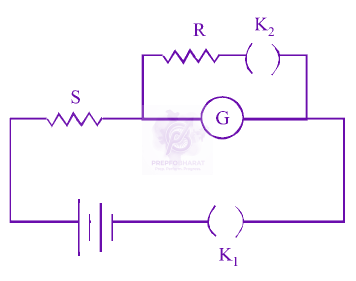 (b)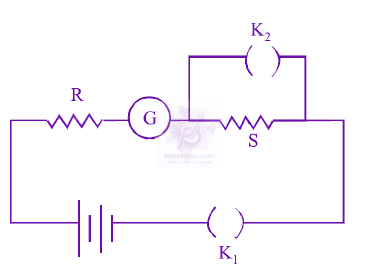 (C)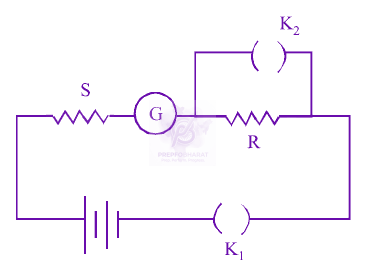 (d)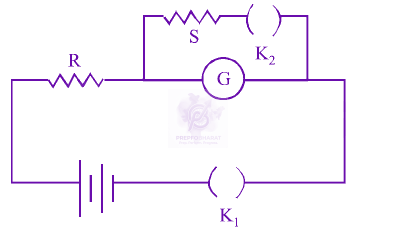
Three identical bars A, B and C are made of different magnetic materials. When kept in a uniform magnetic field, the field lines around them look as follows: 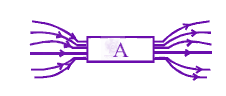 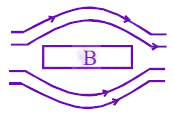 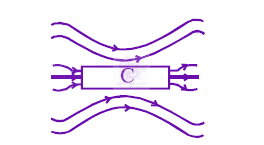 Make the correspondence of these bars with their material being diamagnetic ( $\mathrm{D})$, ferromagnetic (F) and paramagnetic $(\mathrm{P})$ :
Consider two thin identical conducting wires covered with very thin insulating material. One of the wires is bent into a loop and produces magnetic field $\mathrm{B}_1$, at its centre when a current $\mathrm{I}$ passes through it. The ratio $\mathrm{B}_1: \mathrm{B}_2$ is:
Three capacitances, each of 3 $\mu \text{F}$, are provided. These cannot be combined to provide the resultant capacitance of :
If microwaves, $X‐$rays, infrared, gamma rays, ultraviolet, radio waves and visible parts of the electromagnetic spectrum are denoted respectively by $M$, $X$, $I$, $G$, $U$, $R$ and $V$ the following is the arrangement in ascending order of the wavelength
A lamp emits monochromatic green light uniformly in all directions. The lamp is $3 \%$ efficient in converting electrical power to electromagnetic waves and consumes $100 \mathrm{~W}$ of power. The amplitude of the electric field associated with the electromagnetic radiation at a distance of $5 \mathrm{~m}$ from the lamp will be nearly:
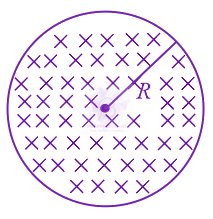 The figure shows a circular area of tthe radius $R$ where a uniform magnetic field $\vec{B}$ is going into the plane of the paper and increasing in magnitude at a constant rate. In that case, which of the following graphs, drawn schematically, correctly shows the variation of the induced electric field $E(r)$?
A sinusoidal voltage $\mathrm{V}(\mathrm{t})=100 \sin (500 \mathrm{t})$ is applied across a pure inductance of $L=0.02 \mathrm{H}$. The current through the coil is:
A square frame of side $10\mathrm{cm}$ and a long straight wire carrying current $1A$ are in the plane of the paper. Starting from close to the wire, the frame moves towards the right with a constant speed of $10m{s}^{-1}$ (see figure). The e.m.f induced at the time the left arm of the frame is at $x=10\mathrm{cm}$ from the wire is 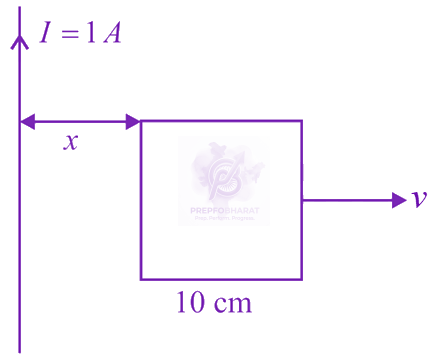
A coil of circular cross-section having 1000 turns and $4 \mathrm{~cm}^2$ face area is placed with its axis parallel to a magnetic field which decreases by $10^{-2} \mathrm{~Wb}$ $\mathrm{m}^{-2}$ in $0.01 \mathrm{~s}$. The e.m.f. induced in the coil is:
A d.c. main supply of e.m.f. $220V$ is connected across a storage battery of e.m.f. $200V$ through a resistance of $1 \Omega$. The battery terminals are connected to external resistance $R$. The minimum value of $R$, so that a current passes through the battery to charge it is:
A conductor lies along the z-axis at $- \text{1.5} \leq \text{z} <\text{1.5} m$ and carries a fixed current of 10.0 A in ${ -\hat{\text{a}} }_{\text{z}}$ direction (see figure). For a field $\vec{\text{B}} = \text{3.0} \times 1 {0}^{ - 4 } {\text{ e}}^{ - \text{0.2x } } { \hat{\text{a}} }_{\text{y}}$ T, find the power required to move the conductor at constant speed to x = 2.0 m, y = 0 m in $5 \times 1 {0}^{ - 3 } \text{ s}$. Assume parallel motion along the x-axis. 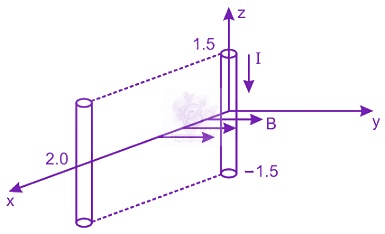
In the circuit shown here, the point '$C$' is kept connected to point $A$ '' till the current flowing through the circuit becomes constant. Afterward, suddenly, point '$C$' is disconnected from point $A$ '' and connected to point '$B$' at time $t=0$. Ratio of the voltage across resistance and the inductor at $t=\frac{L}{R}$ will be equal to : 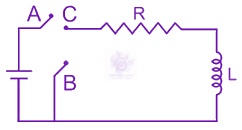
During the propagation of electromagnetic wave in a particular medium :-
Assume that an electric field $\vec{\text{E}} = 3 0 { x }^{2} \hat{ i }$ exists in space. Then the potential difference ${\text{V}}_{\text{A}} - {\text{V}}_{\text{O}}$ , where V$_{O}$ is the potential at the origin and V$_{A}$ the potential at x = 2 m is :
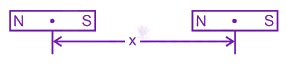
The mid points of two small magnetic dipoles of length $d$ in end-on positions, are separated by a distance $x$$(x\gg d)$. The magnitude of force between them is proportional to ${x}^{-n}$ where $n$ is :