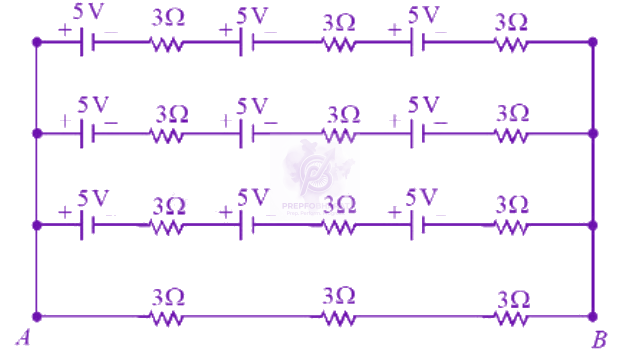
The given circuit consists of four parallel branches connected between the left and right common vertical wires.
Let's find the equivalent electromotive force (EMF) and resistance for each branch:
For the top three active branches, each contains three 5 V cells and three 3 Ω resistors in series.
Equivalent EMF of each active branch, E=5+5+5=15 V.
Equivalent resistance of each active branch, R=3+3+3=9 Ω.
Since these three identical active branches are connected in parallel, we can replace them with a single equivalent voltage source:
Equivalent EMF, Eeq=15 V (as they are identical and in parallel).
Equivalent internal resistance, Req=39=3 Ω.
The fourth (bottom) branch is connected between terminals A and B and acts as the load for this equivalent source. It contains three 3 Ω resistors in series.
Resistance of the branch AB, RAB=3+3+3=9 Ω.
Now, the circuit is simplified to an equivalent source of 15 V with internal resistance 3 Ω connected across a load of 9 Ω.
The current I flowing between terminals A and B (through the bottom branch) is given by Ohm's law:
I=Req+RABEeq
I=3+915=1215 A
I=1.25 A
Answer: 1.25