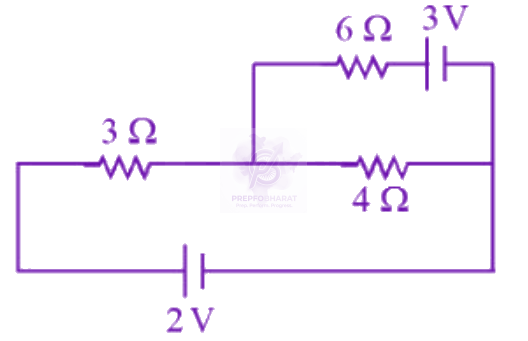
Taking the right-hand wire as the reference node at 0 V, let the left junction (where the 3Ω, 4Ω and 6Ω resistors meet) be Node A at potential VA.
Bottom branch: The positive terminal of the 2 V battery is at the reference, so its negative terminal (and hence the left end of the 3Ω resistor) is at −2 V.
Top branch: The positive terminal of the 3 V battery is at the reference, so its negative terminal (and hence the node between the 6Ω resistor and the 3 V battery) is at −3 V.
Applying KCL at Node A (sum of currents leaving the node is zero):
4VA−0+3VA−(−2)+6VA−(−3)=0
4VA+3VA+2+6VA+3=0
Multiplying throughout by 12:
3VA+4(VA+2)+2(VA+3)=0
3VA+4VA+8+2VA+6=0
9VA+14=0⇒VA=−914 V
Current through the 6Ω resistor (from Node A towards the −3 V point):
I6=6VA−(−3)=6−914+3=6913=5413 A
Heat generated in the 6Ω resistor in t=100 s:
H=I62⋅R⋅t=(5413)2⋅6⋅100
H=2916169⋅600=486169⋅100=48616900 J
Given H=100α J:
100α=48616900
α=48616900⋅100=4861690000≈3477.37
Rounding to the nearest integer:
α=3477
Hence, the answer is 3477.