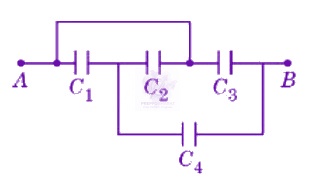
Let the nodes in the circuit be labeled to identify the connections:
Let the input terminal be Node A.
Let the junction between C1 and C2 be Node X.
The top wire connects Node A to the junction between C2 and C3. Thus, this junction is also at the potential of Node A.
The bottom wire connects Node X to the output terminal Node B, with capacitor C4 in this path.
Based on these nodes, the connections of each capacitor are as follows:
C1 is connected between Node A and Node X.
C2 is connected between Node X and Node A.
C3 is connected between Node A and Node B.
C4 is connected between Node X and Node B.
We can now simplify the circuit step-by-step:
Capacitors C1 and C2 are in parallel between nodes A and X. Their equivalent capacitance is:
C12=C1+C2=1μF+1μF=2μF
This equivalent capacitor C12 is in series with C4 (which is connected between X and B). The equivalent capacitance of this branch is:
CAXB=C12+C4C12×C4=2+22×2=1μF
Finally, this branch is in parallel with C3 (which is connected directly between A and B). The total equivalent capacitance between A and B is:
CAB=CAXB+C3=1μF+1μF=2μF
Answer: 2