B=4πyμ0I(1+sinθ1)+4πxμ0I(1+sinθ2)
B=4πyμ0I(1+x2+y2x)+4πxμ0I(1+x2+y2y)
B=4πxμ0I+4πyμ0I+4πμ0I[yx2+y2x+xx2+y2y]⇒B=4πμ0I[x1+y1]+4πμ0Ixyx2+y2=4πμ0I[xyx+y+x2+y2]
JEE Main 2021 — Physics Electromagnetism
There are two infinitely long straight current-carrying conductors and they are held at right angles to each other so that their common ends meet at the origin as shown in the figure given below. The ratio of current in both conductors is 1:1. The magnetic field at point P is_________.
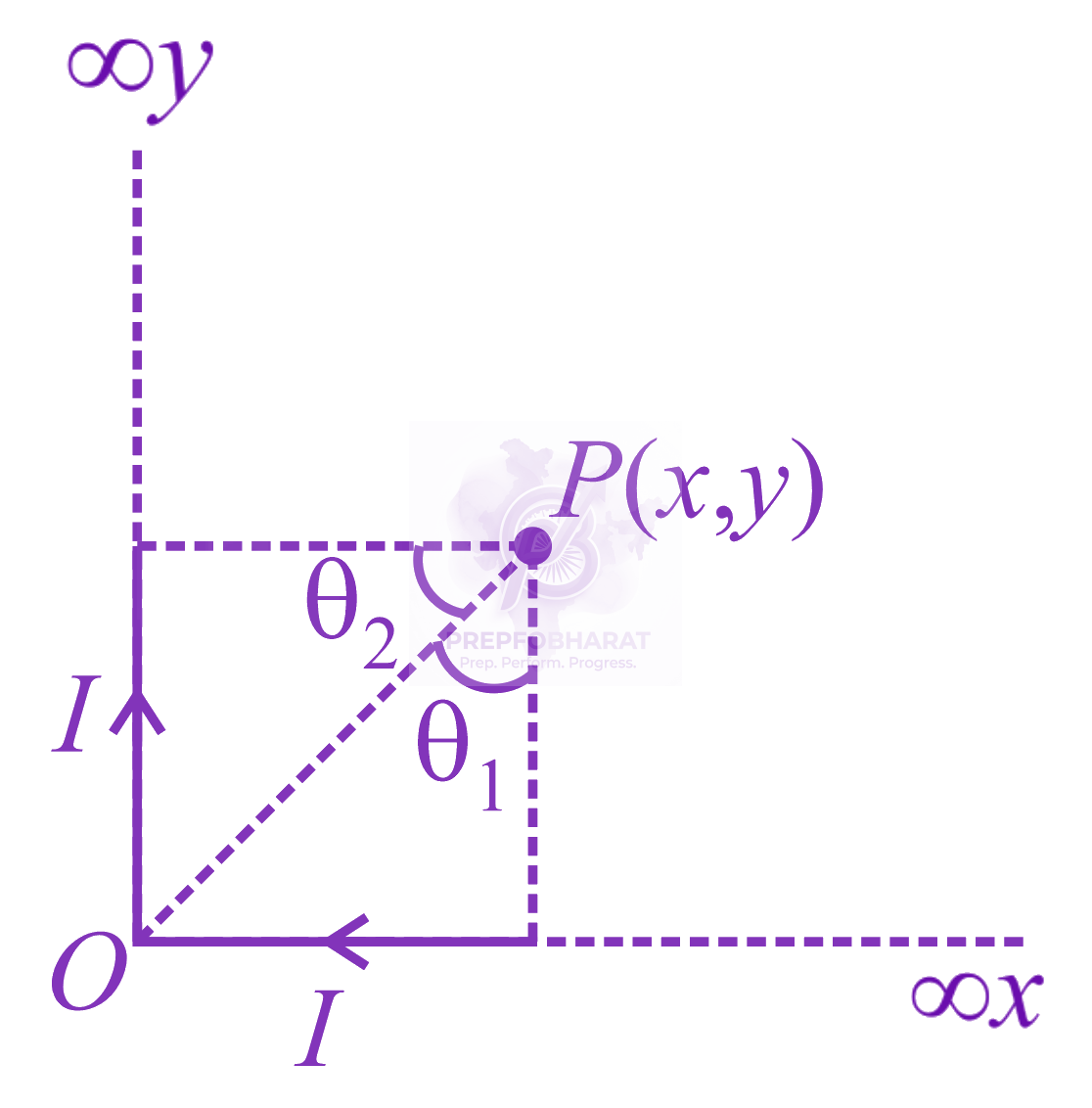
Held on 1 Sept 2021 · Verified 6 Jul 2026.
4πxyμ0I[x2+y2−(x+y)]
4πμ0Ixy[x2+y2−(x+y)]
4πxyμ0I[x2+y2+(x+y)]
4πμ0Ixy[x2+y2+(x+y)]
Sign in to track your attempts and accuracy.
Sign in to keep a private note on this question. Nothing you write is ever public.
A magnetic field vector in an electromagnetic wave is represented by $\vec{B}=B_0\sin\left(2\pi vt-\dfrac{2\pi x}{\lambda}\right)\hat{j}$. Its associated electric field vector is ______.
A plane electromagnetic wave is moving in free space with velocity $c=3 \times 10^{8} \mathrm{~m} / \mathrm{s}$ and its electric field is given as $\vec{E}=54 \sin (k z-\omega t) \hat{j} \mathrm{~V} / \mathrm{m}$, where $\hat{j}$ is the unit vector along $y$-axis. The magnetic field vector $\vec{B}$ of the wave is:
A charged particle moves in a uniform magnetic field. If the velocity is perpendicular to the field, the path of the particle is:
A monochromatic source of light operating at $15$ kW emits $2.5\times 10^{22}$ photons/s. The region of an electromagnetic spectrum to which the emitted electromagnetic radiation belongs to ________. (Take $h=6.6\times 10^{-34}$ J·s and $c=3\times 10^8$ m/s).
An electromagnetic wave of frequency 100 MHz propagates through a medium of conductivity, $\sigma=10 \mathrm{mho} / \mathrm{m}$. The ratio of maximum conduction current density to maximum displacement current density is $\_\_\_\_$. $\left[\text{Take }\frac{1}{4 \pi \epsilon_{\mathrm{o}}}=9 \times 10^{9} \mathrm{Nm}^{2} / \mathrm{C}^{2}\right]$
Work through every JEE Main Electromagnetism PYQ, year by year.