As current in A and B are opposite in direction, net force on C can never be zero if it is kept between
A and B .
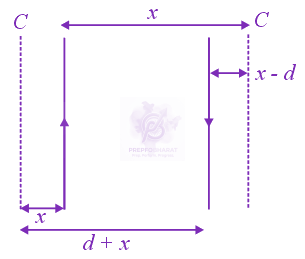
∴2πxμ0I1I=2π(x±d)μ0II2
I1(x±d)=I2x
(I2−I1)x=±I1d
x=±I2−I1I1d
JEE Main 2019 — Physics Electromagnetism
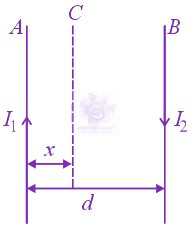
Two wires A & B are carrying currents I1 and I2 as shown in the figure. The separation between them is d . A third wire C carrying a current I is to be kept parallel to them at a distance x from A such that the net force acting on it is zero. The possible values of x are:
Held on 10 Apr 2019 · Verified 6 Jul 2026.
x=±(I1−I2)I1d
x=(I1+I2I1)d and x=(I1−I2)I2d
x=(I1+I2I2)d and x=(I1−I2I2)d
x=(I1−I2I1)d and x=(I1+I2)I2d
Sign in to track your attempts and accuracy.
Sign in to keep a private note on this question. Nothing you write is ever public.
A magnetic field vector in an electromagnetic wave is represented by $\vec{B}=B_0\sin\left(2\pi vt-\dfrac{2\pi x}{\lambda}\right)\hat{j}$. Its associated electric field vector is ______.
A plane electromagnetic wave is moving in free space with velocity $c=3 \times 10^{8} \mathrm{~m} / \mathrm{s}$ and its electric field is given as $\vec{E}=54 \sin (k z-\omega t) \hat{j} \mathrm{~V} / \mathrm{m}$, where $\hat{j}$ is the unit vector along $y$-axis. The magnetic field vector $\vec{B}$ of the wave is:
A charged particle moves in a uniform magnetic field. If the velocity is perpendicular to the field, the path of the particle is:
A monochromatic source of light operating at $15$ kW emits $2.5\times 10^{22}$ photons/s. The region of an electromagnetic spectrum to which the emitted electromagnetic radiation belongs to ________. (Take $h=6.6\times 10^{-34}$ J·s and $c=3\times 10^8$ m/s).
An electromagnetic wave of frequency 100 MHz propagates through a medium of conductivity, $\sigma=10 \mathrm{mho} / \mathrm{m}$. The ratio of maximum conduction current density to maximum displacement current density is $\_\_\_\_$. $\left[\text{Take }\frac{1}{4 \pi \epsilon_{\mathrm{o}}}=9 \times 10^{9} \mathrm{Nm}^{2} / \mathrm{C}^{2}\right]$
Work through every JEE Main Electromagnetism PYQ, year by year.