ϕouter=(μ0nKte−αt)4πR2
ϵ=dt−dϕ=−μ0nK4πR2(e−αt[1−αt])
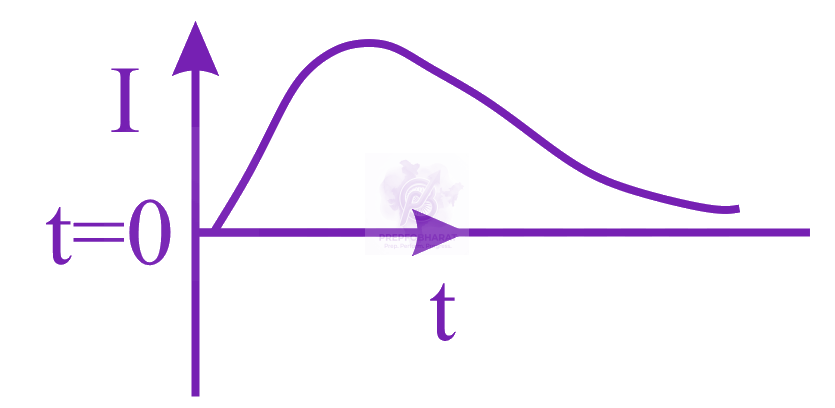
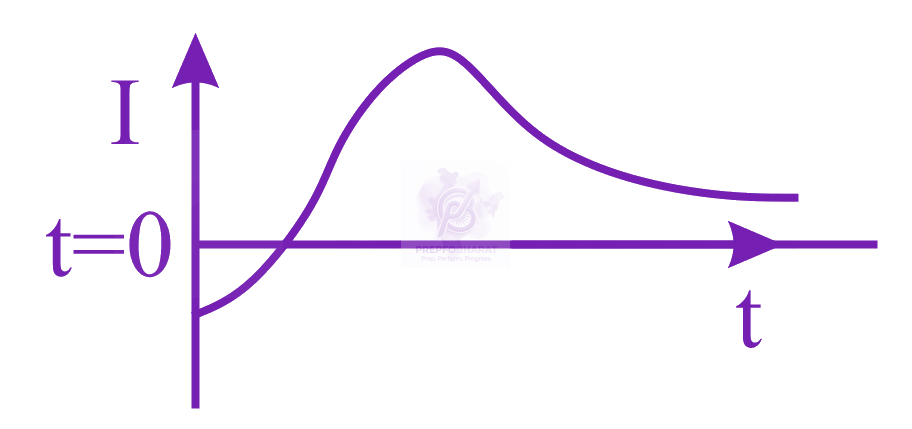
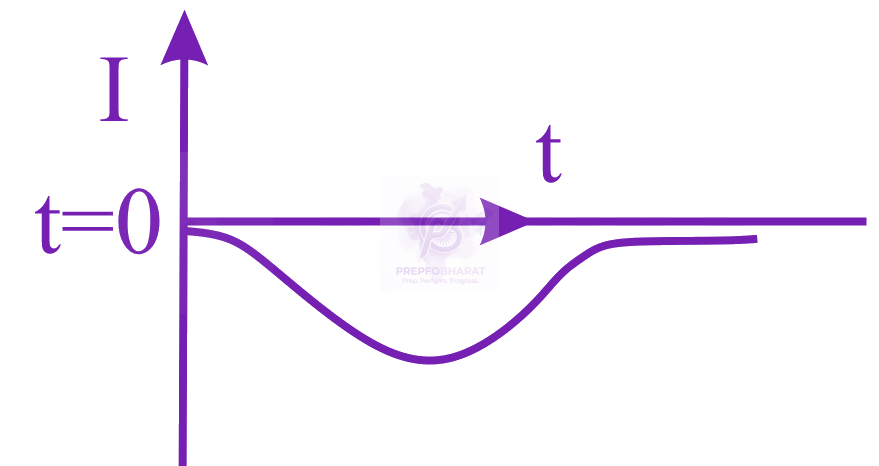
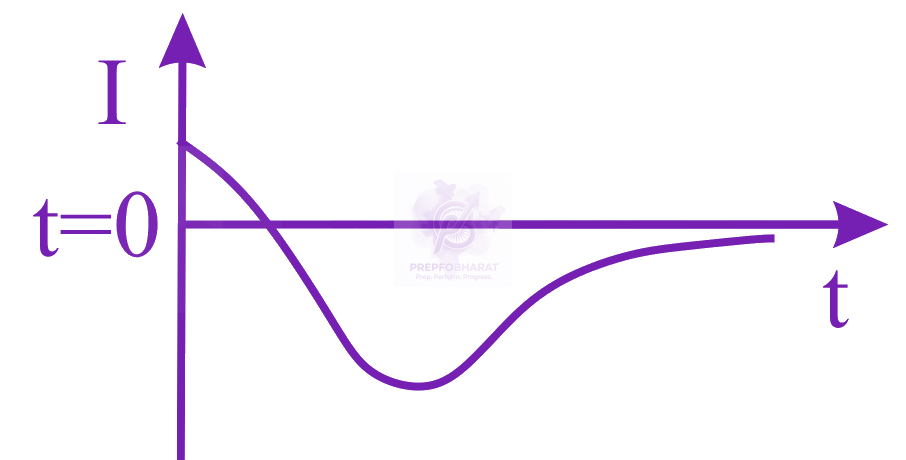
iinduced=Resistance−ce−αt[1−αt]
At t=0, Iinduced=−ve
From the above equation and initial value of current we can say the correct graph is B.
JEE Main 2019 — Physics Electromagnetism
A very long solenoid of radius R is carrying current I(t)=kte−αt(k>0), as a function of time (t≥0). Counterclockwise current is taken to be positive. A circular conducting coil of radius 2R is placed in the equitorial plane of the solenoid and concentric with the solenoid. The current induced in the outer coil is correctly depicted, as a function of time, by:
Held on 9 Apr 2019 · Verified 6 Jul 2026.
Sign in to track your attempts and accuracy.
Sign in to keep a private note on this question. Nothing you write is ever public.
$X P Q Y$ is a vertical smooth long loop having a total resistance $R$ where $P X$ is parallel to $Q Y$ and separation between them is $l$. A constant magnetic field $B$ perpendicular to the plane of the loop exists in the entire space. A rod $C D$ of length $L(L>l)$ and mass $m$ is made to slide down from rest under the gravity as shown in figure. The terminal speed acquired by the rod is $\_\_\_\_$ $\mathrm{m} / \mathrm{s}.(\mathrm{g}=$ acceleration due to gravity) 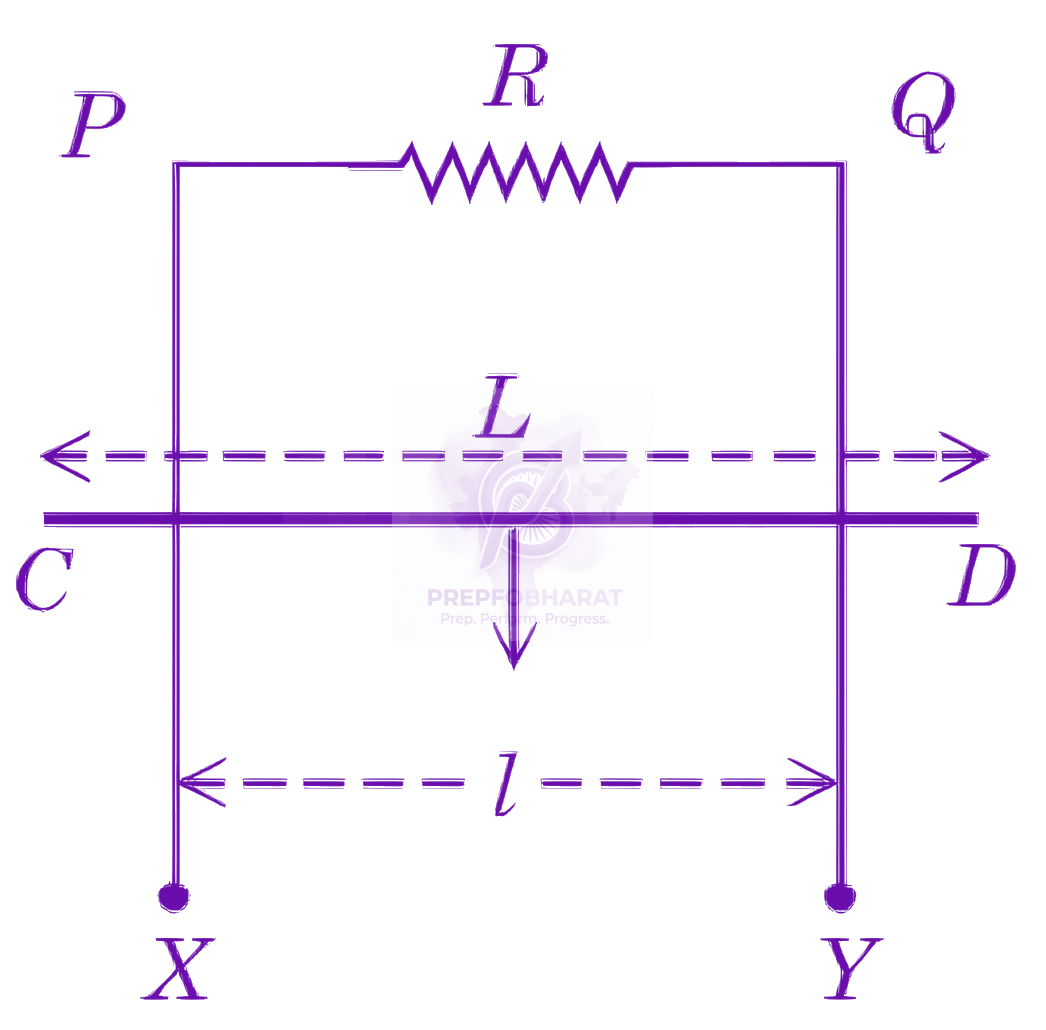
A thin half ring of radius $35$ cm is uniformly charged with a total charge of $Q$ coulomb. If the magnitude of the electric field at centre of the half ring is $100$ V/m, then the value of $Q$ is _______ nC. ($\epsilon_o = 8.85 \times 10^{-12}$ C$^2$/Nm$^2$ and $\pi = 3.14$)
A Wheatstone bridge is initially at room temperature and all arms of the bridge have same value of resistances $\left(R_{1}=R_{2}=R_{3}=R_{4}\right)$. When $R_{3}$ resistance is heated to some temperature, its resistance value has gone up by $10 \%$. The potential difference $\left(V_{a}-V_{b}\right)$ (after $R_{3}$ is heated) is $\_\_\_\_$ V. 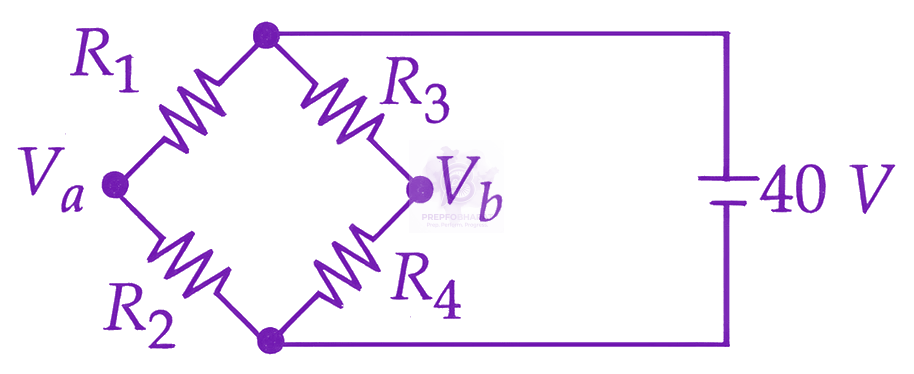
An inductor of inductance $10$ mH having resistance of $100\,\Omega$ is connected to battery of E.M.F. $1.0$ V through a switch as shown in the figure below. After switch is closed, the ratio of instantaneous voltages across the inductor when the current passing through it is $2$ mA and $4$ mA is _______. 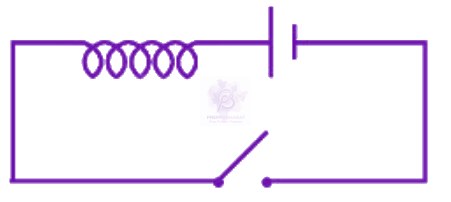
A moving coil of galvanometer when shunted with $2\,\Omega$ resistance gives a full scale deflection for a current of $500$ mA. When a resistance of $470\,\Omega$ is connected in series it gives a full scale deflection for $10$ V potential applied on it. The value of resistance of galvanometer coil is __________ $\Omega$.
Work through every JEE Main Electromagnetism PYQ, year by year.